ToolMage
Sign in

Best 2 Gpu Infrastructure AI tools for Cloud Computing

Popular Gpu Infrastructure AI tools in Cloud Computing include Together AI and NeocloudX, helping you work more efficiently.

NeocloudX
Paid

NeocloudX

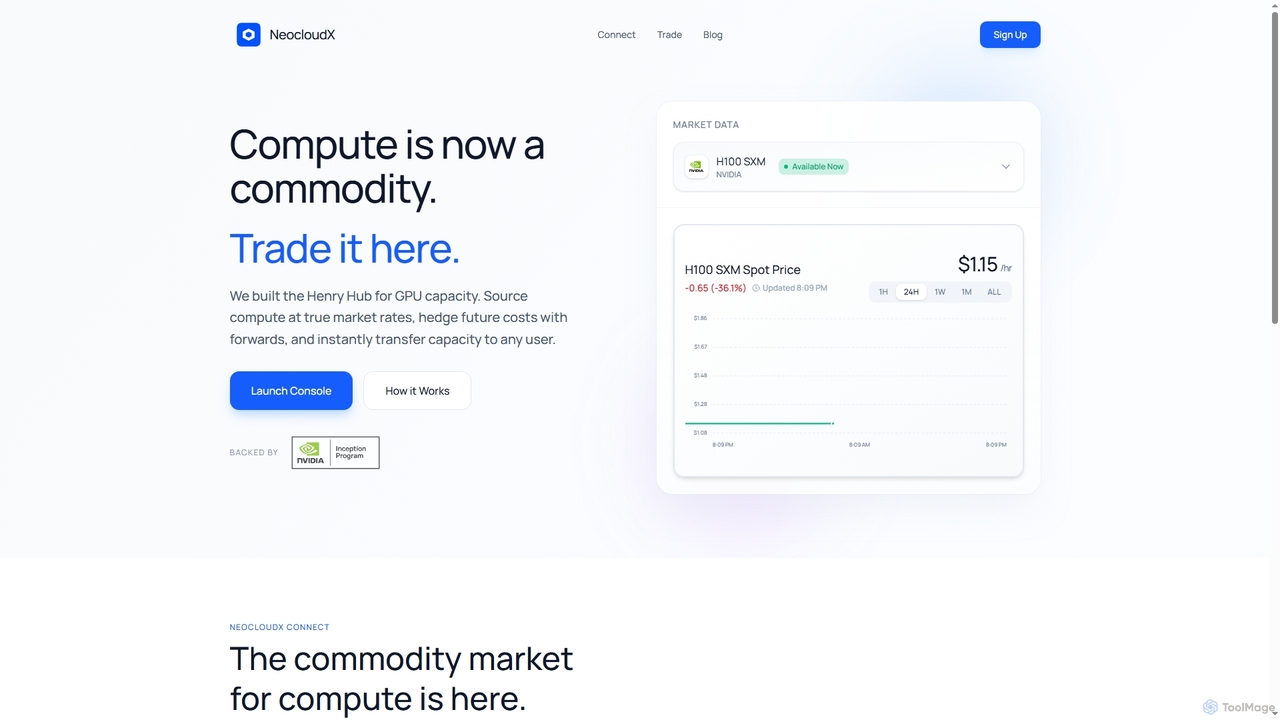
NeocloudX is an innovative marketplace that commoditizes GPU compute capacity, allowing users to buy, sell, and trade high-performance computing resources like NVIDIA H100 SXM GPUs at true market rates. It offers instant access to bare metal performance via a browser-based console, enabling significant cost savings compared to traditional cloud providers.

Machine Learning Infrastructure
Visits 3.4KFavorites 99Likes 89
Together AI
Freemium

Together AI

Together AI is a leading cloud platform for developers, providing fast, cost-effective infrastructure to run, fine-tune, and train open-source generative AI models. It offers an extensive library of over 200 models, serverless inference APIs, customizable fine-tuning, and dedicated GPU clusters, creating an end-to-end solution for building and scaling AI applications.

Gpu Infrastructure
Visits 759.6KFavorites 101Likes 90

About Gpu Infrastructure

GPU Infrastructure provides on-demand access to powerful Graphics Processing Units (GPUs) via the cloud, forming a specialized segment of cloud computing. These platforms are engineered for massively parallel processing, leveraging thousands of cores within each GPU to accelerate computationally intensive tasks. This infrastructure is crucial for training complex AI models, running large-scale scientific simulations, and rendering high-fidelity graphics, offering scalable power that traditional CPU-based servers cannot match. It enables developers and researchers to tackle complex problems without the high cost and maintenance of on-premise hardware.

Core Features

  • High-Performance GPUs: Access to enterprise-grade GPUs (e.g., NVIDIA A100, H100) optimized for AI and high-performance computing (HPC) workloads.
  • Scalable Clusters: Ability to provision and connect multiple GPUs, both within a single server and across a network, for distributed computing tasks.
  • Pre-configured Environments: Ready-to-use software stacks with necessary drivers, CUDA libraries, and popular machine learning frameworks like TensorFlow and PyTorch.
  • High-Speed Networking: Low-latency, high-bandwidth interconnects essential for efficient data transfer in multi-node training and simulation.
  • Flexible Pricing Models: Options such as pay-as-you-go, reserved instances, and spot instances to optimize costs based on workload patterns.

Applicable Scenarios

GPU Infrastructure is essential for industries like technology, scientific research, entertainment, and finance. AI researchers use it to train large language models (LLMs) and computer vision systems. Engineers and scientists run complex simulations for drug discovery, climate modeling, and material science. VFX studios and game developers leverage it for photorealistic rendering and real-time graphics processing.

Selection Criteria

When choosing a provider, evaluate the specific GPU models offered and their performance metrics (VRAM, core count). Assess the platform's scalability and the quality of its network interconnects for multi-GPU setups. Consider the available software ecosystem and management tools to ensure compatibility and ease of use. Finally, compare pricing models to find the most cost-effective solution for your specific compute requirements.

Featured tool rankings

Gpu Infrastructure use cases

1

Training Large-Scale AI Models

An AI research team working on a new large language model (LLM) requires immense computational power. Instead of purchasing and maintaining a multi-million dollar server farm, they utilize a cloud GPU infrastructure provider. They provision a cluster of hundreds of interconnected NVIDIA H100 GPUs. Using a pre-configured environment with PyTorch and distributed training libraries, they can train their model in weeks instead of months. The pay-as-you-go model allows them to scale resources up during intensive training phases and scale down afterward, optimizing their research budget.

2

High-Performance Scientific Computing

A university research lab is running complex fluid dynamics simulations to model climate change. These simulations require solving partial differential equations across vast datasets. By using a GPU infrastructure platform, researchers can access instances with multiple high-VRAM GPUs. This parallel processing capability reduces simulation times from months on a traditional CPU cluster to just a few days. They can run more iterations, test different hypotheses, and publish their findings faster, accelerating scientific discovery without needing a dedicated supercomputer.

3

Photorealistic 3D Rendering for VFX and Animation

A visual effects (VFX) studio is working on a feature film with heavy CGI requirements. Rendering a single frame can take hours on a local workstation. By using a cloud GPU infrastructure, the studio can spin up a render farm of hundreds of GPU instances on demand. They submit render jobs to this farm, which processes frames in parallel. This drastically cuts down rendering time for entire sequences from weeks to a single day. This allows artists to iterate on shots faster and meet tight production deadlines, all while paying only for the compute time they actually use.

4

Accelerating Big Data Analytics and Processing

A financial services company needs to analyze terabytes of market data daily to identify trading patterns. Traditional CPU-based processing is too slow to provide timely insights. They adopt a GPU-accelerated analytics platform running on cloud infrastructure. Using libraries like RAPIDS, which mirror popular data science APIs but run on GPUs, their data scientists can process and visualize massive datasets in minutes instead of hours. This acceleration enables real-time risk assessment and algorithmic trading strategies that were previously impossible.

5

Developing and Hosting Cloud Gaming Services

A startup aims to launch a cloud gaming service, allowing users to stream high-end games to any device. This requires powerful servers that can render game graphics in real-time and stream the video output with low latency. They build their service on a GPU infrastructure platform, using instances equipped with gaming-grade GPUs. This allows them to provide a smooth, high-fidelity gaming experience to thousands of concurrent users without requiring the players to own expensive hardware. The global availability of cloud regions also helps them minimize latency for players worldwide.

6

Computational Drug Discovery and Genomics Research

A biotechnology firm is searching for new drug candidates by simulating protein folding and molecular docking. These tasks are computationally prohibitive on standard computers. By leveraging GPU infrastructure, their computational chemists can run massive parallel simulations on thousands of potential compounds simultaneously. This accelerates the identification of promising candidates for further lab testing from years to a matter of weeks. The secure and scalable nature of the cloud platform also ensures their sensitive research data is protected while providing the necessary computational power.

Gpu Infrastructure FAQ

What is GPU Infrastructure?

GPU Infrastructure refers to cloud computing services that provide on-demand access to servers equipped with powerful Graphics Processing Units (GPUs). Unlike traditional CPU-based servers, this infrastructure is specifically designed to handle parallel processing tasks at a massive scale. It is the foundational technology for demanding workloads such as training artificial intelligence models, running complex scientific simulations, and high-fidelity graphics rendering. By using this service, users can rent computational power without investing in and maintaining expensive physical hardware.

What is the difference between GPU Infrastructure and standard CPU-based cloud servers?

The primary difference lies in their architecture and intended use. Standard cloud servers use CPUs (Central Processing Units), which are excellent for sequential, general-purpose tasks like running web servers or databases. GPU Infrastructure uses GPUs, which contain thousands of smaller cores designed to perform many calculations simultaneously (parallel processing). This makes GPUs exceptionally faster for specific workloads like AI model training, scientific computing, and graphics rendering. In essence, you choose CPU servers for broad, varied tasks and GPU infrastructure for specialized, computationally intensive, parallelizable tasks.

How do I choose the right GPU Infrastructure for my project?

Choosing the right GPU infrastructure involves several key considerations. First, identify your workload's specific needs: are you training AI models, rendering, or running simulations? This determines the required GPU model (e.g., NVIDIA A100 for training, RTX series for rendering). Next, assess your scalability needs; will you need a single GPU or a multi-GPU cluster? Also, consider the software ecosystem, ensuring the provider offers pre-configured environments with the drivers and frameworks you need. Finally, compare pricing models (on-demand, reserved, spot) to align with your budget and usage patterns. It's often useful to start with a smaller instance to benchmark performance before committing to a larger setup.

Who are the primary users of GPU Infrastructure?

The primary users of GPU Infrastructure are professionals and organizations with high-demand computational needs. This includes:

  • AI/ML Engineers and Data Scientists: For training and deploying deep learning models.
  • Researchers and Academics: For scientific simulations in fields like physics, biology, and climate science.
  • VFX Artists and Animators: For rendering complex 3D scenes and animations.
  • Game Developers: For developing and hosting cloud gaming services.
  • Financial Analysts (Quants): For running complex risk models and algorithmic trading simulations.
In general, anyone whose work is bottlenecked by the parallel processing capabilities of traditional CPUs can benefit significantly from GPU infrastructure.

What are the main advantages of using cloud GPU Infrastructure over buying physical hardware?

Using cloud GPU infrastructure offers several key advantages over purchasing physical hardware. The most significant are:

  • Cost-Effectiveness: It eliminates the large upfront capital expenditure for expensive GPUs and server hardware, replacing it with a predictable operational expense (pay-as-you-go).
  • Scalability: You can instantly scale your computational resources up or down based on demand, which is impossible with physical hardware.
  • Access to Latest Technology: Cloud providers constantly update their hardware, giving you access to the latest and most powerful GPUs without needing to purchase new equipment.
  • Reduced Maintenance: The provider handles all hardware maintenance, power, cooling, and security, freeing up your team to focus on their core work.
These factors make cloud GPU infrastructure a more flexible, scalable, and often more economical choice for most use cases.