ToolMage
Sign in

Best 1 Review Automation AI tools for Customer Feedback

Popular Review Automation AI tools in Customer Feedback include Seranova, helping you work more efficiently.

Seranova
Paid

Seranova

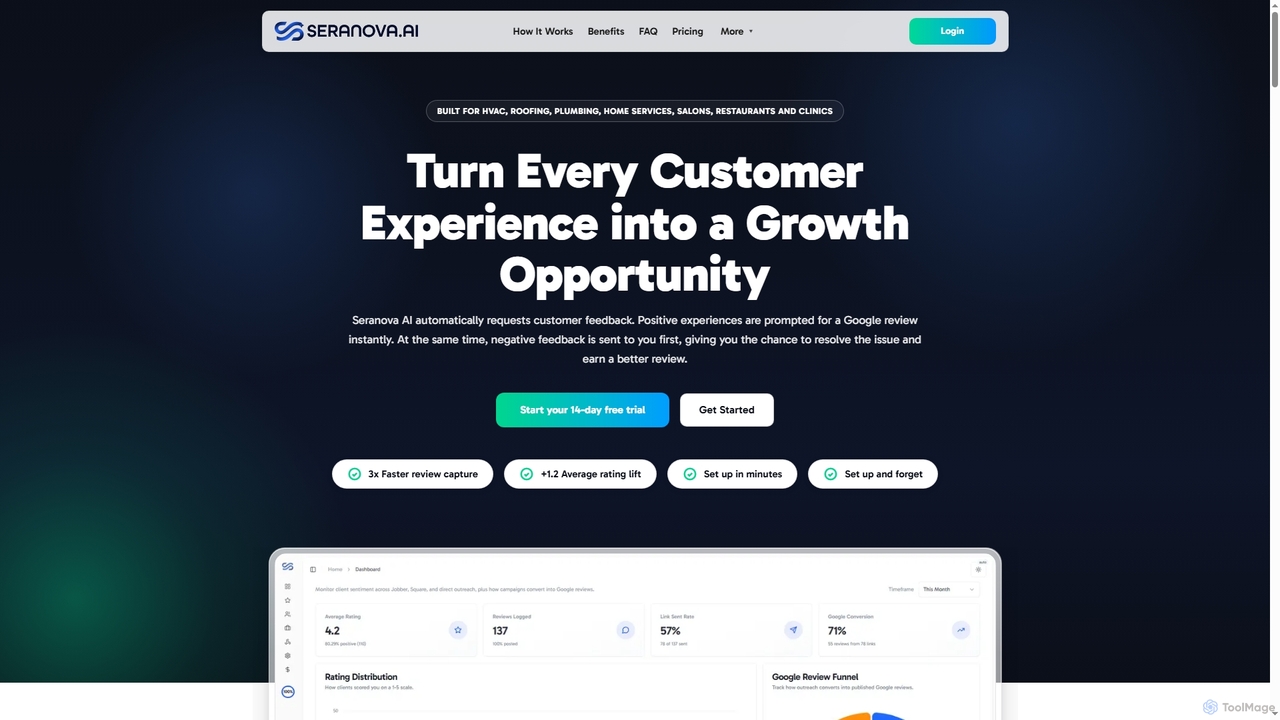
Seranova is an AI-powered reputation management platform designed for local service businesses to automate Google review collection and management. It captures customer feedback, routes positive experiences for public reviews, and handles negative feedback privately, significantly boosting online visibility and trust.

Review Automation
Visits 5.7KFavorites 132Likes 128

About Review Automation

Review Automation tools are AI-powered solutions designed to streamline and enhance the process of collecting, analyzing, and responding to customer reviews and feedback across various digital platforms. These tools leverage natural language processing (NLP) and machine learning to automatically extract sentiment, identify key topics, and even generate contextually relevant responses. By automating these often time-consuming tasks, businesses can gain deeper insights into customer satisfaction, improve their online reputation, and free up valuable human resources, making it a crucial component within the broader Customer Feedback management ecosystem.

Core Features

  • Sentiment Analysis: Automatically detects the emotional tone (positive, negative, neutral) of customer reviews.
  • Topic Extraction: Identifies recurring themes, keywords, and specific product/service aspects mentioned in feedback.
  • Automated Response Generation: Crafts personalized and context-aware replies to reviews, often with human oversight.
  • Review Solicitation: Automates the process of requesting reviews from satisfied customers at opportune moments.
  • Cross-Platform Monitoring: Aggregates and analyzes reviews from multiple sources like Google, Yelp, Amazon, and social media.

Use Cases

Businesses across various sectors utilize Review Automation to manage their online presence and customer perception. E-commerce brands employ these tools to quickly process thousands of product reviews, identifying common issues or popular features. Hospitality providers use them to respond promptly to guest feedback on booking sites, enhancing guest satisfaction and loyalty. SaaS companies leverage review automation to extract feature requests and bug reports from user reviews, directly informing product development cycles.

How to Choose

When selecting a Review Automation tool, consider its integration capabilities with your existing review platforms and CRM systems. Evaluate the accuracy and sophistication of its AI for sentiment analysis and topic extraction, as this directly impacts insight quality. Look for customizable response templates and the level of human intervention required. Scalability, reporting features, and pricing models are also crucial factors to ensure the tool meets your business's evolving needs and budget.

Review Automation use cases

1

Automated Sentiment Analysis of Product Reviews

An e-commerce manager needs to understand customer sentiment across thousands of product reviews daily. Review Automation tools automatically process these reviews, categorizing them by sentiment (positive, negative, neutral) and highlighting key topics. This allows the manager to quickly identify popular features, common complaints, and emerging product issues, saving countless hours of manual review reading and enabling data-driven product improvements.

2

Automating E-commerce Product Review Responses

An e-commerce manager, overwhelmed by hundreds of daily product reviews, uses review automation to draft personalized, on-brand responses. The AI analyzes each review's sentiment and content, generating suitable replies that maintain a consistent brand voice. This saves hours of manual work, ensures timely customer engagement, and significantly boosts customer satisfaction and loyalty.

3

Generating Personalized Responses to Customer Feedback

A hotel chain's customer service team struggles to respond to the high volume of guest reviews on various booking and social media platforms. Review Automation tools generate contextually appropriate and personalized draft responses based on the review's content and sentiment. This significantly reduces response times, ensures consistent brand messaging, and allows human agents to focus on more complex customer interactions, improving overall guest satisfaction and online reputation.

4

Summarizing Hotel Guest Feedback for Operational Insights

A hotel operations manager needs to quickly understand common themes from thousands of guest reviews across various booking platforms. Review automation aggregates and summarizes this feedback, highlighting recurring issues like "slow check-in" or "comfortable beds." This enables the manager to identify key areas for operational improvements and enhance the overall guest experience efficiently.

5

Proactive Review Solicitation for New Product Launches

A marketing team launching a new software feature wants to quickly gather initial user feedback and reviews. Review Automation platforms integrate with user activity data to automatically send personalized review requests to users who have recently engaged positively with the new feature. This systematic approach boosts the volume and quality of early reviews, providing valuable social proof and accelerating market adoption.

6

Identifying App Improvement Areas from User Reviews

A mobile app product manager analyzes user feedback from app store reviews to prioritize feature development and bug fixes. Review automation categorizes reviews by topic (e.g., UI, performance, new features) and sentiment, automatically flagging critical issues or popular requests. This provides data-driven insights, allowing for a more responsive and user-centric product roadmap.

7

Proactive Brand Reputation Monitoring Across Platforms

A marketing specialist is tasked with monitoring brand mentions and reviews across social media, review sites, and forums. Review automation continuously scans these diverse sources, alerting the specialist to sudden spikes in negative sentiment or emerging trends. This proactive approach enables swift responses to potential crises and helps maintain a positive brand image.

8

Identifying Emerging Product Issues from Negative Reviews

A SaaS product team monitors user reviews for insights into software performance and user experience. Review Automation tools analyze negative feedback, automatically identifying recurring technical bugs, usability challenges, or missing features across hundreds of reviews. This enables the product team to prioritize critical fixes and enhancements based on real-world user data, leading to a more stable and user-friendly product.

9

Personalizing Customer Service with Past Feedback Summaries

A customer support lead aims to provide more tailored support by understanding a customer's history of feedback. Integrated review automation tools summarize past reviews and interactions within the CRM for support agents. This allows agents to quickly grasp customer sentiment and issues, leading to more personalized and effective problem-solving during interactions.

10

Cross-Platform Review Aggregation and Reporting

A brand manager oversees the online reputation of a multi-location retail business across Google My Business, Yelp, and social media. Review Automation tools centralize all reviews into a single dashboard, providing a unified view of customer feedback. The system generates comprehensive reports on overall sentiment, common themes, and response rates, allowing the manager to track brand health and identify areas for operational improvement efficiently.

11

Benchmarking Competitor Review Performance for Market Strategy

A market analyst needs to compare their company's online review sentiment and volume against key competitors. Review automation tools collect and analyze competitor reviews, generating comparative reports on sentiment trends, common complaints, and unique selling points. These insights inform strategic competitive positioning and help refine marketing campaigns.

12

Benchmarking Competitor Review Performance

A market analyst wants to understand how their company's customer reviews compare to key competitors. Review Automation tools can be configured to monitor and analyze competitor reviews on public platforms. The AI extracts sentiment and common topics from competitor feedback, providing actionable insights into their strengths and weaknesses, and helping the analyst identify market gaps or opportunities for differentiation.

Review Automation FAQ

What is Review Automation?

Review Automation refers to the use of AI and machine learning technologies to automate tasks related to managing customer reviews and feedback. This includes automatically collecting reviews from various platforms, analyzing their sentiment and content, generating draft responses, and even proactively soliciting new reviews. Its primary goal is to streamline the feedback management process, making it more efficient and insightful for businesses.

What is Review Automation?

Review Automation refers to the use of artificial intelligence and machine learning technologies to automatically manage and analyze customer reviews and feedback. These tools streamline tasks such as collecting reviews from multiple platforms, performing sentiment analysis, summarizing key themes, and even drafting personalized responses, significantly enhancing efficiency and insight generation.

How can Review Automation benefit my business?

Review Automation offers several key benefits. It significantly saves time by automating manual tasks like monitoring and responding to reviews, allowing staff to focus on higher-value activities. It improves customer satisfaction through faster, more consistent, and personalized responses. Furthermore, by providing deep insights into customer sentiment and recurring themes, it helps businesses make data-driven decisions for product development, service improvements, and marketing strategies, ultimately enhancing online reputation and brand loyalty.

How to choose the right Review Automation tool?

When selecting a Review Automation tool, prioritize its integration capabilities with your existing systems (e.g., CRM, e-commerce platforms). Evaluate the accuracy and sophistication of its AI for sentiment analysis and response generation, along with the level of customization it offers. Consider its scalability, pricing model, and the breadth of review platforms it supports to ensure it meets your specific business needs.

What are the key features of Review Automation tools?

Key features typically include AI-powered sentiment analysis to gauge emotional tone, topic extraction to identify recurring themes, and automated response generation for efficient replies. Many tools also offer cross-platform monitoring to aggregate reviews from various sources, review solicitation capabilities to encourage new feedback, and detailed analytics dashboards for performance tracking. Integration with CRM and other business tools is also a common and valuable feature.

What are the main benefits of using Review Automation?

The primary benefits of Review Automation include significant time savings in managing customer feedback, improved customer satisfaction through timely and consistent responses, and the ability to derive actionable insights from large volumes of data. It also helps maintain a consistent brand voice, proactively manage online reputation, and identify product or service improvement areas more efficiently.

How does Review Automation differ from general Customer Feedback management?

While Review Automation is a specialized subset of general Customer Feedback management, it focuses specifically on the *automation* of review-related tasks. General Customer Feedback management encompasses a broader range of activities, including surveys, direct feedback channels, and manual analysis. Review Automation leverages AI to handle the high volume and structured nature of public reviews, providing efficiency and scale that traditional, more manual feedback management methods often lack, especially for public-facing platforms.

How does Review Automation differ from general Customer Feedback tools?

While both fall under the umbrella of customer feedback, Review Automation specifically focuses on *automating* the lifecycle of *public reviews* (e.g., Google, Yelp, app stores). General Customer Feedback tools often encompass broader methods like surveys, feedback forms, and manual analysis. Review Automation is a specialized subset designed for high-volume, public feedback management, emphasizing AI-driven analysis and response generation.

What should I consider when choosing a Review Automation tool?

When selecting a tool, evaluate its compatibility with the review platforms you use most (e.g., Google, Amazon, Yelp). Assess the accuracy and customizability of its AI for sentiment analysis and automated responses. Consider the level of reporting and analytics it provides, as well as its scalability to handle your current and future review volume. Finally, look at its integration capabilities with your existing CRM or customer service software, and compare pricing models to find a solution that fits your budget and specific needs.

What are the key steps to implement Review Automation?

Implementing Review Automation typically involves several steps: first, identify all relevant review platforms your business uses. Next, integrate the chosen automation tool with these platforms and your internal systems. Then, define clear guidelines and templates for automated responses to ensure brand consistency. Finally, continuously monitor the AI's performance, refine its parameters, and regularly review the generated insights to optimize its effectiveness.