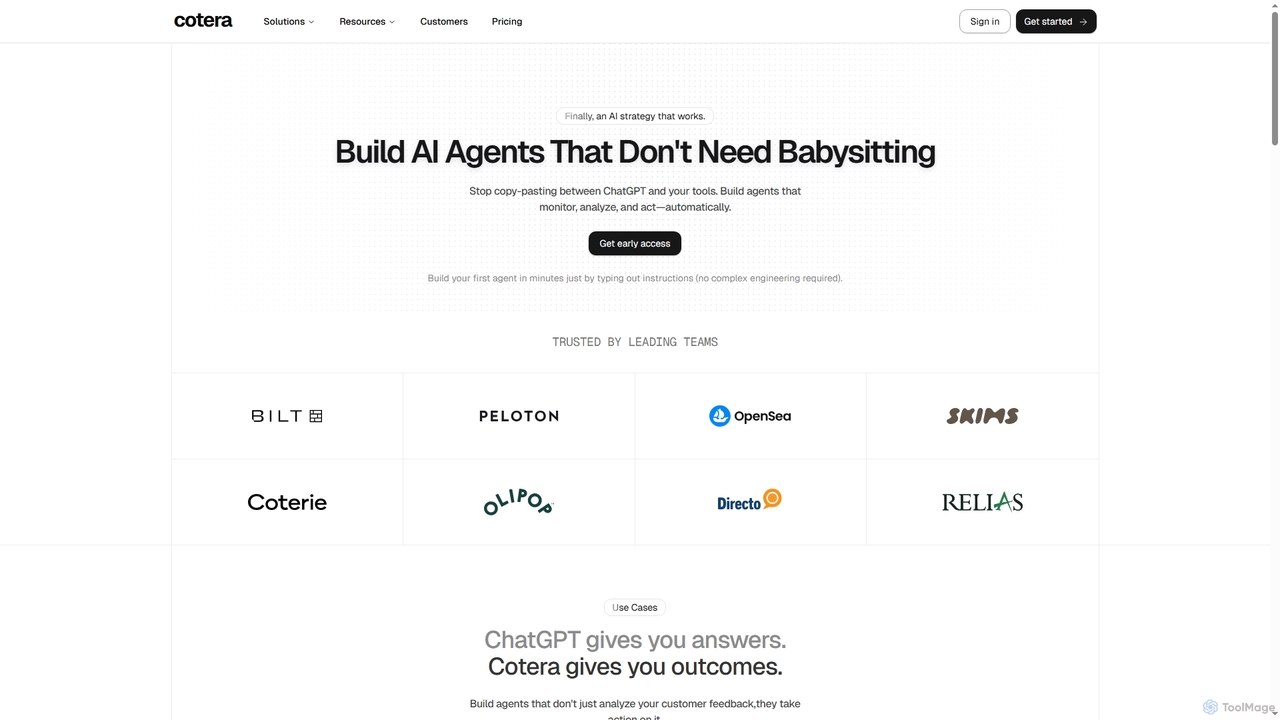
Cotera
Cotera is an AI platform that empowers businesses to build autonomous AI agents capable of monitoring, analyzing, and …
Cotera is an AI platform that empowers businesses to build autonomous AI agents capable of monitoring, analyzing, and acting automatically across various operations. It eliminates manual busywork by enabling users to create sophisticated agents with plain English instructions, integrating seamlessly with existing tools and data warehouses.
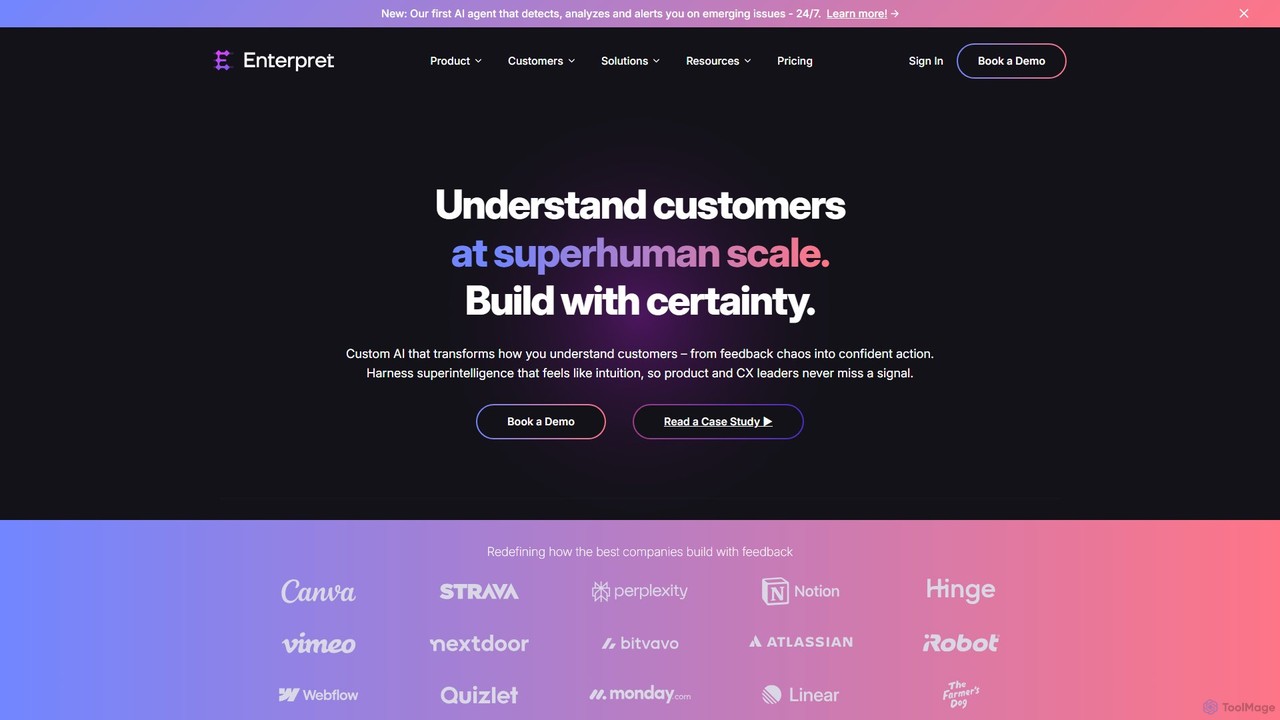
Enterpret
Enterpret is an AI-powered customer feedback intelligence platform that unifies feedback from all channels. It helps product and …
Enterpret is an AI-powered customer feedback intelligence platform that unifies feedback from all channels. It helps product and CX teams analyze qualitative data at scale, uncover actionable insights, and build products with certainty by understanding the true voice of the customer.
About Customer Feedback Analysis
Customer Feedback Analysis tools are AI-powered platforms designed to automatically process and extract actionable insights from large volumes of customer opinions. They utilize Natural Language Processing (NLP) to interpret text and audio data, identifying sentiment, key topics, and user intent. This enables businesses to quickly understand customer satisfaction, pinpoint product issues, and track brand perception across various channels like reviews, surveys, and social media. Unlike general data analysis tools, they are specifically optimized for understanding the nuances of human language in feedback contexts.
Core Features
- Sentiment Analysis: Automatically determines the emotional tone (positive, negative, neutral) behind customer comments.
- Topic & Keyword Extraction: Identifies and categorizes the main subjects and frequently mentioned terms in feedback.
- Intent Recognition: Discerns the underlying purpose of a customer's message, such as a complaint, question, or suggestion.
- Trend Detection: Monitors feedback data over time to spot emerging issues or shifts in customer opinion.
- Root Cause Analysis: Drills down into feedback to uncover the fundamental reasons behind customer satisfaction or dissatisfaction.
Use Cases
These tools are invaluable for product managers, customer experience (CX) teams, marketing departments, and support managers. Industries like SaaS, e-commerce, hospitality, and finance use them to analyze app store reviews, support tickets, NPS surveys, and social media mentions to prioritize feature development, reduce customer churn, and improve service quality.
How to Choose
When selecting a tool, consider its integration capabilities with your existing data sources (e.g., Zendesk, App Store, Twitter). Evaluate the depth of its analytical features, such as multi-language support and industry-specific models. Also, assess the quality of its data visualization and reporting dashboards, and ensure the pricing model aligns with your feedback volume and team size.
Customer Feedback AnalysisUse Cases
Prioritize Product Feature Development
A SaaS product manager needs to decide which features to build for the next quarter. Instead of manually sifting through thousands of support tickets, survey responses, and app store reviews, they use a customer feedback analysis tool. The tool automatically aggregates all data, identifies 'feature request' as a key topic, and highlights that 'dark mode' and 'third-party calendar integration' are the most frequently requested items. This data-driven approach allows the manager to confidently prioritize features that will have the highest impact on user satisfaction and retention.
Detect and Reduce Customer Churn Risk
A customer success team at an e-commerce company wants to proactively identify at-risk customers. They connect their feedback analysis tool to their helpdesk and NPS survey platform. The AI flags comments containing keywords like 'disappointed', 'cancel subscription', and 'poor quality', combined with a strong negative sentiment score. The team creates an automated workflow to alert account managers whenever a high-value customer's feedback is flagged. This allows them to intervene personally, resolve the issue, and potentially prevent churn before it happens.
Monitor Brand Perception on Social Media
After launching a major marketing campaign, a brand manager wants to gauge public reaction in real-time. They set up their feedback analysis tool to monitor mentions of their brand and campaign hashtags on Twitter and public forums. The dashboard shows a live feed of sentiment, with an initial spike in positive mentions. However, the tool also identifies a growing cluster of negative comments related to a misleading claim in one of the ads. This early warning allows the marketing team to quickly issue a clarification and adjust the ad copy, mitigating potential damage to the brand's reputation.
Automate Voice of the Customer (VoC) Reporting
A market research team is responsible for a company-wide Voice of the Customer (VoC) program. Previously, they spent weeks manually collecting, coding, and summarizing feedback from NPS surveys, online reviews, and focus group transcripts. By implementing a feedback analysis tool, they create a unified VoC dashboard. The tool automatically imports data from all sources, categorizes feedback by product area and customer segment, and tracks key metrics like overall sentiment and top complaint drivers. Now, the team can generate comprehensive quarterly reports in hours instead of weeks, freeing up their time for deeper strategic analysis.
Improve Contact Center Agent Performance
A support manager for a large call center wants to improve agent training and first-contact resolution rates. They use a feedback analysis tool that can process call transcripts and post-interaction surveys. The AI identifies recurring issues that customers frequently call about, such as 'billing confusion' and 'password reset problems'. It also flags calls where agents struggled to provide a clear answer. Using these insights, the manager develops targeted training modules for agents and updates the internal knowledge base with clearer instructions, leading to more efficient support and higher customer satisfaction.
Analyze Competitor Strengths and Weaknesses
A business strategist wants to understand why customers choose a competitor's product. They use a feedback analysis tool to scrape and analyze public reviews for their top three competitors from sites like G2 and Capterra. The tool categorizes feedback into themes such as 'Pricing', 'User Interface', and 'Customer Support'. The analysis reveals that while their own product is praised for its features, competitors are consistently rated higher for their intuitive UI and responsive support. This insight directly informs the company's strategic roadmap, highlighting the need to invest in UX/UI improvements to gain a competitive edge.