ga4sql
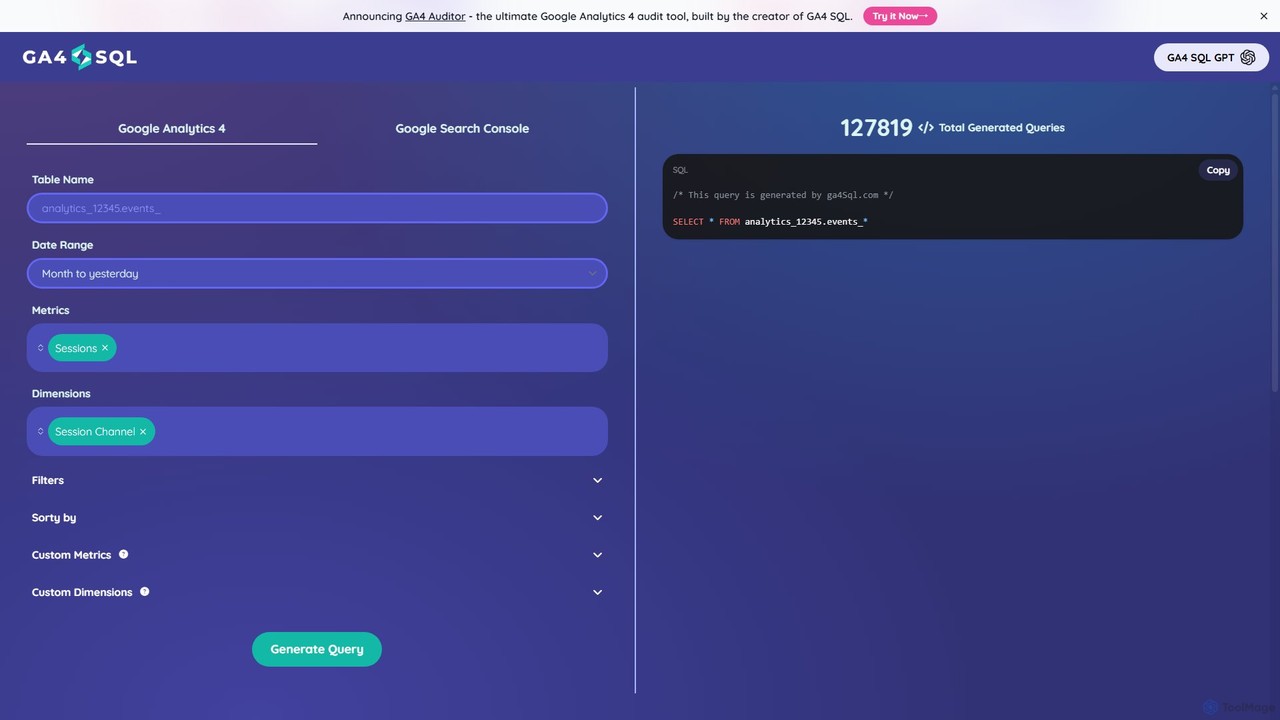
ga4sql is a free, user-friendly tool that empowers marketers and analysts to generate Google Analytics 4 (GA4) BigQuery …
ga4sql is a free, user-friendly tool that empowers marketers and analysts to generate Google Analytics 4 (GA4) BigQuery queries without any SQL knowledge. Simply select your desired metrics, dimensions, and date range through an intuitive interface, and the tool instantly creates the correct SQL query. It's the fastest way to unlock deep insights from your GA4 data in BigQuery, saving time and eliminating coding errors.
About Data And Analytics
AI Data and Analytics tools are a class of software that leverages machine learning and natural language processing to automate the extraction of insights from complex datasets. These tools go beyond traditional business intelligence by automatically identifying patterns, predicting future outcomes, and generating data-driven narratives. They empower organizations to make faster, more accurate decisions, optimize operations, and understand customer behavior without requiring deep data science expertise. A key advantage is their ability to process unstructured data like text and images, unlocking new sources of valuable information.
Core Features
- Predictive Modeling: Builds and deploys models to forecast future trends, customer behavior, and operational outcomes.
- Automated Data Cleansing: Automatically identifies and corrects errors, duplicates, and inconsistencies within datasets to improve data quality.
- Natural Language Query (NLQ): Allows users to ask questions about their data in plain language and receive answers in the form of charts or reports.
- Anomaly Detection: Proactively identifies unusual patterns or outliers in data that may indicate fraud, system failures, or new opportunities.
- Automated Insight Generation: Surfaces key findings, correlations, and trends from data without requiring manual exploration by an analyst.
Use Cases
These tools are widely used across industries like e-commerce, finance, healthcare, and marketing. Business analysts use them to understand market trends, marketing teams to optimize campaign performance, and operations managers to forecast demand and streamline supply chains. For example, a retail company can analyze transaction data to personalize promotions, while a financial institution can detect fraudulent activity in real-time.
How to Choose
When selecting an AI Data and Analytics tool, first consider its data source integration capabilities to ensure it connects with your existing systems. Evaluate the user interface to determine if it suits your team's technical skill level, from no-code platforms for business users to advanced environments for data scientists. Assess its scalability to handle growing data volumes and verify that its core functionalities, such as text analysis or time-series forecasting, align with your primary business objectives.
Data And AnalyticsUse Cases
Automating Sales Forecasting for Retail
A retail operations manager needs to manage inventory for hundreds of products across multiple locations. Using an AI analytics tool, they connect historical sales data, promotional calendars, and external factors like holidays. The tool's predictive models automatically generate weekly and monthly sales forecasts for each product SKU. This process allows for precise inventory planning, reducing stockouts by up to 20% and minimizing overstocking costs, ultimately saving the planning team dozens of hours each month.
Analyzing Customer Feedback from Multiple Channels
A product manager is tasked with understanding sentiment from thousands of weekly customer reviews, support tickets, and social media comments. Manually processing this volume of unstructured text is impractical. By feeding this data into an AI analytics tool with Natural Language Processing (NLP), they can automatically perform sentiment analysis and topic modeling. The tool visualizes key themes and identifies emerging issues, providing data-backed evidence to prioritize the product roadmap and quickly address top customer pain points.
Detecting Fraudulent Financial Transactions
A financial analyst at a fintech company needs to monitor millions of transactions in real-time to identify fraud. Traditional rule-based systems often miss sophisticated patterns. By implementing an AI-powered anomaly detection tool, the system learns normal transaction patterns for each user. It then flags deviations in real-time, such as unusual purchase amounts, locations, or frequencies. This approach significantly increases the accuracy of fraud detection, reduces false positives by over 40%, and protects both the company and its customers from financial loss.
Optimizing Marketing Campaign Performance
A digital marketing manager runs multiple ad campaigns across various platforms but struggles to understand the true ROI. By consolidating all campaign data into an AI analytics platform, the tool performs advanced attribution modeling to identify the most effective customer touchpoints. It also uses clustering algorithms to segment audiences based on behavior. Based on these insights, the manager can reallocate 15% of the ad budget to higher-performing channels, leading to a 25% increase in qualified leads without increasing overall spend.
Enhancing Supply Chain Logistics
A supply chain coordinator manages a complex network of suppliers, warehouses, and shipping routes where delays are costly. By feeding real-time data from GPS, weather forecasts, and inventory systems into an AI analytics tool, the platform can predict potential delays and suggest optimal shipping routes. It also recommends inventory rebalancing across warehouses to meet regional demand fluctuations. This proactive approach reduces shipping delays by 18% and lowers fuel costs, improving on-time delivery rates and overall operational efficiency.
Personalizing E-commerce User Experience
An e-commerce manager wants to increase conversion rates by showing relevant recommendations to each visitor. An AI analytics engine is used to track user browsing behavior, purchase history, and items viewed in real-time. This data powers a recommendation system that displays personalized product suggestions on the homepage, product pages, and in marketing emails. This level of personalization directly leads to a higher engagement rate, increasing the average order value by 12% and boosting the overall site conversion rate.