Quick Data Converter
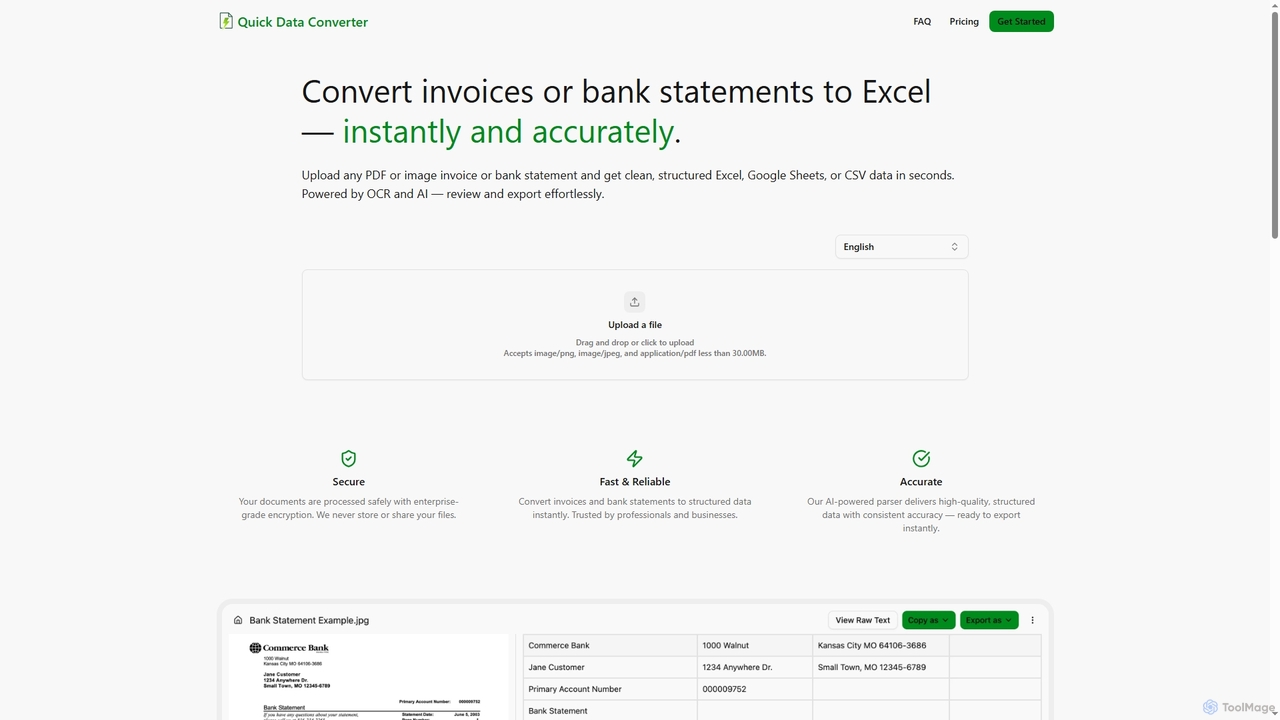
Quick Data Converter is an AI-powered tool that instantly and accurately transforms PDF and image invoices or bank …
Quick Data Converter is an AI-powered tool that instantly and accurately transforms PDF and image invoices or bank statements into clean, structured data formats like Excel, CSV, and Google Sheets. It leverages OCR and AI for efficient data extraction, ensuring high accuracy and security for professionals and businesses.
Kadabra
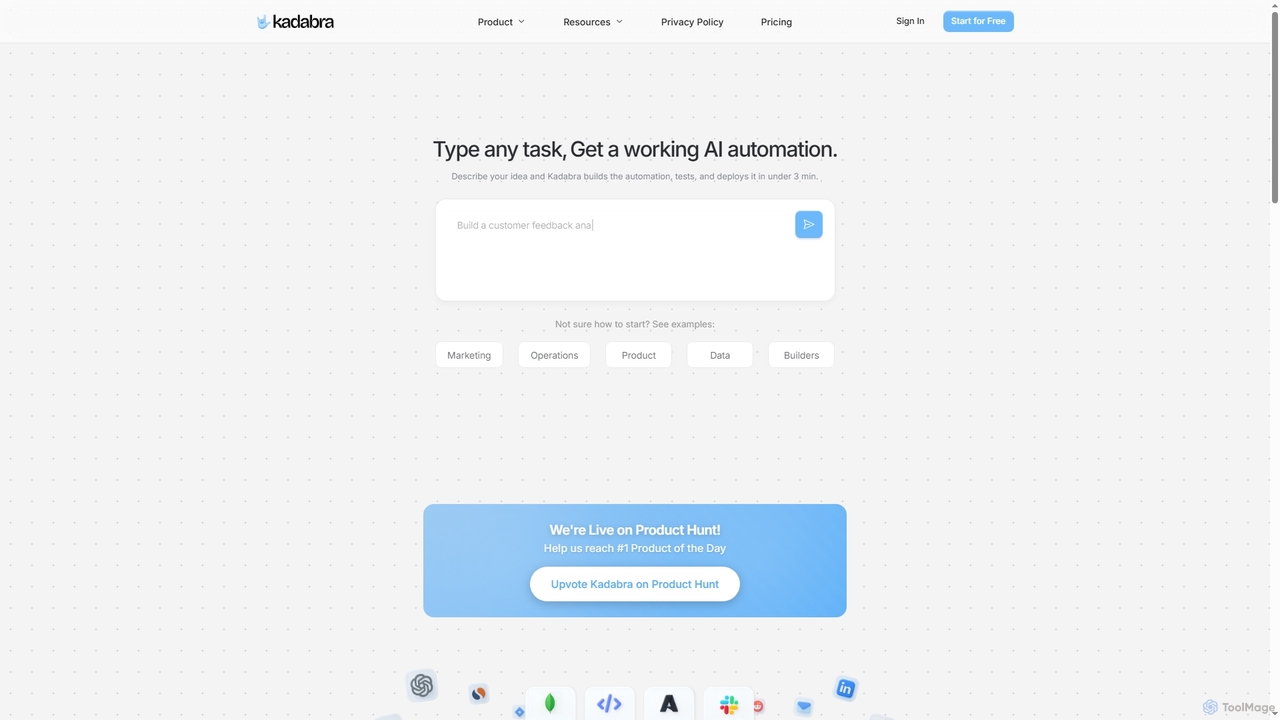
Kadabra is an AI-powered platform that transforms plain English descriptions into functional, deployable business and data automations. It …
Kadabra is an AI-powered platform that transforms plain English descriptions into functional, deployable business and data automations. It allows users to build, test, and deploy complex workflows visually in minutes, integrating with a wide range of popular tools to streamline operations and enhance productivity.
About Data Extraction
Data Extraction tools are AI-powered solutions designed to automatically identify, collect, and structure specific information from various sources, both digital and physical. Leveraging advanced machine learning, natural language processing (NLP), and computer vision, these tools transform unstructured or semi-structured data into usable formats. They significantly streamline data processing workflows, enabling businesses and individuals to efficiently gather insights, populate databases, and automate reporting from vast amounts of text, images, and documents, thereby enhancing data-driven decision-making within the broader field of data management.
Core Features
- Automated Data Identification: Automatically locates and recognizes key data points (e.g., names, dates, amounts, addresses) within documents or web pages.
- Structured & Unstructured Data Handling: Extracts information from diverse formats, including PDFs, images, web pages, emails, and scanned documents.
- OCR (Optical Character Recognition): Converts text from images or scanned documents into machine-readable and editable data.
- Pattern Recognition & NLP: Uses AI to understand context and extract relevant entities, sentiments, or relationships from natural language text.
- Customizable Extraction Rules: Allows users to define specific rules or train models for highly precise and tailored data retrieval.
Applicable Scenarios
Data Extraction tools are indispensable for industries dealing with large volumes of information, such as finance, legal, healthcare, and e-commerce. They are used by data analysts, business intelligence specialists, compliance officers, and researchers to automate the tedious process of manual data entry and information gathering, ensuring accuracy and speed in critical operations.
How to Choose
When selecting a Data Extraction tool, consider its accuracy in handling your specific data types (e.g., invoices, contracts, web pages), its ability to integrate with existing systems (APIs), the level of customization offered for extraction rules, and its scalability to process varying data volumes. Evaluate the user interface for ease of use and the vendor's support for ongoing model training and maintenance.
Data ExtractionUse Cases
Automating Invoice Processing
Finance departments can utilize AI data extraction tools to automatically capture key information such as vendor names, invoice numbers, line items, and total amounts from incoming invoices, regardless of their format. This eliminates manual data entry, reduces processing time, minimizes errors, and accelerates payment cycles, allowing staff to focus on higher-value financial analysis.
Automating Invoice Processing
Finance departments use AI data extraction to automatically pull vendor names, invoice numbers, line items, and total amounts from scanned or digital invoices. This significantly reduces manual data entry, minimizes human errors, and accelerates payment cycles, allowing finance teams to focus on analysis rather than repetitive data input.
Extracting Product Information for E-commerce
An e-commerce manager needs to monitor competitor pricing and product specifications across dozens of online stores daily. Using an AI data extraction tool, they configure automated web scrapers to visit competitor sites, identify product names, prices, descriptions, and images. This allows for real-time competitive analysis, enabling dynamic pricing adjustments and inventory optimization without manual data collection.
Automating Invoice Processing
Finance departments or small business owners can use AI data extraction tools to automatically pull key information like vendor names, invoice numbers, dates, line items, and total amounts from incoming invoices (PDFs, scanned images). This eliminates manual data entry, reduces errors, and accelerates accounts payable workflows, allowing for faster reconciliation and financial reporting.
Competitor Price Monitoring for E-commerce
E-commerce businesses can deploy web scraping tools to regularly extract product prices, availability, and customer reviews from competitor websites. This provides real-time market intelligence, enabling dynamic pricing strategies, identifying market trends, and ensuring competitive positioning without manual data collection efforts.
Extracting Key Information from Legal Contracts
Legal professionals leverage these tools to quickly identify and extract critical clauses, dates, party names, and obligations from vast numbers of legal documents. This aids significantly in due diligence, contract review, and compliance checks, saving countless hours of manual document analysis and ensuring accuracy in legal proceedings.
Automating Invoice and Receipt Processing
A finance department receives hundreds of invoices and receipts in various formats (PDF, scanned images) monthly. An AI data extraction tool with OCR capabilities automatically scans these documents, identifies key fields like vendor name, invoice number, date, line items, and total amount. This data is then structured and exported directly into their accounting system, drastically reducing manual data entry errors and processing time.
Extracting Legal Document Information
Legal professionals, paralegals, and compliance officers utilize data extraction AI to quickly identify and extract critical clauses, dates, party names, and specific terms from contracts, legal briefs, and regulatory documents. This significantly speeds up due diligence, contract review, and compliance audits, reducing the time spent on manual document analysis.
Digitizing Legal Contracts and Documents
Law firms and legal departments use data extraction to parse vast libraries of legal documents, contracts, and case files. The tools identify and extract clauses, dates, parties, and specific terms, making documents searchable, facilitating due diligence, compliance checks, and contract lifecycle management with significantly reduced manual review time.
Real-time Market Research & Competitor Monitoring
Marketing and business intelligence teams employ web scraping and data extraction to gather product prices, customer reviews, feature sets, and promotional offers from competitor websites. This provides real-time insights for strategic decision-making, competitive pricing adjustments, and identifying market trends, ensuring businesses remain agile and informed.
Gathering Market Intelligence from Web Sources
A market research analyst aims to understand industry trends and consumer sentiment by analyzing news articles, blogs, and social media. An AI data extraction tool uses NLP to identify relevant keywords, entities, and sentiment scores from vast amounts of unstructured text data. This provides comprehensive insights into market dynamics, brand perception, and emerging topics, informing strategic business decisions.
Gathering Market Research Data from Web
Market researchers and business analysts employ web data extraction tools to automatically collect product prices, customer reviews, competitor information, and industry trends from various websites. This enables comprehensive market analysis, competitive intelligence gathering, and trend identification without the need for manual browsing and copying.
Extracting Customer Feedback for Sentiment Analysis
Marketing and customer service teams can extract customer comments, reviews, and social media posts using NLP-powered tools. This allows for automated sentiment analysis, identifying common pain points, product preferences, and emerging trends, providing actionable insights to improve products, services, and customer satisfaction.
Streamlining Customer Onboarding with Document Analysis
Financial institutions or service providers use data extraction to automatically process customer identification documents (e.g., passports, utility bills) and application forms. This speeds up the onboarding process, reduces manual errors, and enhances the customer experience by minimizing the time and effort required for new account setup or service activation.
Populating CRM with Lead Information
A sales team wants to enrich their CRM with public lead information from professional networking sites or company directories. An AI data extraction tool is configured to scrape specific profiles or listings, extracting contact names, job titles, company details, and email addresses. This automates lead generation and qualification, providing sales representatives with a more complete and accurate prospect database.
Digitizing Healthcare Records
Healthcare providers and medical researchers use data extraction to convert handwritten notes, patient charts, and lab results (often in image or PDF format) into structured, searchable electronic health records. This improves data accessibility, supports clinical research, and enhances patient care by providing a unified view of medical history.
Healthcare Patient Record Digitization
Healthcare providers leverage OCR and intelligent data extraction to convert scanned patient records, lab results, and medical forms into structured digital data. This improves data accessibility for medical staff, enhances diagnostic processes, ensures compliance with data regulations, and supports research by creating searchable, analyzable datasets.
Populating Databases from Unstructured Text
Data analysts and developers utilize data extraction to convert information from emails, reports, research papers, or customer feedback into structured database fields. This enables easier querying, advanced analysis, and integration with business intelligence tools, transforming raw, disparate text into actionable, organized data for decision-making.
Monitoring Brand Mentions and Reputation
A marketing team needs to track online mentions of their brand, products, and key executives across various platforms. An AI data extraction tool continuously monitors social media, forums, and news sites, extracting relevant posts and articles. It then uses sentiment analysis to gauge public perception, allowing the team to quickly respond to feedback and manage brand reputation effectively.
Populating CRM from Business Cards/Emails
Sales and marketing teams leverage AI data extraction to automatically capture contact details (names, titles, companies, emails, phone numbers) from scanned business cards, email signatures, or meeting notes. This streamlines CRM database population, ensuring accurate and up-to-date contact information for lead management and outreach campaigns.
Real Estate Market Data Collection
Real estate analysts and investors use data extraction to gather property listings, pricing trends, neighborhood demographics, and rental rates from various online portals. This provides comprehensive market insights for property valuation, investment analysis, and identifying lucrative opportunities, significantly speeding up market research.
Enhancing Healthcare Record Management
Healthcare providers use AI-powered extraction to pull patient demographics, diagnoses, treatments, and medication details from clinical notes, medical reports, and lab results. This improves data accessibility for research, patient care coordination, and regulatory compliance, ensuring critical health information is accurately captured and readily available for analysis.
Streamlining Legal Document Review
A legal firm is conducting e-discovery for a complex case, involving thousands of contracts and legal documents. An AI data extraction tool is used to identify and extract specific clauses, dates, parties involved, and other critical information from these documents. This accelerates the review process, ensures consistency in data identification, and reduces the labor-intensive task of manual document analysis.
Monitoring Social Media for Brand Mentions
Brand managers and PR specialists use data extraction tools to continuously scan social media platforms and news sites for mentions of their brand, products, or competitors. These tools extract sentiment, key topics, and user demographics, providing real-time insights into public perception and enabling proactive reputation management.