PostgresML
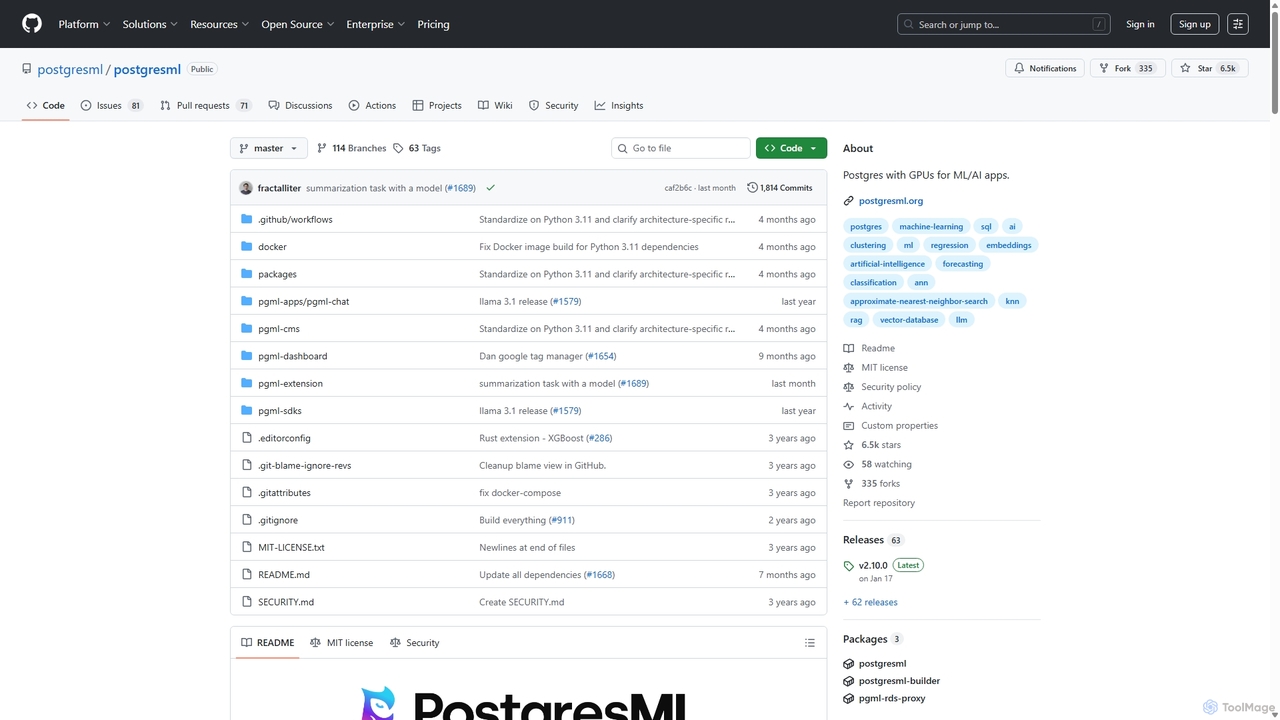
PostgresML is a powerful open-source extension that integrates machine learning and AI directly into your PostgreSQL database. It …
PostgresML is a powerful open-source extension that integrates machine learning and AI directly into your PostgreSQL database. It enables GPU-accelerated inference, vector search, and complete RAG pipelines using simple SQL commands, eliminating data movement and simplifying the MLOps stack for high-performance, scalable AI applications.
About Vector Database
A Vector Database is a specialized database designed to store, manage, and search high-dimensional vector embeddings efficiently. Unlike traditional databases that query based on exact matches, vector databases use Approximate Nearest Neighbor (ANN) algorithms to find items based on their semantic similarity. This allows applications to understand context and relationships in complex, unstructured data like text, images, and audio. As a key component in the modern AI stack, they power advanced features such as semantic search, recommendation engines, and long-term memory for large language models (LLMs).
Core Features
- High-Dimensional Vector Storage: Natively handles and indexes vectors with hundreds or thousands of dimensions, which are common outputs from AI models.
- Approximate Nearest Neighbor (ANN) Search: Provides ultra-fast similarity search by finding the 'closest' vectors in the database, enabling real-time performance on massive datasets.
- Metadata Filtering: Combines vector similarity search with traditional attribute-based filtering, allowing for complex queries like "find images similar to this one, but only those tagged 'outdoors'".
- Scalability and Performance: Engineered for horizontal scaling to manage billions of vectors while maintaining low-latency query responses.
- Real-time Indexing: Supports the continuous addition of new data vectors without significant performance degradation or downtime.
Use Cases
Vector databases are crucial for developers and data scientists building AI-native applications. They are widely used in e-commerce for creating product recommendation systems, in enterprise software for building intelligent knowledge base search, and in generative AI applications to provide long-term memory for chatbots through Retrieval-Augmented Generation (RAG).
How to Choose
When selecting a vector database, consider its performance metrics, such as query latency and indexing speed. Evaluate the deployment model—whether you need a fully managed cloud service, a self-hosted solution, or a serverless option. Also, assess its ecosystem, including integrations with popular AI frameworks like LangChain and LlamaIndex, and the flexibility of its supported ANN algorithms and filtering capabilities.

Vector DatabaseUse Cases
Building Semantic Search for Knowledge Bases
A software development team needs to build an intelligent search function for their extensive technical documentation. Instead of relying on keyword matching, which often fails to find relevant articles, they use a vector database. Each document is converted into a vector embedding by an AI model. When a developer searches for a query like "how to fix authentication bugs," the system converts the query into a vector and uses the database's ANN search to find the most semantically similar document vectors. This provides highly relevant results, even if the exact keywords aren't present, significantly reducing troubleshooting time.
Powering E-commerce Product Recommendations
An online fashion retailer wants to improve its 'You might also like' feature. They use a multimodal AI model to generate vector embeddings for each product image and its description. These vectors are stored in a vector database. When a customer views a product, the system queries the database to find products with the most similar vectors. This allows for recommendations based on visual style, color patterns, and textual descriptions (e.g., 'summer dress'), creating a more engaging and personalized shopping experience that can increase conversion rates.
Creating Long-Term Memory for AI Chatbots
A company deploys an AI customer support chatbot. To ensure conversations are consistent and personalized, they use a vector database as the chatbot's long-term memory. Key information from each user interaction (e.g., user preferences, past issues) is summarized, converted into a vector, and stored. Before responding to a new query, the chatbot searches the vector database for relevant past interactions. This process, known as Retrieval-Augmented Generation (RAG), allows the chatbot to recall context, avoid asking repetitive questions, and provide more helpful, context-aware support.
Implementing Visual Search for Media Assets
A large marketing agency manages a digital asset library with millions of images and videos. Manually tagging each asset is impractical. By using a vector database, they can implement a powerful visual search feature. An AI model processes each image and generates a vector representing its visual content. A designer can then upload an image (e.g., a photo of a sunset over a city) to find all visually similar assets in the library. They can further refine the search with metadata filters, such as 'horizontal orientation' or 'contains people', streamlining the creative workflow and asset discovery process.
Detecting Anomalies in Financial Transactions
A fintech company aims to detect fraudulent transactions in real-time. They model each transaction as a high-dimensional vector containing features like amount, time, location, and merchant type. These vectors are streamed into a vector database. The system identifies anomalies by searching for vectors that are distant from any established clusters of normal transaction patterns. When a new transaction vector is found to be an outlier, it is flagged for immediate review by a fraud analyst. This similarity-based approach can uncover novel fraud patterns that rule-based systems might miss.
Accelerating Drug Discovery with Molecular Search
In pharmaceutical research, scientists need to identify molecules with similar structural or functional properties. They represent vast libraries of chemical compounds as vector embeddings (e.g., molecular fingerprints). A researcher can then take a target molecule, convert it to its vector representation, and query a vector database to find the top-k most similar compounds from millions of candidates. This similarity search drastically accelerates the initial screening process for new drug candidates, helping researchers focus their efforts on the most promising molecules and reducing development time.