
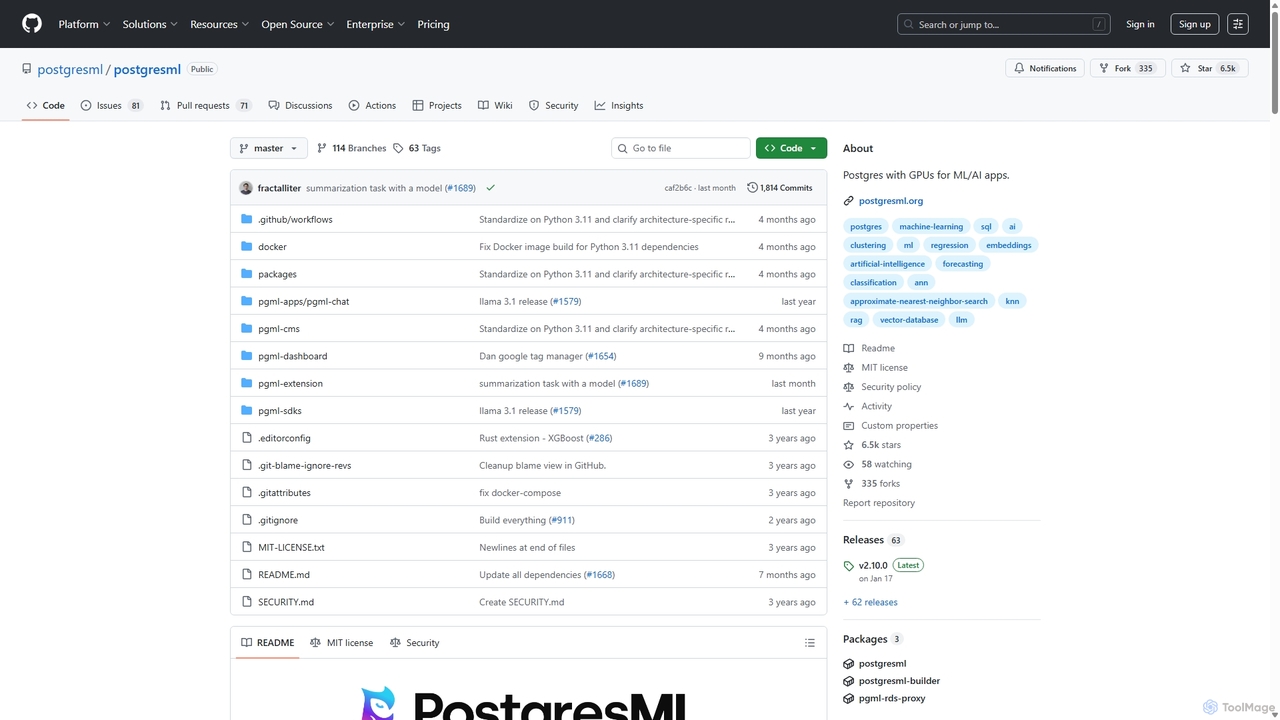
PostgresML Overview
PostgresML is a transformative open-source extension that brings machine learning and AI capabilities directly into the PostgreSQL database. By embedding models and algorithms within the data layer, it fundamentally changes how AI applications are built. The core philosophy is that it's more efficient, manageable, and reliable to move models to the data, rather than constantly moving large, dynamic datasets to the models. This approach eliminates complex data pipelines, reduces latency, and enhances security.
PostgresML turns your existing database into a full-featured AI platform. It supports a wide range of functionalities, from traditional machine learning models like classification and regression to cutting-edge deep learning applications involving Large Language Models (LLMs) and vector search. By leveraging the power of GPUs, it accelerates computations and model inference, making real-time AI feasible for high-throughput systems.
How to use PostgresML
Getting started with PostgresML is designed to be straightforward, with options for both cloud and self-hosted environments.
- PostgresML Cloud (Recommended): The easiest way to begin is by signing up for a free account on the PostgresML Cloud. This provides you with a serverless, fully managed PostgreSQL database in seconds, complete with access to GPUs and state-of-the-art LLMs without any setup overhead.
- Self-Hosting: For users who prefer to manage their own infrastructure, PostgresML can be self-hosted using Docker. You can pull the official image and run it with a simple command, giving you full control over your environment. The command is typically:
docker run -it -v postgresml_data:/var/lib/postgresql -p 5433:5432 -p 8000:8000 ghcr.io/postgresml/postgresml:latest. - Executing Queries: Once set up, you interact with PostgresML using standard SQL. You can train models (e.g.,
pgml.train()), make predictions (e.g.,pgml.predict()), and execute complex AI pipelines. For example, generating text embeddings is as simple as calling thepgml.embed()function on a text column. - Using SDKs: For seamless application integration, PostgresML offers specific client libraries like Korvus (for Python, JavaScript, Rust, and C) and postgresml-django, which integrate the entire RAG pipeline into a single database query or ORM operation.
Core Features of PostgresML
- In-Database ML/AI: Run machine learning and AI operations directly within PostgreSQL, eliminating the need for separate systems and data transfers.
- GPU Acceleration: Leverages GPU power for significantly faster computations and model inference, crucial for real-time applications.
- Large Language Models (LLMs): Integrates and utilizes state-of-the-art LLMs from hubs like Hugging Face directly in your database.
- End-to-End RAG Pipeline: Provides built-in SQL functions for the entire Retrieval-Augmented Generation (RAG) workflow:
pgml.chunkfor text splitting,pgml.embedfor generating vector embeddings,pgml.rankfor re-ranking results, andpgml.transformfor text generation. - Vector Search: Seamlessly integrates with pgvector for efficient and scalable high-dimensional vector similarity search.
- Diverse ML Algorithms: Includes over 47 built-in classification and regression algorithms (like XGBoost) for traditional machine learning tasks.
- High Performance & Scalability: Delivers 8-40x faster inference compared to HTTP-based model serving and is designed to support millions of transactions per second with horizontal scaling.
- Comprehensive NLP Tasks: Supports a wide range of NLP tasks including text classification, summarization, translation, question answering, and text generation.
Use Cases for PostgresML
PostgresML is ideal for developers and data scientists building a new generation of AI-powered applications.
- Semantic Search & Recommendation Engines: Build powerful search systems that understand user intent by using vector embeddings to find semantically similar items.
- AI-Powered Chatbots & Q&A Systems: Implement sophisticated RAG pipelines to build chatbots that can answer questions based on a private knowledge base stored within the database.
- Real-time Fraud Detection: Train and deploy classification models directly in the database to analyze transaction data in real-time and flag suspicious activities with low latency.
- Data Analysis & Business Intelligence: Use in-database NLP to summarize customer reviews, classify support tickets, or extract insights from unstructured text data without ever moving it out of Postgres.
- Personalized Content Generation: Leverage LLMs to generate personalized marketing copy, product descriptions, or email responses based on user data stored in the database.
Advantages of PostgresML
The primary advantage of PostgresML is its architectural simplicity and efficiency.
- Reduced Latency: By co-locating models and data, it eliminates network overhead, leading to faster query performance.
- Enhanced Security & Privacy: Data remains within the secure confines of your database, simplifying compliance and reducing the risk of data breaches.
- Simplified MLOps Stack: It consolidates the data store, model serving, and vector database into a single system, reducing infrastructure complexity and operational costs.
- Developer Experience: Allows developers to use familiar SQL to build and deploy complex AI features, lowering the barrier to entry and accelerating development cycles.
- Scalability: Built on the robust and scalable foundation of PostgreSQL, it can handle enterprise-grade workloads.
Pricing and Plans
PostgresML operates on a freemium model, offering flexibility for different needs.
- Open Source Self-Hosting: The PostgresML extension is open-source (MIT license) and can be self-hosted for free, giving you complete control over your environment.
- PostgresML Cloud: A managed, serverless cloud platform is available. It includes a generous free tier that allows developers to get started quickly with a free database, GPU access, and pre-configured LLMs. Paid plans are available for applications requiring more resources, dedicated GPUs, and enterprise-level support.
PostgresML Alternatives

MindsDB
MindsDB is an open-source AI layer for databases, enabling developers to build, train, and deploy AI models and agents using standard SQL. It connects to hundreds of data sources, unifies structured and unstructured data into knowledge bases, and allows you to get AI-powered answers directly from your data without complex ETL pipelines.
Machine Learning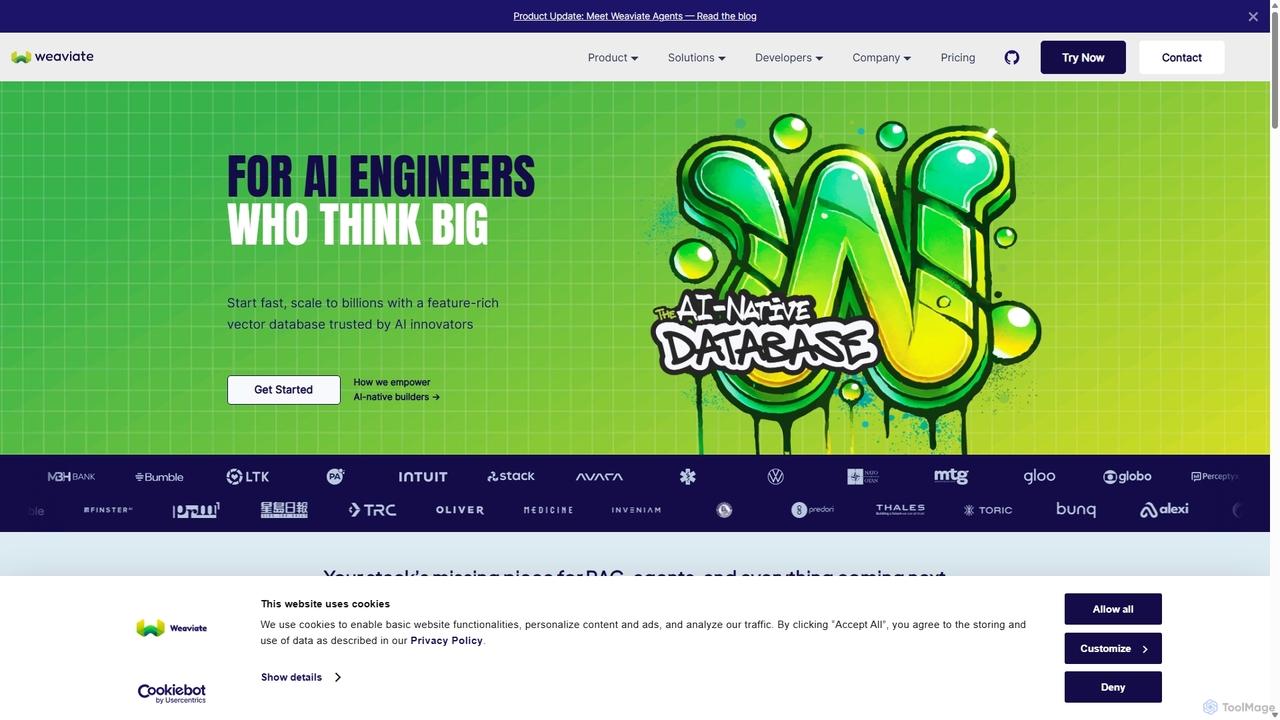
Weaviate
Weaviate is an open-source, AI-native vector database designed for developers. It enables scalable, low-latency vector, keyword, and hybrid search. Ideal for building AI applications like semantic search, recommendation engines, and Retrieval-Augmented Generation (RAG) systems, it integrates seamlessly with popular machine learning models to store and query data based on semantic meaning.
Vector Database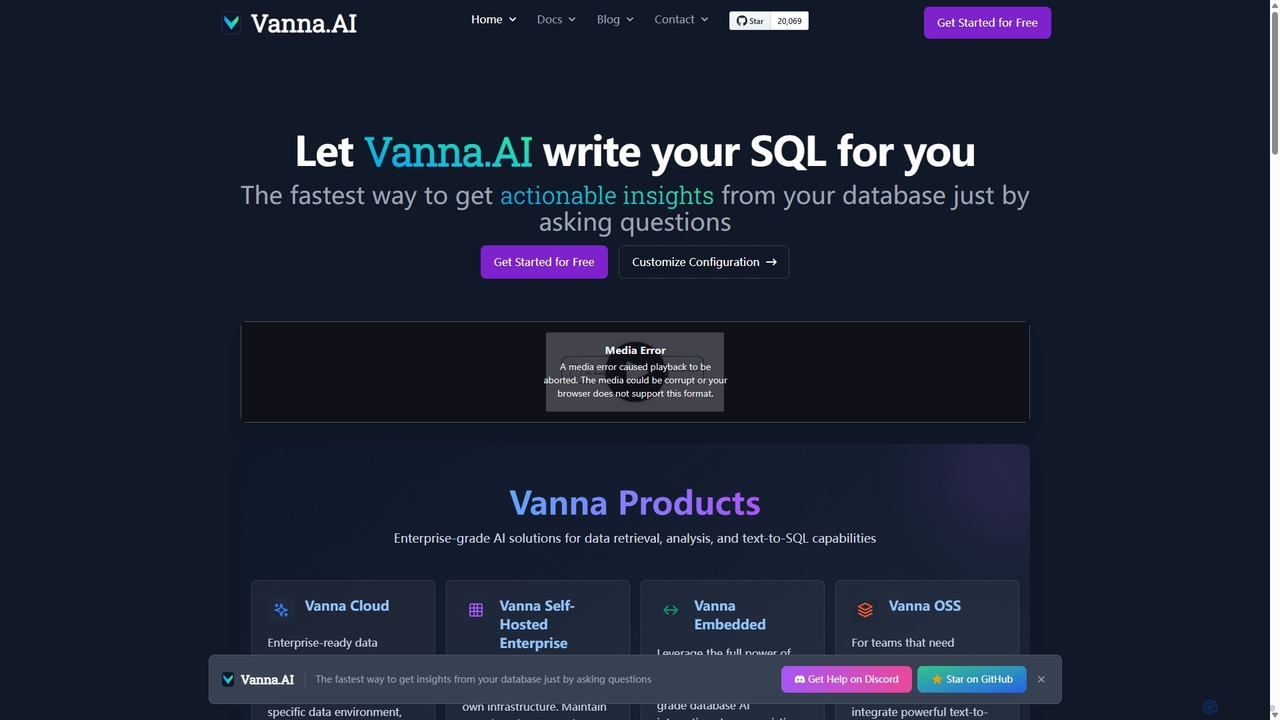
Vanna.AI
Vanna.AI is an open-source, personalized AI SQL agent that transforms natural language questions into accurate SQL queries. It uses a Retrieval-Augmented Generation (RAG) model trained on your specific database schema, documentation, and past queries to achieve high accuracy on complex datasets. It's designed for security, flexibility, and easy integration into any application, empowering both technical and non-technical users to gain insights from their data effortlessly.
Business Intelligence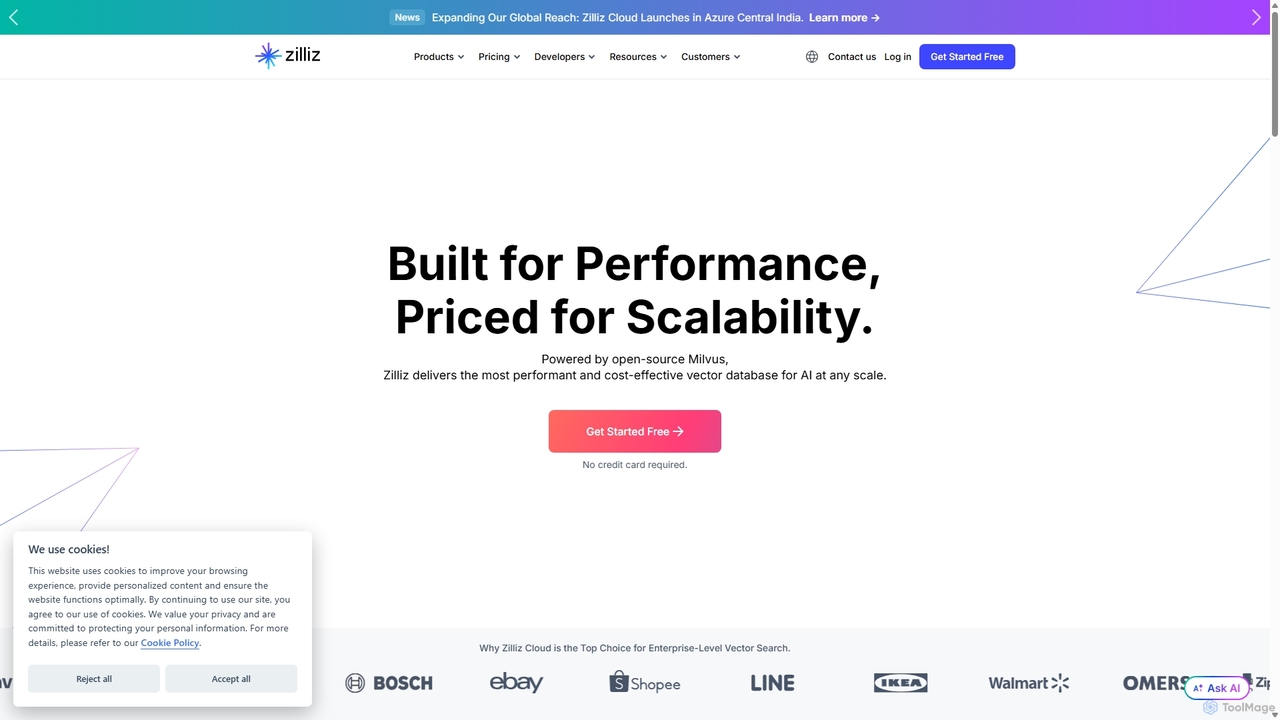
Zilliz
Zilliz is an enterprise-grade vector database built for scalable AI applications. Powered by the popular open-source project Milvus, it provides a high-performance, cost-effective, and fully-managed service (Zilliz Cloud) for storing, indexing, and searching billions of vector embeddings. It's designed to power applications like RAG, recommendation systems, and multimodal search, with seamless integrations into major AI frameworks and cloud platforms.
Machine Learning
Neosync
Neosync is an open-source platform for data anonymization and synthetic data generation. It helps developers and data scientists create safe, privacy-compliant, and realistic datasets for testing, development, and AI model training, ensuring referential integrity across databases.
Data GenerationPostgresML Categories
PostgresML Jobs
PostgresML Embed Widget
Copy this embed code to place the badge on your blog, article, or product site and send readers directly to this ToolMage detail page.

Related AI tools
MindsDB
MindsDB is an open-source AI layer for databases, enabling developers to build, train, and deploy AI models and agents using standard SQL. It connects to hundreds of data sources, unifies structured and unstructured data into knowledge bases, and allows you to get AI-powered answers directly from your data without complex ETL pipelines.
Machine LearningWeaviate
Weaviate is an open-source, AI-native vector database designed for developers. It enables scalable, low-latency vector, keyword, and hybrid search. Ideal for building AI applications like semantic search, recommendation engines, and Retrieval-Augmented Generation (RAG) systems, it integrates seamlessly with popular machine learning models to store and query data based on semantic meaning.
Vector DatabaseVanna.AI
Vanna.AI is an open-source, personalized AI SQL agent that transforms natural language questions into accurate SQL queries. It uses a Retrieval-Augmented Generation (RAG) model trained on your specific database schema, documentation, and past queries to achieve high accuracy on complex datasets. It's designed for security, flexibility, and easy integration into any application, empowering both technical and non-technical users to gain insights from their data effortlessly.
Business Intelligence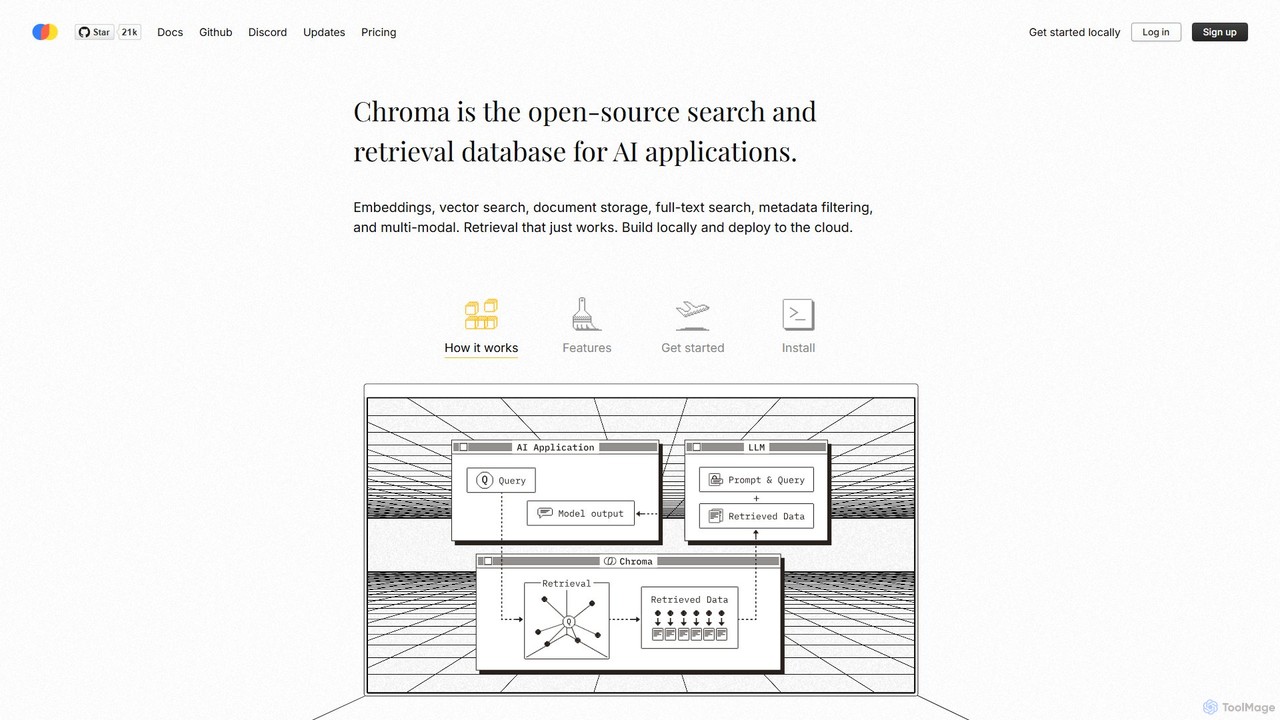
Chroma
Chroma is the open-source, AI-native retrieval database designed for building powerful AI applications with Retrieval-Augmented Generation (RAG). It simplifies storing and searching embeddings, documents, and metadata, offering vector search, full-text search, and a scalable, serverless cloud platform. It's built to be easy to use, cost-effective, and powerful, from local development to large-scale production.
Vector DatabaseZilliz
Zilliz is an enterprise-grade vector database built for scalable AI applications. Powered by the popular open-source project Milvus, it provides a high-performance, cost-effective, and fully-managed service (Zilliz Cloud) for storing, indexing, and searching billions of vector embeddings. It's designed to power applications like RAG, recommendation systems, and multimodal search, with seamless integrations into major AI frameworks and cloud platforms.
Machine Learning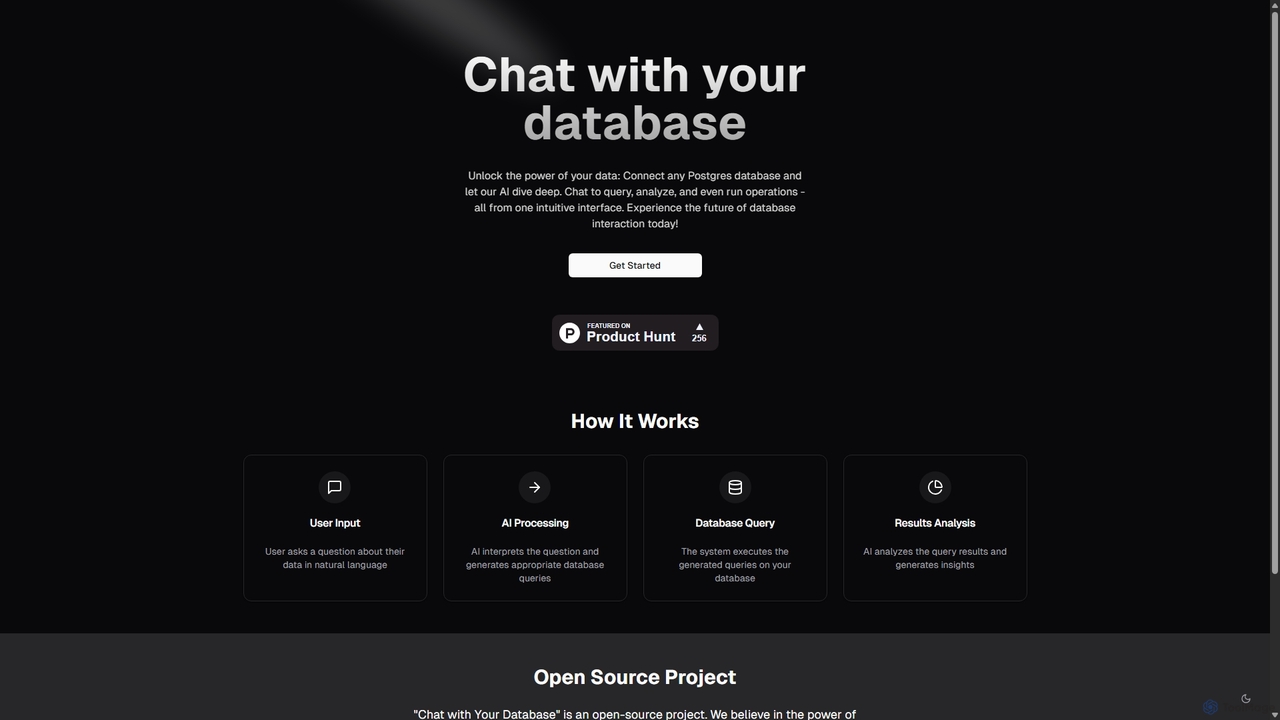
Chat With Your Database
An open-source AI tool that allows you to interact with your PostgreSQL database using natural language. Ask questions, get insights, and perform operations through a simple chat interface, eliminating the need for complex SQL queries.
Business Intelligence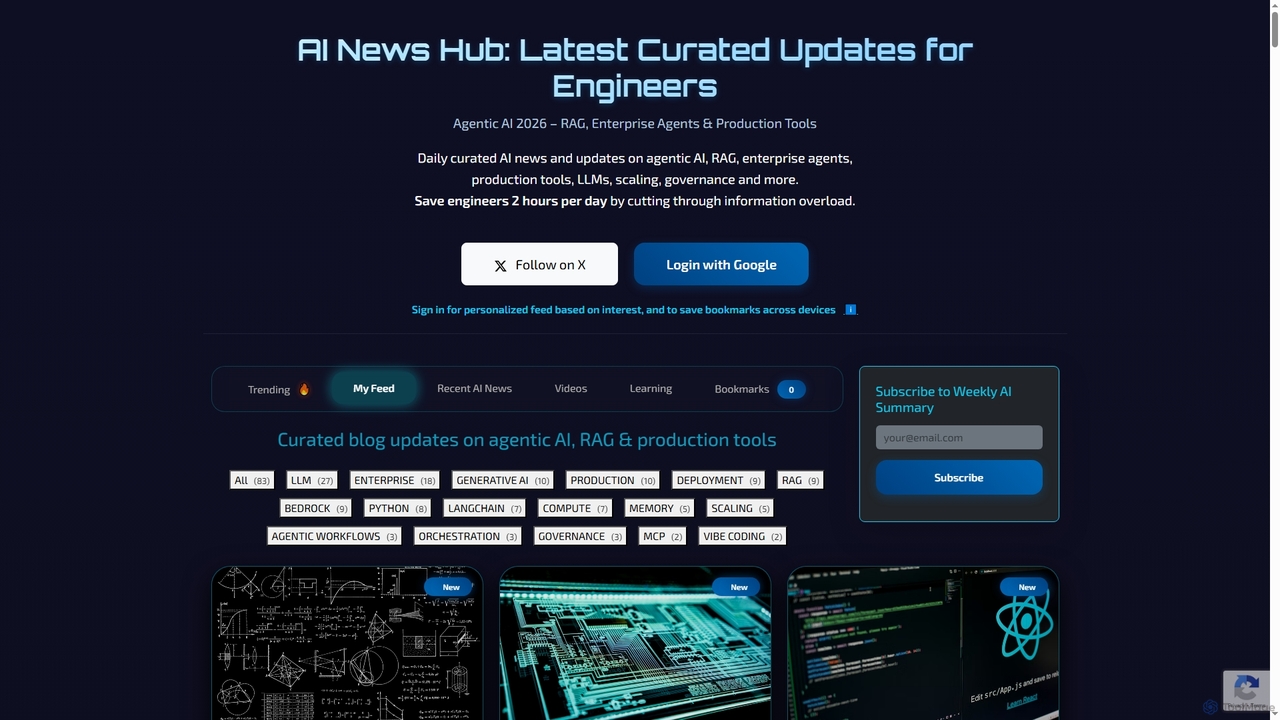
AI News Hub
AI News Hub is a comprehensive platform providing real-time AI announcements, curated blog updates on agentic AI, RAG, and production tools. It offers a personalized feed, bookmarking capabilities, and a rich collection of learning resources, including roadmaps, courses, and videos, to keep developers and enthusiasts informed and skilled in the rapidly evolving AI landscape.
Aggregation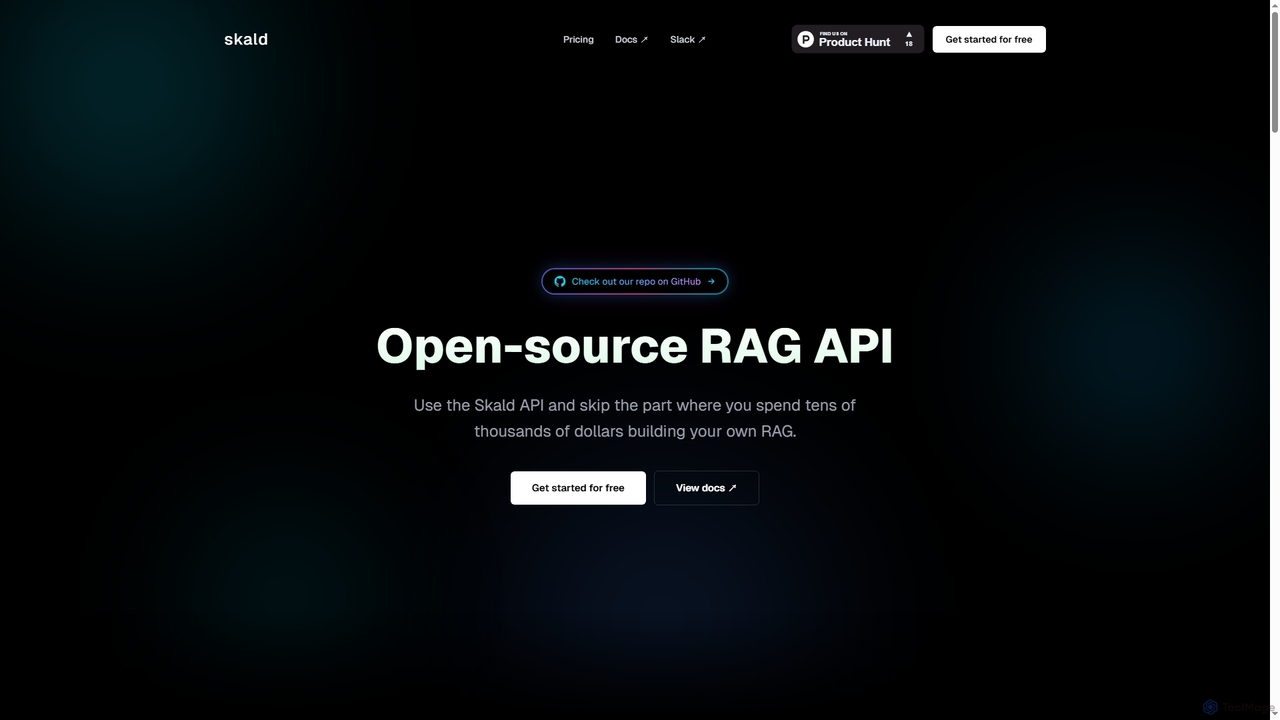
Skald
Skald is an open-source RAG API designed for developers to quickly build AI agents without the complexity of managing RAG infrastructure. It simplifies knowledge storage, context management, and semantic search, offering a powerful solution for integrating long-term memory into AI applications.
Rag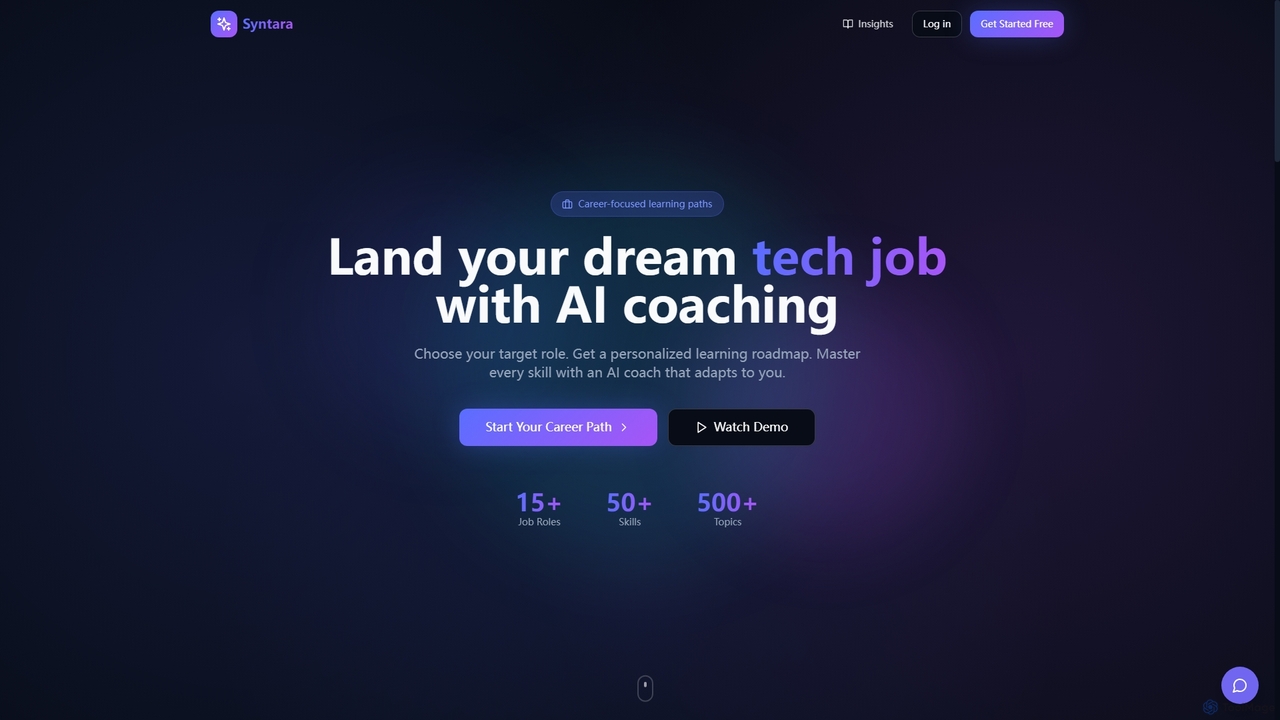
Syntara
Syntara is an AI-powered learning platform designed to accelerate tech careers. It offers personalized learning roadmaps, adaptive AI coaching, and structured skill paths to help individuals master in-demand tech skills like AI/ML, prompt engineering, and data science, and ultimately land their dream jobs.
Machine Learning Education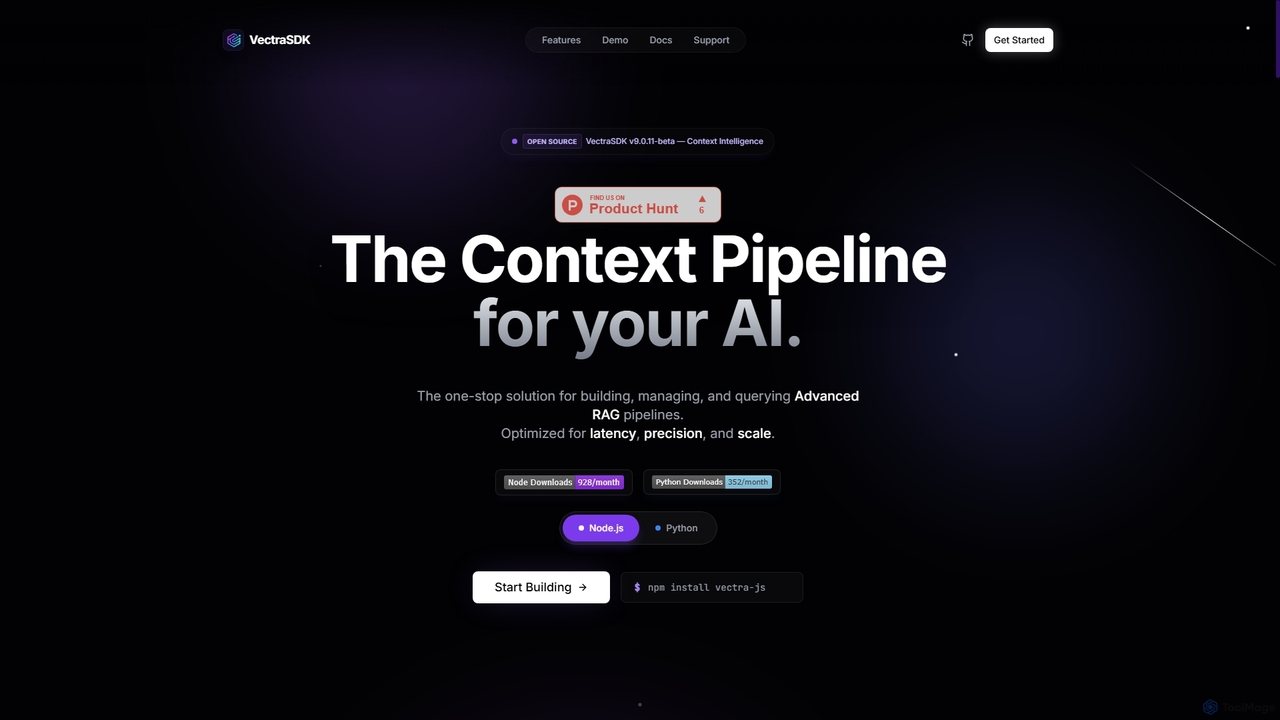
Vectra
Vectra is an open-source, production-grade SDK for Node.js and Python, designed to build, manage, and query advanced Retrieval-Augmented Generation (RAG) pipelines. It offers a comprehensive toolkit for developing context-aware AI applications, optimized for low latency, high precision, and scalability.
Rag PipelinesNeosync
Neosync is an open-source platform for data anonymization and synthetic data generation. It helps developers and data scientists create safe, privacy-compliant, and realistic datasets for testing, development, and AI model training, ensuring referential integrity across databases.
Data Generation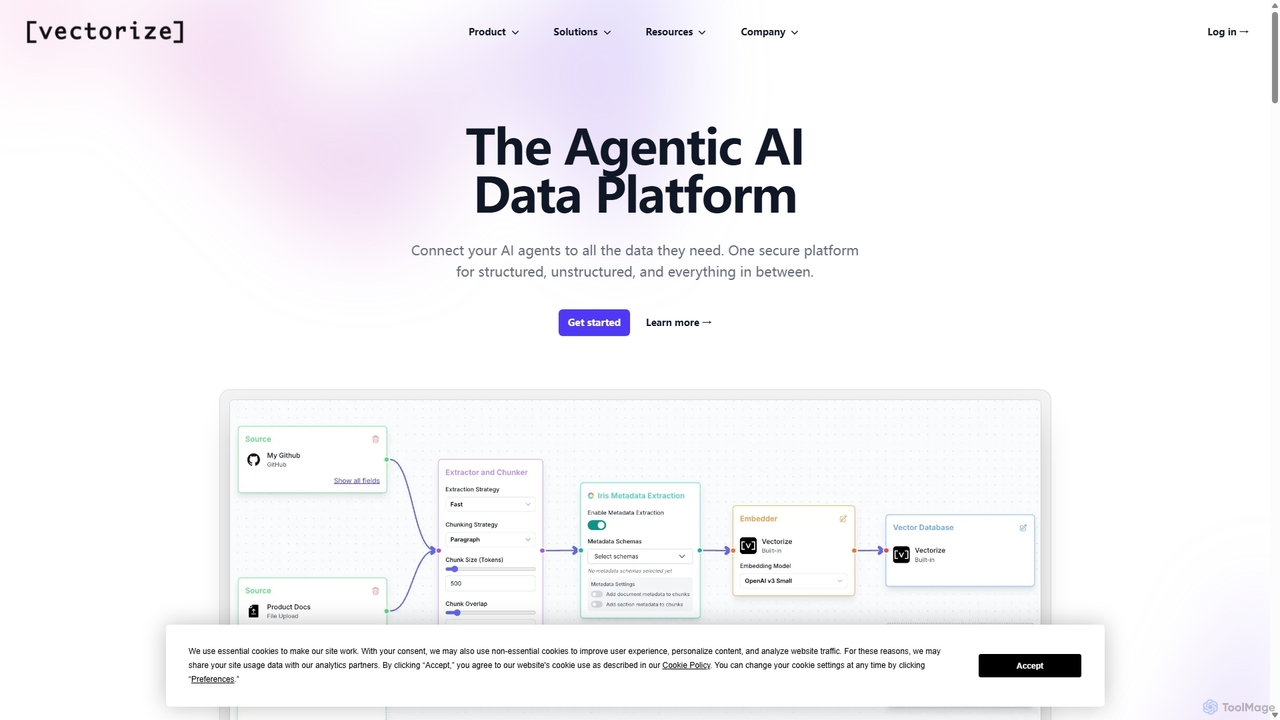
Vectorize
Vectorize is a RAG-as-a-Service platform that simplifies building AI applications on unstructured data. It offers managed RAG pipelines, extensive data source connectors, and the flexibility to use its managed vector database or connect your own, enabling developers to deploy production-ready AI solutions quickly.
Rag
Milvus
Milvus is a high-performance, open-source vector database built for AI applications. It enables developers to manage and search through billions of high-dimensional vectors with minimal latency. Ideal for building scalable systems like retrieval-augmented generation (RAG), recommendation engines, and semantic search, Milvus offers flexible deployment options from local prototyping to large-scale distributed clusters.
Machine Learning
Jyek
Jyek is an AI agent platform that understands objectives, creates execution plans, uses tools, and delivers verifiable results for complex, multi-step tasks.
Automation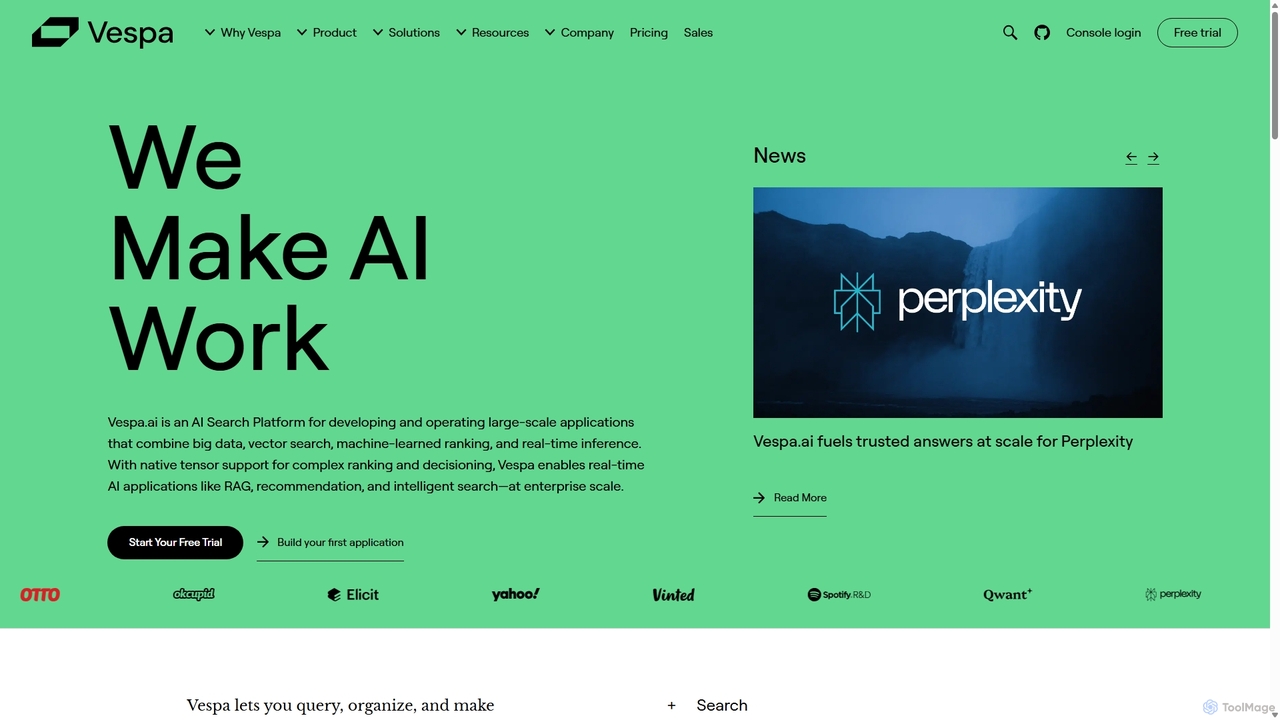
Vespa.ai
Vespa.ai is a high-performance AI search platform for building large-scale applications. It unifies vector search, text search, and machine-learned ranking to power advanced use cases like Retrieval-Augmented Generation (RAG), recommendation engines, and intelligent search. Designed for real-time inference and scalability, it's trusted by leading companies like Spotify and Perplexity to handle massive datasets with low latency.
Search
PostgresML Comments (0)
Sign in to comment.
Sign inNo comments yet.