
ToolMage
Sign in

Best 1 Search AI tools for Ai Infrastructure

Popular Search AI tools in Ai Infrastructure include Vespa.ai, helping you work more efficiently.

Vespa.ai
Freemium

Vespa.ai

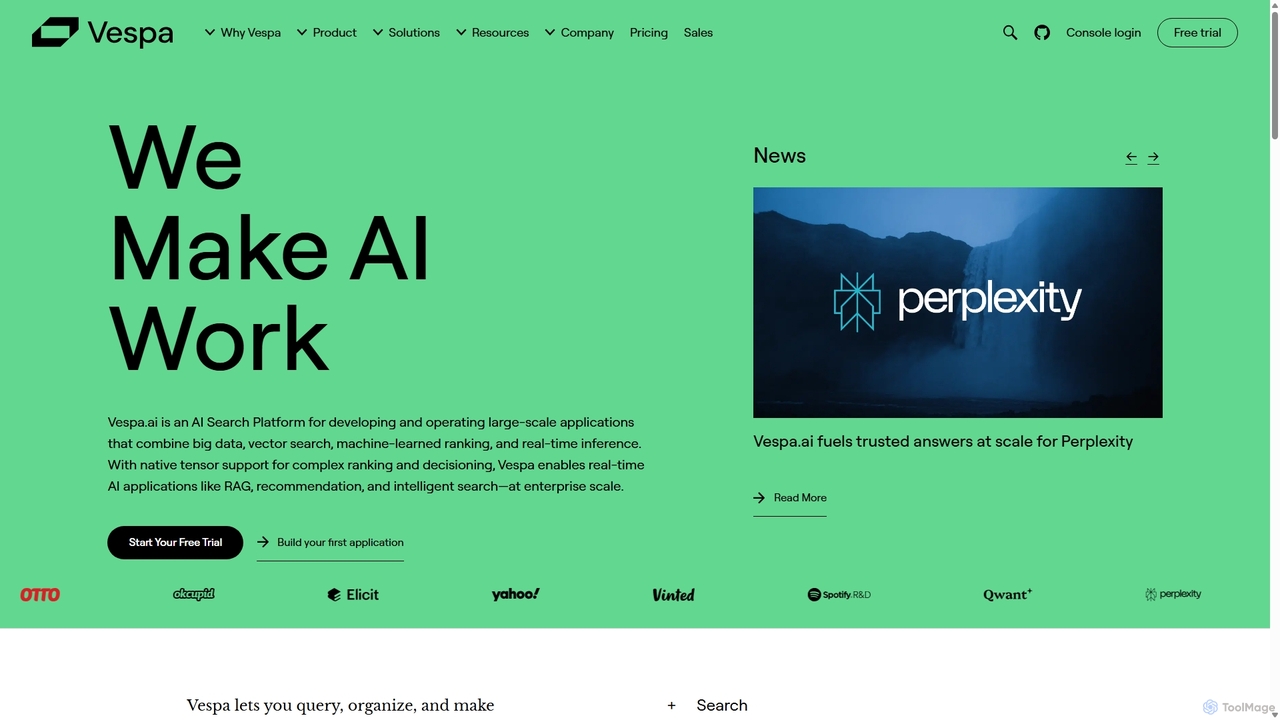
Vespa.ai is a high-performance AI search platform for building large-scale applications. It unifies vector search, text search, and machine-learned ranking to power advanced use cases like Retrieval-Augmented Generation (RAG), recommendation engines, and intelligent search. Designed for real-time inference and scalability, it's trusted by leading companies like Spotify and Perplexity to handle massive datasets with low latency.

Search
Visits 45.3KFavorites 124Likes 108

About Search

AI-powered Search tools are a critical component within AI Infrastructure, designed to revolutionize how users discover and interact with information. These tools leverage advanced AI techniques like natural language processing (NLP), semantic understanding, and vector search to go beyond keyword matching, providing highly relevant and context-aware results. They enable organizations to unlock the full potential of their data, transforming raw information into actionable insights and significantly enhancing user experience across various applications.

Core Features

  • Semantic Understanding: Interprets the meaning and intent behind queries, not just keywords.
  • Vector Search: Indexes and retrieves information based on semantic similarity, improving relevance.
  • Natural Language Querying: Allows users to ask questions in conversational language, like a human.
  • Personalized Results: Adapts search outcomes based on user history, preferences, and roles.
  • Knowledge Graph Integration: Connects disparate data points to provide a holistic view and richer context.

Applicable Scenarios

AI Search tools are indispensable for enterprises managing vast amounts of unstructured data, from internal documents and customer support knowledge bases to e-commerce product catalogs. They empower employees to quickly find critical information, enhance customer self-service portals, and drive more intelligent product discovery experiences.

How to Choose

When selecting an AI Search solution, consider its ability to integrate with your existing data sources, the accuracy and relevance of its search algorithms, and its scalability to handle growing data volumes. Evaluate its natural language processing capabilities, customization options for specific business needs, and robust security features to protect sensitive information.

Search use cases

1

Enhance Enterprise Knowledge Discovery

For large organizations, employees often struggle to find specific documents, reports, or expert knowledge buried within vast internal systems. AI Search tools allow employees to use natural language queries to quickly locate relevant information across various data silos, improving productivity and decision-making by providing instant access to institutional knowledge.

2

Intelligent Customer Support & Self-Service

Customers often seek quick answers to their questions through self-service portals or chatbots. AI Search tools power these platforms by understanding customer intent from natural language queries and instantly retrieving the most accurate and relevant information from extensive knowledge bases, reducing support tickets and improving customer satisfaction.

3

Personalized E-commerce Product Discovery

Online shoppers often use vague or descriptive terms when searching for products. AI Search tools in e-commerce can interpret these nuanced queries, understand product attributes and user preferences, and present highly personalized and relevant product recommendations, leading to higher conversion rates and an improved shopping experience.

4

Legal Document Review and Discovery

Legal professionals face the daunting task of sifting through massive volumes of legal documents, case files, and precedents. AI Search tools can rapidly analyze these texts, identify key entities, relationships, and relevant clauses based on semantic understanding, significantly accelerating the discovery process and reducing manual effort in legal research and e-discovery.

5

Research & Development Information Retrieval

Researchers and developers need to stay updated with the latest scientific papers, patents, and technical specifications. AI Search tools can intelligently sift through vast academic databases and technical repositories, identifying highly relevant articles, experiments, and data sets that match complex research questions, thereby accelerating innovation and discovery cycles.

6

Media & Content Archiving Search

Media companies and content creators manage extensive archives of videos, images, and articles. AI Search tools can process and index this rich media content, enabling users to search for specific scenes, objects, faces, or topics within videos, or retrieve images based on complex visual descriptions, significantly streamlining content reuse and production workflows.

Search FAQ

What are AI Search tools?

AI Search tools are advanced information retrieval systems that leverage artificial intelligence, particularly natural language processing and machine learning, to understand user intent and context beyond simple keyword matching. They provide more relevant, personalized, and comprehensive search results by interpreting the meaning of queries and the content itself, often utilizing techniques like vector search and knowledge graphs.

How do AI Search tools differ from traditional keyword search?

Traditional keyword search relies on exact or partial keyword matches, often leading to irrelevant results if the exact phrasing isn't used. AI Search, conversely, understands the semantic meaning and intent behind a query, even if the exact keywords aren't present. It can infer context, recognize synonyms, and connect related concepts, providing more intelligent and contextually accurate results that truly answer the user's underlying question.

What are the key benefits of implementing AI Search in an enterprise?

Implementing AI Search in an enterprise offers several key benefits. It significantly improves information discoverability, allowing employees to find critical data faster and make better decisions. It enhances customer experience through intelligent self-service, reducing support costs. Furthermore, it boosts productivity by automating information retrieval, fosters innovation by connecting disparate knowledge, and provides valuable insights into user behavior and content gaps.

What should I consider when choosing an AI Search solution?

When selecting an AI Search solution, prioritize its ability to understand complex natural language queries and deliver highly relevant results. Key considerations include its scalability to handle your data volume, integration capabilities with existing systems (databases, CRM, CMS), and customization options to tailor search behavior to specific business needs. Also, evaluate its security features, performance, and the vendor's support and roadmap for future enhancements.

Can AI Search tools integrate with existing data sources?

Yes, most AI Search tools are designed with robust integration capabilities to connect with a wide array of existing data sources. This includes structured databases (SQL, NoSQL), unstructured data repositories (document management systems, cloud storage), CRM platforms, CMS, and even real-time data streams. The goal is to create a unified search experience across all enterprise information, regardless of where it resides, making it a fundamental part of AI Infrastructure.