Golf
Golf is an enterprise-grade, protocol-aware firewall designed for the Model Context Protocol (MCP). It provides a centralized security …
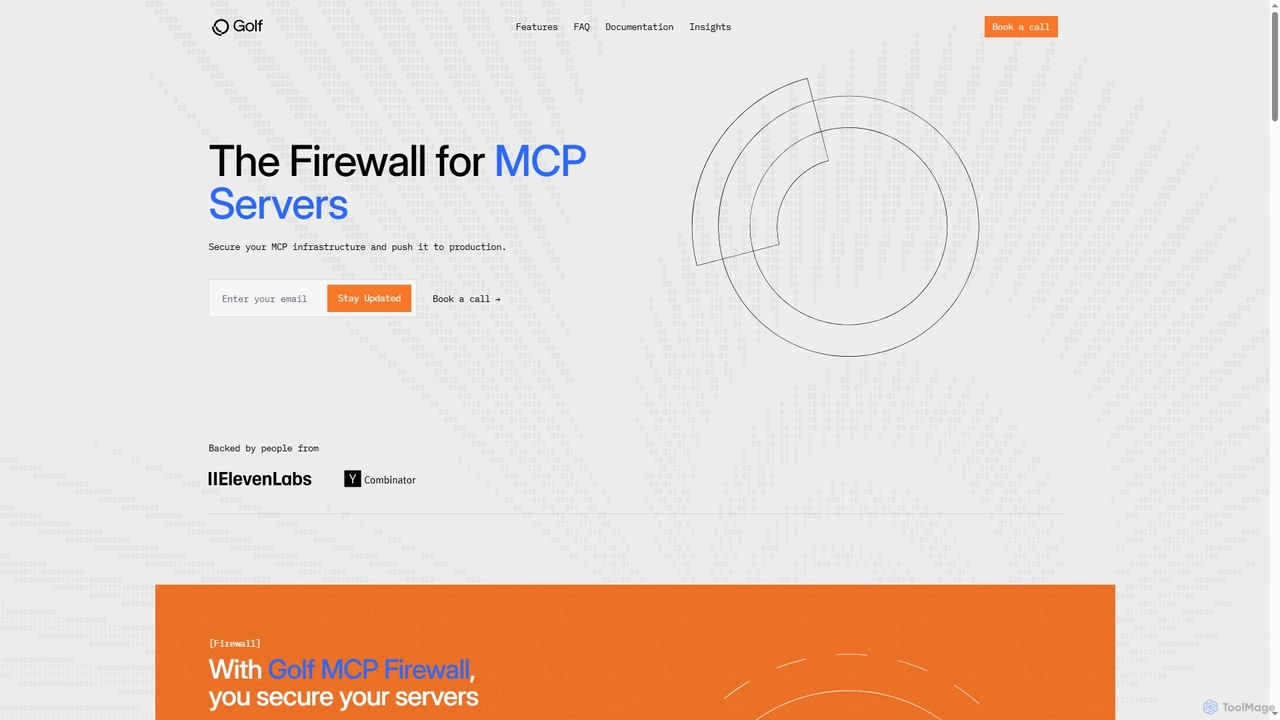
Golf is an enterprise-grade, protocol-aware firewall designed for the Model Context Protocol (MCP). It provides a centralized security layer to protect MCP servers from specific threats like prompt injection and token hijacking, enabling businesses to securely deploy AI agent infrastructure into production.
About Agent Security
Agent Security tools are a specialized category within AI Infrastructure designed to protect autonomous and semi-autonomous AI agents from unique threats. These tools act as a security layer, monitoring and controlling an agent's inputs, actions, and access to data and external tools. They are crucial for preventing vulnerabilities like prompt injection, data leakage, and unauthorized tool execution, ensuring agents operate safely within their intended boundaries. This enables developers to confidently deploy powerful agents in production environments without exposing systems to new attack vectors.
Core Features
- Prompt Injection Defense: Analyzes and sanitizes user inputs to prevent malicious instructions from hijacking the agent's behavior.
- Data Leakage Prevention (DLP): Monitors agent outputs and data access to block the unintentional exposure of sensitive information.
- Tool & API Access Control: Enforces granular permissions, restricting which external tools, APIs, or functions an agent is allowed to use.
- Behavioral Anomaly Detection: Establishes a baseline of normal agent activity and alerts on deviations that could indicate a compromise.
- Audit Trail & Logging: Provides detailed logs of all agent decisions, actions, and interactions for security forensics and compliance.
Use Cases
Agent Security is critical for enterprises deploying AI agents in customer-facing roles, such as advanced chatbots with access to user accounts, or for internal automation, like IT support agents that can modify system settings. It is also essential for applications where agents interact with external data sources, execute code, or perform financial transactions, safeguarding both the application and its users.
How to Choose
When selecting an Agent Security tool, evaluate its compatibility with your agent framework (e.g., LangChain, LlamaIndex). Assess the breadth of its threat detection capabilities, the granularity of its policy controls, and the quality of its monitoring and logging features. Also, consider the performance impact on your agent's latency and the ease of integration into your existing development and deployment workflows.

Agent SecurityUse Cases
Securing Customer Service AI Agents
A financial services company deploys an AI agent to handle customer support inquiries with access to user account information. An Agent Security tool is implemented to scan all incoming queries for prompt injection attempts, preventing attackers from tricking the agent into revealing other users' private data. It also redacts sensitive PII, like account numbers, before they are logged, ensuring compliance with data privacy regulations like GDPR.
Protecting Internal IT Automation Agents
An IT department uses an AI agent to automate routine tasks like resetting passwords and provisioning software access. This agent has high-level system permissions. An Agent Security platform enforces strict access control, ensuring the agent can only use pre-approved tools and scripts. It monitors the agent's behavior for anomalies, such as an attempt to escalate its own privileges, immediately blocking the action and alerting security personnel.
Safeguarding Code Generation & Execution
A software development platform integrates an AI agent that can write, test, and execute code. To prevent the generation of malicious or insecure code, an Agent Security tool is used. It scans the agent-generated code for common vulnerabilities (e.g., SQL injection) before execution. Furthermore, it runs the code within a secure sandbox, limiting its access to the file system and network, thus preventing any potential damage if a vulnerability is exploited.
Auditing Financial Analysis Agents
An investment firm employs an AI agent to analyze market data and generate investment recommendations. Due to the sensitive nature of the data, robust auditing is a legal requirement. An Agent Security tool provides a complete, unchangeable audit trail of every document the agent accessed and every query it ran. This detailed logging allows compliance officers to easily review the agent's activities and prove that no data was misused or leaked.
Controlling Autonomous Web Research Agents
A market research company uses autonomous agents to browse the web and gather competitor information. These agents risk encountering malicious websites. An Agent Security solution acts as a secure proxy, scanning all web content before the agent processes it. It blocks access to known malicious domains and prevents the agent from executing any untrusted JavaScript or downloading executable files, keeping the underlying infrastructure safe.
Validating Agent-to-Agent Communication
A complex logistics system uses a team of specialized AI agents that collaborate to optimize supply chains. To prevent a compromised agent from disrupting the entire system, an Agent Security framework secures the communication channels. It verifies the identity of each agent and ensures that messages exchanged conform to a strict protocol, rejecting any malformed or unauthorized requests.