ToolMage
Sign in

Best 1 Custom Solutions AI tools for Ai Infrastructure

Popular Custom Solutions AI tools in Ai Infrastructure include AE Studio, helping you work more efficiently.

AE Studio
Paid

AE Studio

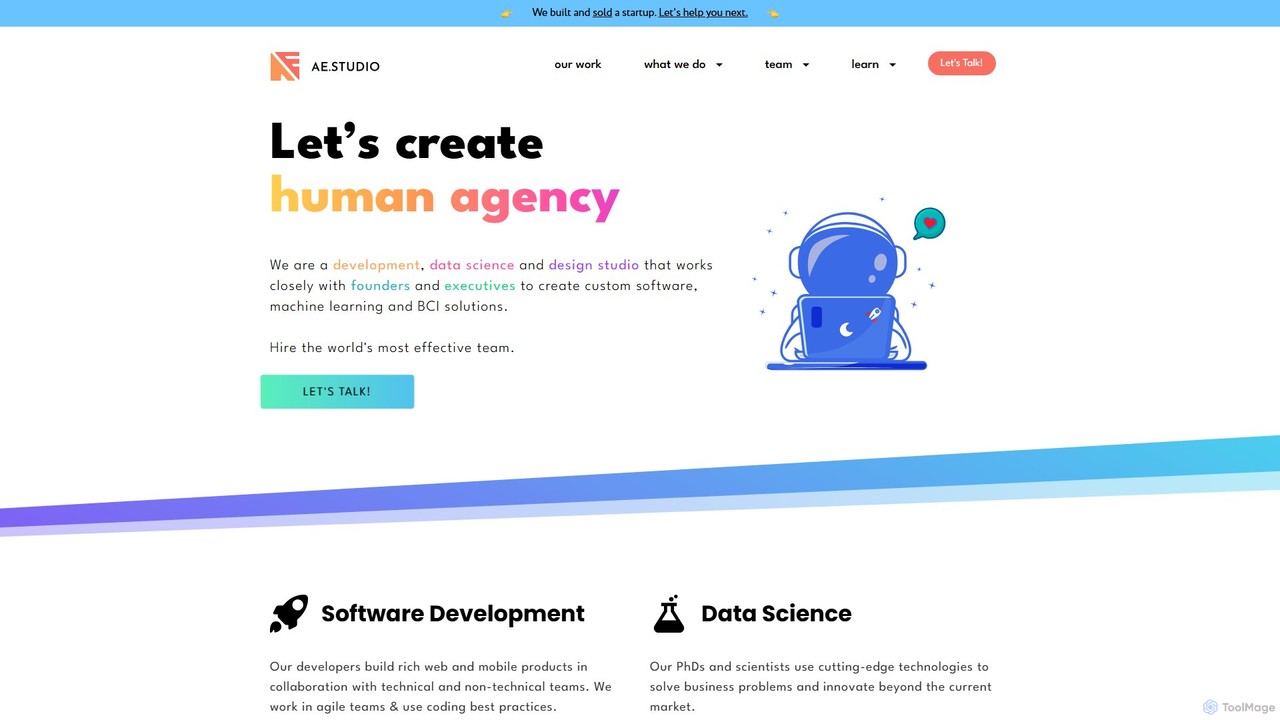
AE Studio is an elite development, data science, and design agency specializing in creating custom software, machine learning, and Brain-Computer Interface (BCI) solutions. They partner with founders and executives, acting as a dedicated team of senior experts to build innovative products with a focus on increasing human agency.

Custom Solutions
Visits 27.1KFavorites 120Likes 112

About Custom Solutions

Custom Solutions are services and platforms that design, build, and deploy AI systems tailored to specific business needs. Unlike off-the-shelf tools, they leverage core AI infrastructure to create unique models, workflows, and applications from the ground up. This approach is ideal for enterprises with unique data sets or complex operational challenges that standard AI tools cannot address. The result is a highly integrated, optimized, and proprietary AI capability that provides a distinct competitive advantage.

Core Features

  • Bespoke Model Development: Training or fine-tuning AI models on proprietary data for highly specific tasks.
  • End-to-End MLOps Integration: Managing the entire AI lifecycle from data preparation to deployment and continuous monitoring.
  • Custom Workflow Automation: Designing automated processes that fit perfectly into existing, unique business operations.
  • Scalable Deployment Architecture: Building robust and scalable infrastructure to support the custom AI solution as the business grows.

Use Cases

Custom Solutions are primarily adopted by medium to large enterprises in sectors like finance, healthcare, and manufacturing, where data privacy and unique process requirements are critical. For instance, a bank might build a custom fraud detection model trained on its transaction data, or a hospital could develop a personalized diagnostic tool based on its patient records.

How to Choose

When selecting a provider, evaluate their industry expertise and relevant case studies. Assess their technical capabilities, including the range of models they work with and their MLOps proficiency. Consider the total cost of ownership, which includes development, deployment, and ongoing maintenance, as well as the level of post-launch support offered.

Custom Solutions use cases

1

Developing a Custom Fraud Detection System for Fintech

A financial services company requires a fraud detection system that understands its unique transaction patterns and customer behaviors. They partner with a custom solutions provider to build a machine learning model trained exclusively on their historical transaction data. This tailored approach results in a system with significantly higher accuracy and fewer false positives compared to generic, off-the-shelf solutions. The system integrates directly into their payment processing workflow, enabling real-time risk assessment and directly reducing financial losses from fraudulent activities.

2

Creating a Personalized Product Recommendation Engine

A large e-commerce retailer wants to move beyond basic recommendation algorithms. They use a custom solution to build a deep learning engine that analyzes complex user behaviors, including clickstreams, viewing time, and purchase history, alongside product metadata. The custom model is designed to understand nuanced relationships between products and user preferences. Deployed across their website and mobile app, this tailored engine provides highly relevant, real-time suggestions, which increases user engagement, boosts the average order value, and improves customer loyalty.

3

Building a Predictive Maintenance Model for Manufacturing

A factory operator aims to minimize equipment downtime by moving from reactive to predictive maintenance. A custom AI solution is developed to analyze real-time sensor data (e.g., temperature, vibration, pressure) from critical machinery. The model is trained on historical performance and failure data specific to their equipment. It learns the unique failure patterns and predicts potential breakdowns before they occur, allowing the maintenance team to schedule repairs proactively. This tailored system significantly reduces unplanned downtime, extends equipment lifespan, and saves substantial operational costs.

4

Automating Document Processing for the Legal Industry

A large law firm handles thousands of contracts, each with non-standard clauses and formats. A custom Natural Language Processing (NLP) solution is built to automate the review process. The model is trained on the firm's historical contracts and legal criteria to accurately extract specific information, classify clauses by type, and identify potential risks or deviations from standard terms. This custom tool integrates with their document management system, reducing the manual review time for lawyers by hours per contract and ensuring a higher level of consistency and accuracy in due diligence.

5

Developing a Medical Image Analysis Tool for Healthcare

A research hospital needs an AI tool to detect specific, rare anomalies in MRI scans that standard software often misses. A custom computer vision model is developed by a solutions provider, trained on the hospital's vast, annotated medical image archive. This ensures the model is highly specialized in identifying the subtle patterns relevant to their research and patient demographic. The resulting tool integrates into the radiologists' workflow, acting as an assistive technology to highlight areas of interest, leading to earlier, more accurate diagnoses and advancing medical research.

6

Fine-tuning an LLM for Enterprise Knowledge Management

A multinational corporation needs an internal chatbot that understands its specific jargon, products, and policies. Instead of using a generic chatbot, they use a custom solutions platform to fine-tune a powerful Large Language Model (LLM) on their private knowledge base, including internal documents, wikis, and support tickets. The result is a highly accurate internal assistant that provides instant, context-aware answers to employee queries. This custom solution improves internal communication, reduces the time employees spend searching for information, and onboards new hires more efficiently.

Custom Solutions FAQ

What are AI Custom Solutions?

AI Custom Solutions are specialized services or platforms used to create bespoke artificial intelligence systems tailored to a company's unique data and operational needs. Instead of providing a one-size-fits-all tool, they involve the entire lifecycle of developing, training, and deploying AI models and workflows for a specific business problem. This ensures optimal performance, seamless integration with existing systems, and the creation of a proprietary AI asset.

How do Custom Solutions differ from pre-built AI tools?

The key difference is specificity versus generality. Pre-built AI tools are ready-to-use products designed for a broad audience with common problems (e.g., a general chatbot). Custom Solutions are built-to-order services for a single client's unique problem. Key distinctions include:

  • Data: Custom solutions are trained on your proprietary data for higher accuracy.
  • Integration: They are designed to fit perfectly within your existing tech stack and workflows.
  • Ownership: You own the final model as a competitive asset, unlike a subscription to a shared tool.
  • Cost: Custom solutions typically have a higher initial investment but can offer a greater long-term ROI.

Who should consider using AI Custom Solutions?

AI Custom Solutions are best suited for organizations that have a specific, high-value problem that cannot be adequately solved by off-the-shelf software. Ideal candidates include:

  • Enterprises with unique data: Companies in finance, healthcare, or logistics with large, proprietary datasets that can provide a competitive edge.
  • Businesses with complex workflows: Organizations needing AI that deeply integrates into specialized operational processes.
  • Companies seeking a strategic advantage: Businesses aiming to build a proprietary AI capability that competitors cannot easily replicate.
Generally, this approach is a better fit for medium to large enterprises with a clear business case and a defined ROI goal.

What is the typical process for developing a custom AI solution?

The development process is a collaborative partnership that typically follows several key stages:

  1. Discovery & Strategy: Defining the business problem, assessing data readiness, and setting clear success metrics.
  2. Data Preparation & Modeling: Collecting, cleaning, and labeling data, followed by selecting and training or fine-tuning the appropriate AI model.
  3. Integration & Deployment: Embedding the trained model into existing business systems and workflows, often using MLOps practices for scalability.
  4. Monitoring & Maintenance: Continuously tracking the model's performance in a live environment and retraining it as needed to maintain accuracy.

What factors should I consider when choosing a Custom Solutions provider?

Selecting the right partner is critical for success. Key factors to evaluate include:

  • Industry Expertise: Do they have proven experience and case studies in your specific domain (e.g., finance, healthcare)?
  • Technical Proficiency: Assess their capabilities in relevant AI fields (NLP, computer vision, etc.) and their approach to MLOps for long-term model management.
  • Team & Communication: Evaluate the expertise of their team and their process for collaboration and project management.
  • Total Cost of Ownership: Look beyond the initial development cost to understand ongoing maintenance, support, and infrastructure fees.