Summon
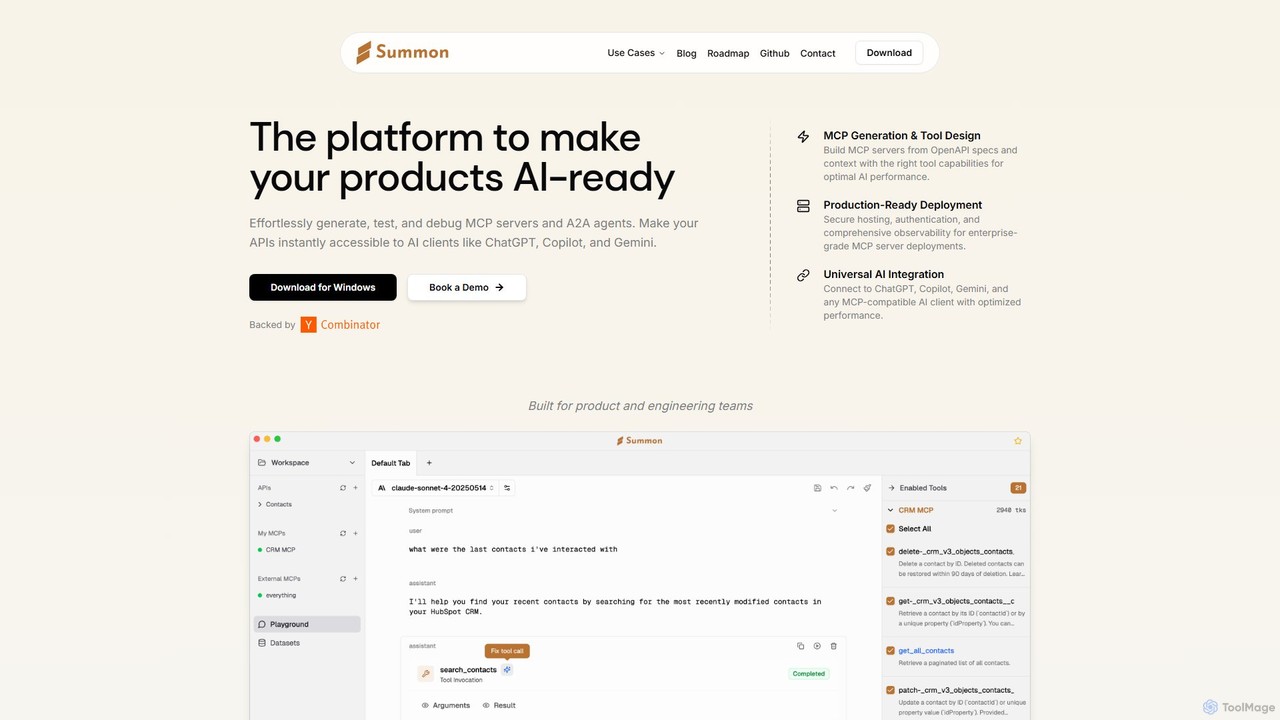
Summon is a developer platform designed to make your product's APIs AI-ready. It enables you to effortlessly generate, …
Summon is a developer platform designed to make your product's APIs AI-ready. It enables you to effortlessly generate, test, and deploy secure MCP servers from OpenAPI specs, making your services instantly accessible to major AI clients like ChatGPT, Copilot, and Gemini. By bridging the gap between your APIs and the AI ecosystem, Summon helps you unlock new distribution channels, increase user engagement, and provide seamless, AI-powered workflows for your customers.
About Agent Development
Agent Development tools are frameworks and platforms for building, testing, and deploying autonomous AI agents. These agents go beyond simple chatbots by using Large Language Models (LLMs) to reason, plan, and execute complex, multi-step tasks. They can interact with software, APIs, and data sources to achieve specific goals with minimal human intervention. This capability makes them a core component of advanced AI infrastructure, enabling the automation of sophisticated digital workflows.
Core Features
- Task Decomposition: Automatically breaking down a high-level objective into a sequence of smaller, manageable steps.
- Tool Integration (Tool Use): Equipping agents with the ability to use external tools like web browsers, code interpreters, and APIs to gather information or perform actions.
- Planning & Reasoning: Creating and adapting strategies to achieve goals, including self-correction when encountering errors.
- Memory Management: Providing agents with short-term and long-term memory to maintain context and learn from past interactions.
- Multi-Agent Collaboration: Enabling multiple specialized agents to work together to solve complex problems that are beyond the scope of a single agent.
Use Cases
Agent Development platforms are primarily used by developers, AI engineers, and businesses aiming to automate complex processes. For example, a developer might build an agent to autonomously write, debug, and test code. In business, these tools can create agents for market research, complex customer support resolution, or automated supply chain management, where the agent interacts with multiple internal systems.
How to Choose
When selecting an Agent Development tool, consider the technical expertise required; some are code-intensive frameworks (e.g., LangChain, AutoGen) offering high flexibility, while others are low-code platforms for faster deployment. Evaluate the ecosystem of pre-built tools and integrations. Also, assess the observability features for debugging the agent's decision-making process and the scalability for production environments.

Agent DevelopmentUse Cases
Automated Code Generation and Debugging
A software developer uses an agent development platform to create a 'coding assistant' agent. The developer provides a high-level requirement in natural language, such as 'Create a Python script that fetches weather data from an API and saves it to a CSV file.' The agent decomposes this task, searches for a suitable weather API, writes the Python code, integrates the API key, and even writes unit tests. If an error occurs during execution, the agent can read the error message, search for solutions online, and attempt to fix the code itself, significantly speeding up the development cycle.
Complex Market Research and Reporting
A business analyst tasks an AI agent with creating a comprehensive report on the competitive landscape for a new product. The agent is given access to web search, financial news APIs, and internal sales data. It autonomously browses competitor websites, extracts key product features, analyzes recent news articles for market trends, pulls relevant sales figures from the internal database, and synthesizes all the information into a structured report with charts and summaries. This automates a process that would typically take a human analyst days to complete.
Autonomous Customer Support Resolution
A company deploys a support agent to handle complex technical support tickets. When a new ticket arrives, the agent first queries the internal knowledge base for solutions. If none are found, it accesses diagnostic tools via API to analyze the user's system logs. Based on the analysis, it might perform actions like resetting a user's account settings or escalating the ticket to a specific human engineering team, attaching a full summary of its findings. This goes beyond a simple FAQ bot by actively investigating and taking steps to resolve the issue.
Personalized Travel Itinerary Planning
A user wants to plan a 7-day trip to Japan. They interact with a travel agent that asks for their budget, interests (e.g., history, food, nature), and travel pace. The agent then uses a tool to search for flights, another to find hotels matching the criteria, and a third to look up attractions and restaurants. It cross-references opening times and travel durations between locations to create a logical, day-by-day itinerary. The agent can even make reservations by interacting with booking APIs, presenting a complete, bookable travel plan to the user.
Automated Financial Data Analysis
A financial analyst uses a multi-agent system to evaluate a potential stock investment. One agent is specialized in scraping financial statements (income, balance sheet) from public filings. A second agent scours news APIs and social media for recent sentiment about the company. A third agent, a data scientist, takes the structured data from the first two agents, performs a quantitative analysis, and generates visualizations. A final 'manager' agent compiles the outputs into a single investment memo, providing a recommendation based on the combined findings.
Proactive System Monitoring and Maintenance
A DevOps engineer configures an AI agent to monitor a complex cloud infrastructure. The agent continuously checks performance metrics from services like AWS CloudWatch. If it detects an anomaly, such as a sudden spike in CPU usage on a server, it doesn't just send an alert. It proceeds to analyze logs to find the root cause, decides on a corrective action (like restarting a service or scaling up resources), executes the action via the cloud provider's API, and then verifies that the system has returned to a stable state, documenting the entire incident automatically.