LakeSail
LakeSail offers a high-performance, open-source framework called Sail, designed as a drop-in replacement for Apache Spark. Built in …
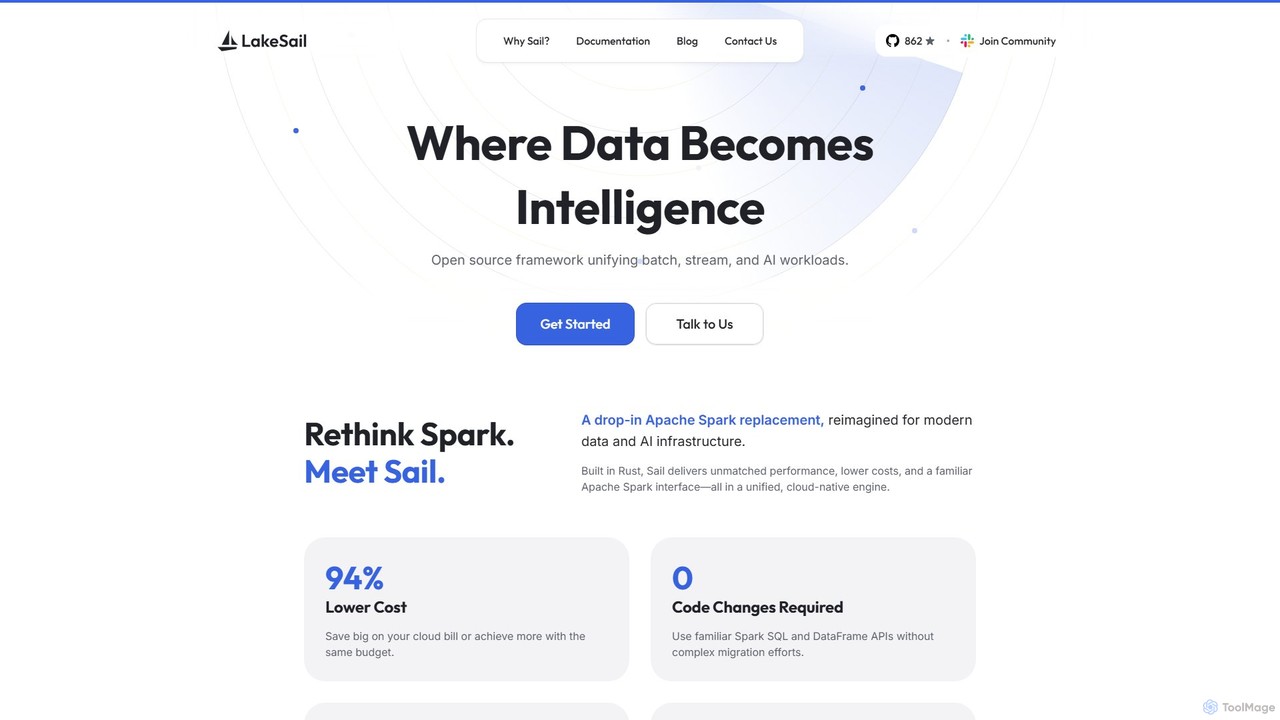
LakeSail offers a high-performance, open-source framework called Sail, designed as a drop-in replacement for Apache Spark. Built in Rust, it unifies batch, stream, and AI workloads, delivering up to 8x faster execution and 94% lower cloud costs without requiring any code changes. It eliminates JVM overhead for superior efficiency and scalability in modern data and AI infrastructures.
About Big Data
Big Data tools are specialized platforms designed to process, manage, and analyze massive, complex datasets that exceed the capabilities of traditional data-processing software. As a core component of AI Infrastructure, these tools utilize distributed computing frameworks and parallel processing to handle the sheer volume, velocity, and variety of information. They enable organizations to extract valuable insights, identify hidden patterns, and build predictive models from their data. This capability is fundamental for training large-scale machine learning models and powering data-intensive AI applications.
Core Features
- Distributed Processing: Executes complex queries and data transformations across multiple servers simultaneously using frameworks like Apache Spark or Hadoop.
- Scalable Storage: Offers flexible storage solutions such as data lakes or distributed file systems (like HDFS) that can scale to petabytes and beyond.
- Real-time Data Ingestion: Captures and processes continuous streams of data from sources like IoT devices, social media feeds, and application logs.
- Advanced Analytics & ML Integration: Provides built-in libraries and APIs for machine learning, statistical analysis, and data mining tasks directly on large datasets.
Applicable Scenarios
Big Data tools are essential in industries handling vast amounts of information. For example, financial services use them for real-time fraud detection and risk analysis. E-commerce platforms rely on them to power personalized recommendation engines and optimize supply chains. In healthcare, they are used for analyzing genomic data and patient records to advance medical research.
Selection Criteria
When choosing a Big Data tool, consider its scalability to ensure it can handle future data growth. Evaluate its processing capabilities—whether you need real-time stream processing or batch processing. Assess its integration ecosystem for compatibility with your existing BI tools and machine learning frameworks. Finally, consider the deployment model (cloud, on-premise, or hybrid) and the technical expertise required to manage the platform.

Big DataUse Cases
Predicting Customer Churn in Telecommunications
A data science team at a major telecom company uses a big data platform to reduce customer churn. They ingest terabytes of daily data, including call detail records, network usage, billing information, and customer support interactions. Using distributed processing, they clean and aggregate this data to create comprehensive customer profiles. The team then applies machine learning algorithms on the platform to build a predictive model that identifies customers at high risk of leaving. This allows the marketing team to launch targeted retention campaigns, offering personalized discounts or service upgrades, ultimately reducing churn by a measurable percentage.
Real-time Fraud Detection for Financial Services
A financial institution implements a real-time big data streaming platform to combat fraud. The system ingests millions of transaction events per second from various sources like credit card swipes, online payments, and ATM withdrawals. It continuously analyzes these streams against historical data and complex fraud patterns using machine learning models. If a transaction deviates from a user's normal behavior or matches a known fraud signature, the system instantly flags it and can trigger an alert or block the transaction within milliseconds. This proactive approach significantly reduces financial losses and protects customer accounts without impacting the user experience.
Optimizing Supply Chains with Predictive Analytics
A global logistics company leverages a big data analytics platform to enhance its supply chain efficiency. The platform integrates data from diverse sources, including GPS trackers on vehicles, weather forecasts, traffic data, and warehouse inventory systems. By analyzing this vast dataset, data analysts can build models that predict delivery times with high accuracy, identify optimal shipping routes in real-time, and forecast demand to prevent stockouts or overstocking. This data-driven approach leads to reduced fuel costs, improved on-time delivery rates, and a more resilient supply chain capable of adapting to unforeseen disruptions.
Personalizing E-commerce Customer Experiences
An online retail giant uses a big data platform to create highly personalized shopping experiences. The system collects and processes real-time data on user behavior, such as clicks, products viewed, items added to cart, and past purchases. This data is combined with demographic information to power a sophisticated recommendation engine. As a user browses the site, the engine suggests relevant products, creates personalized homepages, and sends targeted email promotions. This level of personalization, made possible by processing massive datasets, significantly increases user engagement, conversion rates, and average order value.
Advancing Medical Research with Genomic Data Analysis
A biomedical research institute uses a big data platform to analyze petabytes of genomic sequencing data. Processing this data with traditional methods would be prohibitively slow. The platform's distributed computing capabilities allow researchers to run complex bioinformatics pipelines, perform genome-wide association studies, and identify genetic markers linked to diseases like cancer and Alzheimer's. By accelerating the analysis of vast genomic datasets, these tools empower scientists to make breakthroughs in personalized medicine, drug discovery, and understanding the genetic basis of human health.
Enabling Predictive Maintenance in Manufacturing
A heavy machinery manufacturer equips its products with IoT sensors that stream operational data like temperature, vibration, and pressure. This data is fed into a big data platform for real-time analysis. Data engineers build models that detect subtle anomalies in the data streams, which often precede equipment failure. When the system predicts a potential failure, it automatically generates a maintenance alert for service teams. This shift from reactive to predictive maintenance allows the company to schedule repairs before a breakdown occurs, minimizing costly downtime, extending equipment lifespan, and improving customer satisfaction.