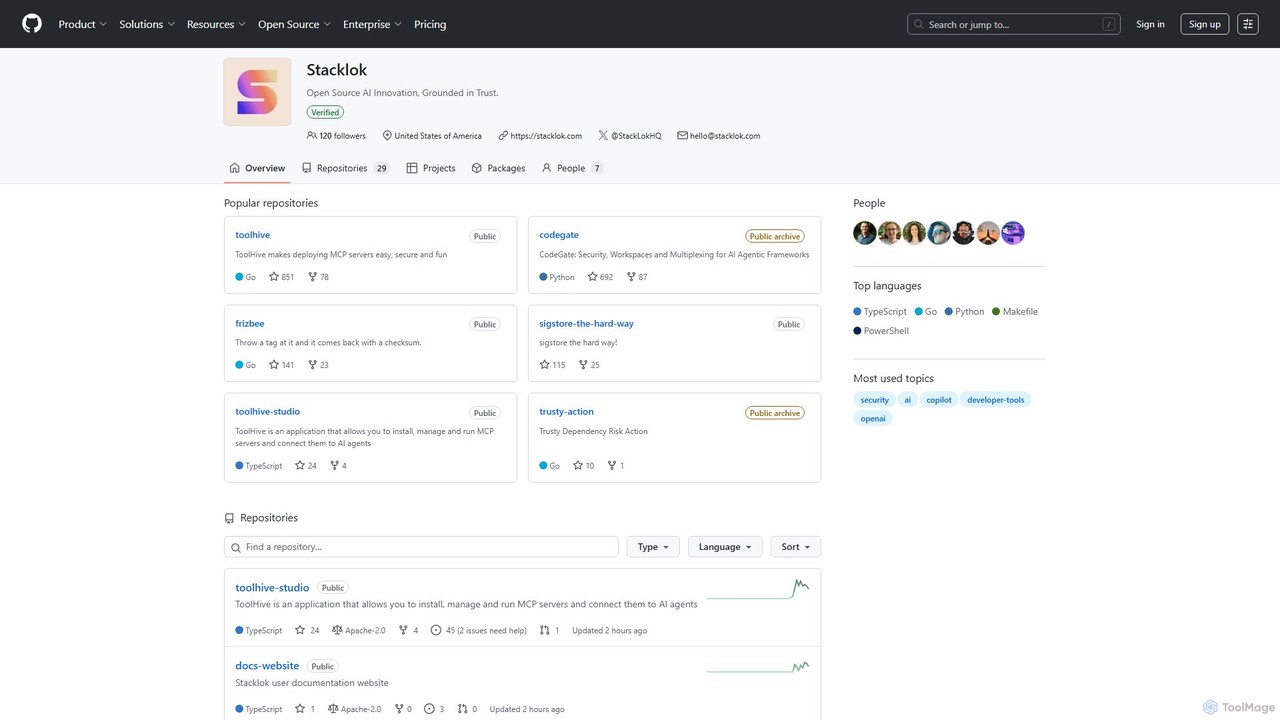
codegate
Codegate is an open-source security gateway and multiplexing framework for AI agentic systems. Developed by Stacklok, it provides …
Codegate is an open-source security gateway and multiplexing framework for AI agentic systems. Developed by Stacklok, it provides secure workspaces and policy-based access control, enabling developers to build and manage complex multi-agent applications safely and efficiently.
About Agentic Frameworks
Agentic Frameworks are sophisticated software libraries and platforms specifically engineered to facilitate the creation of autonomous AI agents. These frameworks provide the essential architectural components that empower AI agents to perceive their environment, engage in complex reasoning, formulate multi-step plans, execute diverse tasks, and continuously learn from their interactions and experiences. By extending the foundational capabilities of large language models (LLMs), Agentic Frameworks enable the development of goal-oriented systems that can operate with a high degree of independence. They represent a critical layer within the broader AI infrastructure, transforming static models into dynamic, proactive entities capable of solving real-world problems.
Core Features
- Planning & Task Orchestration: Enables agents to autonomously break down overarching, complex goals into a series of smaller, manageable sub-tasks, and then orchestrate their sequential execution to achieve the desired outcome.
- Memory Management: Provides robust mechanisms for agents to store, retrieve, and contextualize past interactions, observations, and learned knowledge, ensuring coherent and informed decision-making over time.
- Tool Integration: Facilitates seamless integration with a wide array of external tools, APIs, and services (e.g., web search engines, code interpreters, databases, calendar apps), significantly extending the agent's operational capabilities beyond its core LLM.
- Reflection & Self-Correction: Equips agents with the crucial ability to critically evaluate their own performance, identify potential errors or inefficiencies in their plans or actions, and subsequently refine their strategies for improved future execution.
- Environment Interaction: Offers structured interfaces and protocols that enable agents to effectively perceive information from and enact changes within various digital or, in some cases, physical environments.
Applicable Scenarios
Agentic Frameworks are indispensable for developing highly sophisticated AI applications that demand sustained, multi-step reasoning, adaptive behavior, and dynamic interaction with complex environments. This encompasses a wide range of applications, from automating intricate business processes and creating advanced, context-aware personal assistants to building intelligent systems for scientific research, data analysis, and complex problem-solving. They empower developers to transcend the limitations of single-turn AI interactions, fostering the creation of truly autonomous, adaptive, and resilient AI solutions that can tackle real-world challenges with minimal human oversight.
How to Choose
When selecting an Agentic Framework, several critical factors should guide your decision. Prioritize frameworks offering high modularity and flexibility, allowing for easy integration of custom components and diverse large language models. Evaluate the breadth and maturity of its tool integration ecosystem, as this directly impacts the agent's capabilities. Consider the framework's observability features, which are vital for debugging, monitoring agent behavior, and understanding its decision-making process. Scalability is another key consideration, ensuring the framework can support your application's growth and increasing demands. Finally, robust community support, comprehensive documentation, and active development are crucial for long-term project success and efficient problem-solving.

Agentic FrameworksUse Cases
Automated Research & Literature Review
Researchers and academics can leverage Agentic Frameworks to build autonomous research assistants. These agents can be tasked with identifying relevant papers, extracting key information, summarizing findings, and even synthesizing new hypotheses from vast datasets. By orchestrating web searches, database queries, and document analysis tools, the agent significantly accelerates the literature review process, allowing researchers to focus on deeper analysis rather than manual data collection.
Intelligent Customer Support Automation
Businesses can deploy Agentic Frameworks to create advanced customer support agents capable of handling complex, multi-turn inquiries. Unlike traditional chatbots, these agents can understand nuanced customer intent, access various internal knowledge bases and CRM systems, diagnose issues, and even initiate resolution steps (e.g., scheduling a callback, processing a refund). This leads to higher first-contact resolution rates and frees human agents for more critical tasks.
Personalized Learning & Tutoring Systems
Educators and e-learning platforms can utilize Agentic Frameworks to develop personalized AI tutors. An agent can assess a student's learning style and progress, dynamically generate tailored exercises, provide detailed feedback, and adapt the curriculum in real-time. By maintaining a memory of student interactions and learning outcomes, the agent offers a highly individualized educational experience, enhancing engagement and comprehension.
DevOps Automation & Incident Response
DevOps engineers can employ Agentic Frameworks to build autonomous systems for monitoring, troubleshooting, and automating operational tasks. An agent can continuously observe system logs and metrics, detect anomalies, diagnose the root cause of incidents by querying various tools, and even execute pre-approved remediation scripts. This proactive approach minimizes downtime and reduces the manual burden of incident management, improving system reliability.
Creative Content Generation & Iteration
Marketing teams and content creators can use Agentic Frameworks to streamline the content creation pipeline. An agent can be given a brief (e.g., "create social media posts for a new product launch"), brainstorm ideas, draft initial copy, generate image prompts, and iterate on the content based on feedback. By integrating with various creative tools and platforms, the agent accelerates content production and ensures brand consistency across multiple channels.
Financial Portfolio Optimization & Monitoring
Financial advisors and individual investors can benefit from Agentic Frameworks for intelligent portfolio management. An agent can continuously analyze market data, news, and economic indicators, identify investment opportunities or risks, suggest portfolio rebalancing strategies, and execute trades through integrated APIs. This enables data-driven decision-making, personalized risk management, and automated responses to market changes, optimizing investment performance.