
Apex.AI
Apex.AI provides a comprehensive software development kit (SDK) and toolchain for building safe, certified, and reliable autonomous systems. …
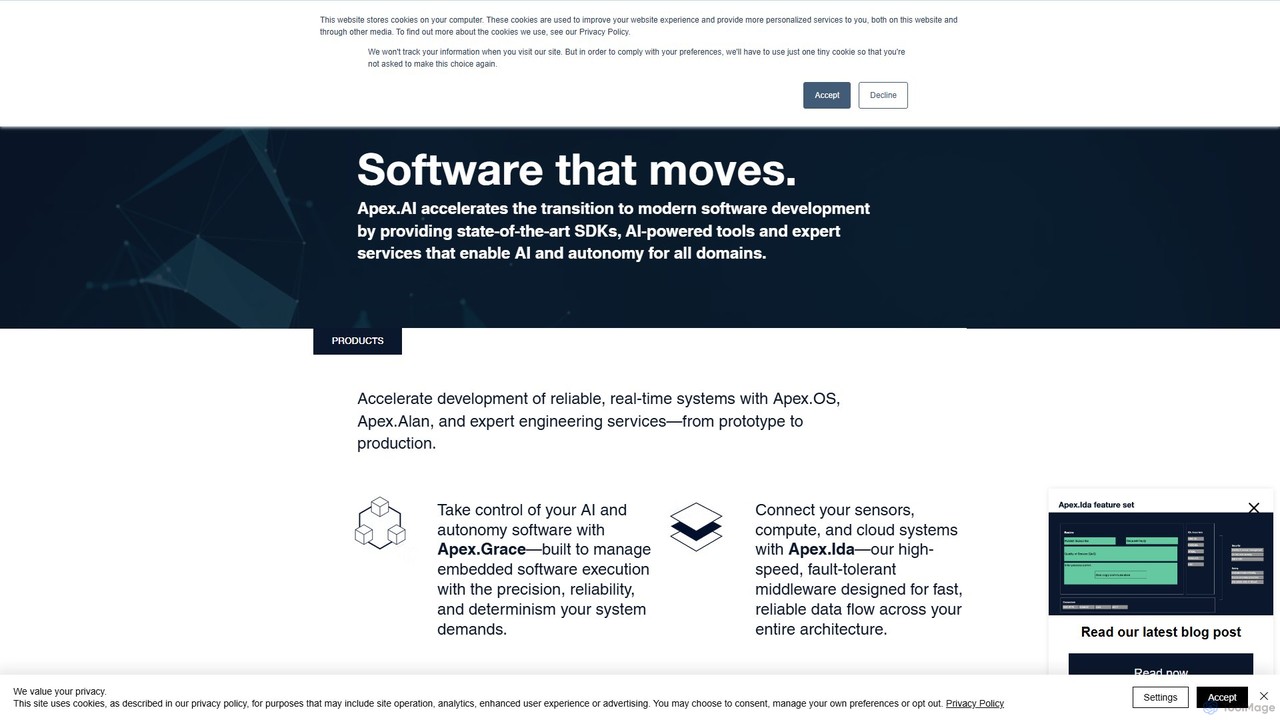
Apex.AI provides a comprehensive software development kit (SDK) and toolchain for building safe, certified, and reliable autonomous systems. Designed for automotive, robotics, and industrial applications, it accelerates development from prototype to production with a real-time OS, middleware, and automated testing tools based on open standards like ROS 2.
About Autonomous Systems
Autonomous Systems are a class of AI tools designed to operate independently and make complex decisions to achieve specific goals without direct human intervention. These systems leverage advanced algorithms for perception, planning, and execution, allowing them to adapt to dynamic and unpredictable environments. They are fundamental for creating self-managing applications, from automated financial trading to intelligent robotics, enabling true operational autonomy. As a specialized area within AI Infrastructure, they provide the core decision-making engine for applications that must react and optimize in real-time.
Core Features
- Goal-Oriented Decision Making: Autonomously formulates plans and executes actions to achieve high-level objectives.
- Environment Perception: Senses, interprets, and models its operational environment to inform its decisions.
- Real-time Adaptation: Adjusts its behavior and strategies in response to changing conditions or unforeseen events.
- Self-Learning and Optimization: Improves performance over time by analyzing outcomes and learning from experience.
- Multi-Agent Coordination: Enables multiple autonomous agents to communicate and collaborate on complex, distributed tasks.
Use Cases
Autonomous Systems are deployed in sectors requiring high-speed, complex decision-making. This includes finance for algorithmic trading, logistics for dynamic supply chain optimization, software development for autonomous coding agents, and cybersecurity for automated threat detection and response. They empower developers and businesses to build applications that can manage intricate processes with minimal human oversight.
How to Choose
When selecting an Autonomous System tool, consider the complexity of the decision-making required for your task. Evaluate its integration capabilities with your existing data sources and platforms. Assess the system's scalability to handle growing task volumes and its mechanisms for safety, control, and human oversight. Finally, consider the level of expertise needed to configure and maintain the system effectively.
Autonomous SystemsUse Cases
Develop an Autonomous Financial Trading Agent
A quantitative analyst aims to automate a complex trading strategy that operates 24/7. Using an autonomous systems platform, they define high-level goals like 'maximize profit while limiting risk to X%'. The agent independently monitors real-time market data, news feeds, and economic indicators. It uses its decision-making engine to identify trading opportunities, calculate optimal position sizes, and execute trades across multiple exchanges. The system continuously learns from trade outcomes, adapting its strategy to changing market volatility without requiring manual intervention, thus capturing opportunities that a human trader might miss.
Create an Autonomous Code Generation Agent
A software development team needs to accelerate the creation of boilerplate code and microservices. They provide an autonomous agent with a high-level specification, such as 'Create a REST API endpoint for user authentication with JWT'. The agent accesses the existing codebase for context, plans the required files and functions, writes the code in the appropriate language, and generates corresponding unit tests. It then attempts to build and run the tests. If errors occur, it autonomously debugs and refactors the code until all tests pass, significantly reducing development time for routine tasks.
Automate Complex Research and Reporting
A market research firm needs to produce in-depth reports on emerging technology trends. A researcher tasks an autonomous agent with the topic 'The impact of generative AI on e-commerce'. The agent formulates a research plan, scours academic journals, news articles, and financial reports, and identifies key data points and expert opinions. It then synthesizes this information, structures it into a coherent narrative, generates charts from the data, and produces a draft report. This allows the human researcher to focus on high-level analysis and interpretation rather than data collection and initial drafting.
Manage Dynamic Logistics and Supply Chains
A global logistics company faces constant disruptions from weather, traffic, and port delays. They deploy an autonomous system to manage their supply chain. The system continuously ingests data from GPS trackers, weather services, and carrier updates. When it detects a potential delay for a critical shipment, it autonomously evaluates alternative routes, carriers, and modes of transport. It calculates the cost and time implications of each option and automatically re-books the shipment on the optimal path to meet delivery deadlines, notifying all relevant stakeholders of the change.
Deploy an Autonomous Cybersecurity Defense System
A security operations center (SOC) is overwhelmed by the volume of security alerts. They implement an autonomous system for threat detection and response. The system monitors network traffic and endpoint behavior in real-time. Upon detecting anomalous activity indicative of a malware infection, it doesn't just create an alert. It autonomously quarantines the affected device from the network, analyzes the malware to identify its signature, and pushes a new rule to firewalls across the organization to block similar threats, all within seconds of the initial detection.
Orchestrate a Multi-Agent Marketing Campaign
A marketing team launches a multi-channel product campaign. They use an autonomous system composed of specialized agents. A 'Content Agent' generates blog posts and social media updates. A 'Social Media Agent' schedules posts, engages with comments, and monitors trends. An 'Ad Agent' manages PPC campaigns, adjusting bids and targeting based on real-time performance. A 'Coordination Agent' oversees the entire operation, ensuring consistent messaging and allocating budget to the best-performing channels, creating a self-optimizing campaign that adapts faster than a human team could.