ToolMage
Sign in

Best 1 Vector Database AI tools for Database

Popular Vector Database AI tools in Database include DeConsole, helping you work more efficiently.

DeConsole
Freemium

DeConsole

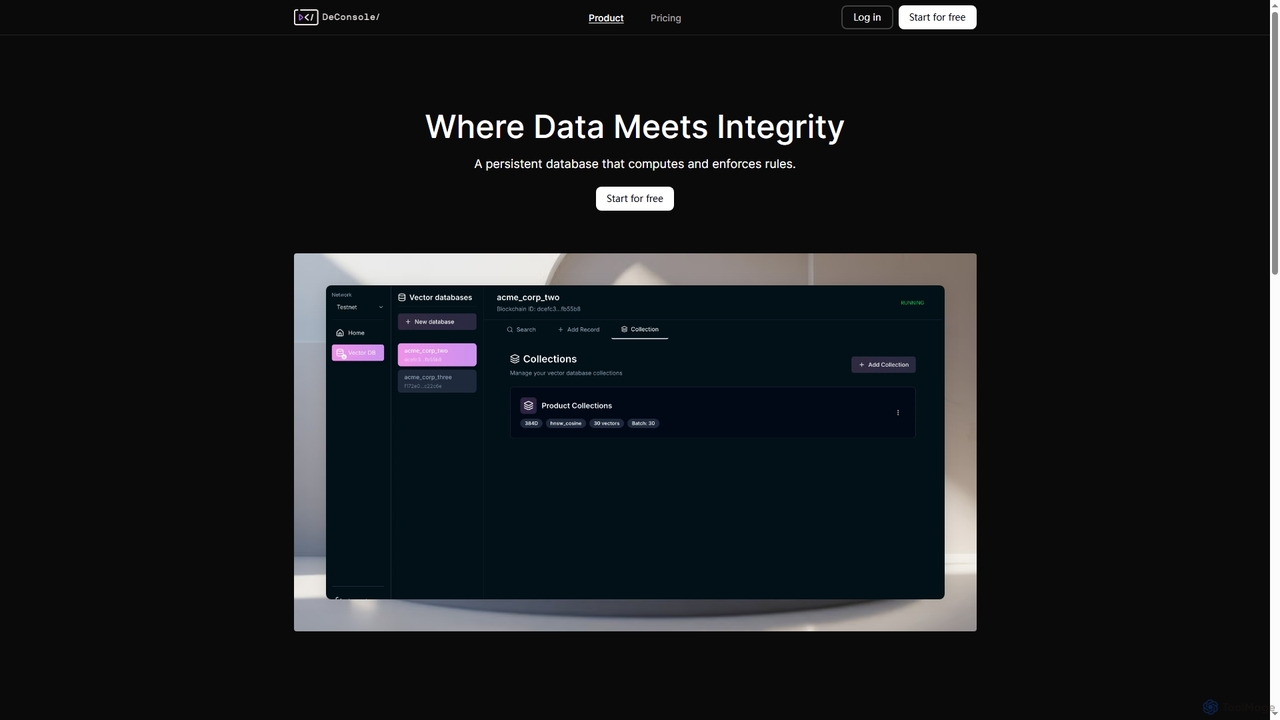
DeConsole is a distributed, persistent, and tamper-resistant database service designed for critical data, offering the simplicity of a cloud DBaaS without a single point of control. It computes and enforces rules, ensuring data integrity and providing a tamper-evident history for various applications, especially AI.

Rag Systems
Visits 6.4KFavorites 111Likes 117

About Vector Database

Vector databases are specialized data storage systems designed to efficiently store, index, and query high-dimensional vector embeddings. Unlike traditional databases that manage structured data, vector databases excel at handling unstructured data by representing it as numerical vectors, enabling fast similarity searches and semantic understanding. They are crucial for AI applications requiring real-time similarity matching, recommendation systems, and advanced search functionalities, providing the backbone for modern intelligent systems.

Core Features

  • Efficient Vector Indexing: Utilizes advanced algorithms (e.g., HNSW, IVF) to index high-dimensional vectors for rapid similarity search.
  • Similarity Search: Enables finding vectors most similar to a query vector based on distance metrics (e.g., cosine similarity, Euclidean distance).
  • Scalability: Designed to handle billions of vectors and high query throughput, often distributed across multiple nodes.
  • Metadata Filtering: Allows combining vector similarity search with traditional metadata filtering for more precise results.

Use Cases

Vector databases are essential in scenarios where semantic understanding and similarity are paramount. They power intelligent search engines that go beyond keyword matching, recommendation systems that suggest relevant items based on user preferences, and anomaly detection systems that identify unusual patterns in data streams.

How to Choose

When selecting a vector database, consider its indexing algorithms for performance, scalability for your data volume, supported similarity metrics, integration capabilities with existing AI frameworks, and cost-effectiveness. Evaluate its ability to handle metadata filtering and real-time updates for dynamic applications.

Vector Database use cases

1

Building Semantic Search Engines

Content platforms or e-commerce sites can use vector databases to power semantic search. Users input natural language queries, which are converted into vectors. The database then finds documents or products with semantically similar vectors, providing more relevant results than keyword-based search, even for nuanced queries.

2

Developing AI-Powered Recommendation Systems

Streaming services or online retailers leverage vector databases to recommend content or products. User interaction data (e.g., watched movies, purchased items) is embedded into vectors. By finding similar user or item vectors, the system can suggest highly personalized recommendations, enhancing user engagement and sales.

3

Implementing Real-time Anomaly Detection

Financial institutions or cybersecurity firms deploy vector databases for real-time anomaly detection. Network traffic logs or transaction data are converted into vectors. The database quickly identifies vectors that are significantly dissimilar to known normal patterns, flagging potential fraud or security breaches instantly.

4

Enhancing Generative AI Applications with RAG

Developers building large language model (LLM) applications use vector databases for Retrieval Augmented Generation (RAG). Relevant external knowledge (documents, articles) is stored as vectors. When an LLM receives a query, the vector database retrieves contextually similar information, allowing the LLM to generate more accurate and up-to-date responses.

5

Powering Image and Video Search

Media companies or digital asset management systems utilize vector databases for visual search. Images or video frames are embedded into vectors. Users can then query by example (uploading an image) or by text description, and the database returns visually or semantically similar media assets, streamlining content discovery.

6

Creating Intelligent Chatbots and Q&A Systems

Customer service departments or knowledge management platforms employ vector databases to build intelligent chatbots. Knowledge base articles or FAQs are vectorized. When a user asks a question, the chatbot queries the vector database to find the most semantically relevant answers, providing accurate and context-aware responses.

Vector Database FAQ

What is a Vector Database?

A vector database is a specialized database designed to store, index, and query high-dimensional vectors, which are numerical representations of data like text, images, or audio. Its primary function is to perform efficient similarity searches, finding vectors that are "close" to a given query vector based on various distance metrics. This capability is fundamental for AI applications that rely on understanding semantic relationships rather than exact matches.

How does a Vector Database differ from a Traditional Relational Database?

Traditional relational databases store structured data in tables with rows and columns, optimized for exact matches and transactional operations. Vector databases, conversely, are optimized for storing and querying unstructured data represented as high-dimensional vectors, focusing on similarity search. While relational databases use SQL for precise data retrieval, vector databases use vector similarity algorithms to find approximate nearest neighbors, making them suitable for semantic search and AI applications.

What are the key benefits of using a Vector Database?

The main benefits include enabling semantic search capabilities, powering advanced recommendation systems, facilitating real-time anomaly detection, and enhancing generative AI models through Retrieval Augmented Generation (RAG). They offer superior performance for similarity queries on large datasets, allowing AI applications to understand context and relationships in data more effectively than traditional methods.

What are common use cases for Vector Databases?

Vector databases are widely used in semantic search engines for websites and applications, personalized recommendation systems (e.g., e-commerce, streaming), fraud detection, cybersecurity threat analysis, image and video recognition, and powering intelligent chatbots or Q&A systems. They are also critical for augmenting large language models (LLMs) with external, up-to-date information.

How do Vector Databases handle scalability and performance?

Vector databases achieve scalability and performance through several techniques. They use approximate nearest neighbor (ANN) algorithms (like HNSW, IVF) to index vectors efficiently, allowing for fast searches even with billions of vectors. Many are designed for distributed architectures, enabling horizontal scaling across multiple nodes. They also optimize for high query throughput and low latency, often leveraging in-memory processing and specialized hardware.