
CompareLabs
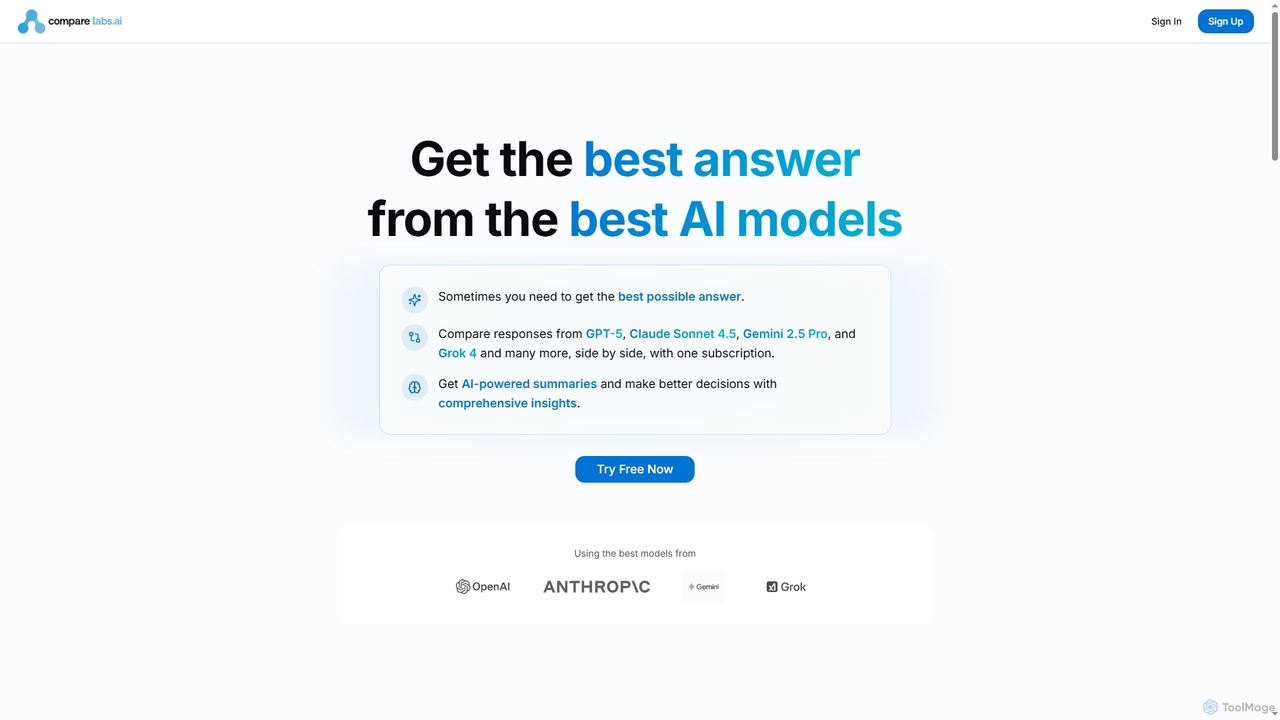
CompareLabs is an advanced AI platform that allows users to simultaneously query and compare responses from over 20 …
CompareLabs is an advanced AI platform that allows users to simultaneously query and compare responses from over 20 leading AI models, including GPT-5, Claude Sonnet 4.5, Gemini 2.5 Pro, and Grok 4. It synthesizes these diverse perspectives into a comprehensive "meta-answer," enabling users to get the best possible insights for complex research, creative writing, and problem-solving.
About Analysis
AI Analysis tools are a class of software that use machine learning and statistical models to examine large datasets and uncover insights. They automate the process of identifying patterns, correlations, and anomalies that are often invisible to human analysts. These tools are a critical component of data-driven decision-making, enabling businesses to understand past performance, predict future trends, and identify the root causes of complex problems. Their primary function is to transform raw data into actionable intelligence.
Core Features
- Data Integration: Connects and processes data from multiple sources like databases, APIs, and files.
- Predictive Forecasting: Utilizes historical data to build models that predict future outcomes and trends.
- Pattern Recognition: Automatically detects significant patterns, clusters, and outliers in complex datasets.
- Root Cause Analysis: Identifies the most likely factors contributing to a specific event or outcome.
- Natural Language Processing (NLP): Extracts insights from unstructured text data, such as customer reviews or reports.
Use Cases
These tools are widely used in marketing for customer segmentation, in finance for risk assessment and fraud detection, and in operations for supply chain optimization. For example, an e-commerce company can use an AI analysis tool to predict which customers are likely to churn based on their purchase history and website activity.
How to Choose
When selecting a tool, consider its data source compatibility and integration capabilities. Evaluate the complexity of its modeling features against your team's technical skills. Also, assess its visualization and reporting functions for clarity, and compare pricing models based on data volume or user seats.
AnalysisUse Cases
Predicting Customer Churn
A subscription-based service provider uses an AI analysis tool to monitor customer behavior. The tool integrates data from CRM, support tickets, and usage logs. It identifies patterns preceding cancellations, such as decreased activity or frequent support issues, and assigns a churn risk score to each user. This allows the retention team to proactively engage high-risk customers with targeted offers, reducing overall churn.
Analyzing Market Trends from Social Media
A consumer goods company's marketing team uses an AI analysis tool to monitor conversations across social media platforms. The tool applies sentiment analysis and topic modeling to millions of posts, identifying emerging consumer preferences and competitor strategies. This provides real-time market intelligence, guiding product development and campaign messaging without relying on slow, traditional market research.
Optimizing Inventory Management
A retail chain employs an AI analysis tool to forecast product demand. By analyzing historical sales data, seasonality, and external factors like holidays or weather events, the tool predicts demand for each item at each store location. This helps inventory managers optimize stock levels, minimizing both stockouts and overstock situations, leading to increased sales and reduced carrying costs.
Identifying Financial Anomalies for Fraud Detection
A financial institution integrates an AI analysis tool into its transaction processing system. The tool learns normal transaction patterns for each account and flags deviations in real-time. It can detect unusual spending locations, amounts, or frequencies that indicate potential fraud. This automated system significantly improves the speed and accuracy of fraud detection, protecting both the institution and its customers.
Evaluating Sales Funnel Performance
A B2B software company's sales team connects their CRM data to an AI analysis tool. The tool visualizes the entire sales funnel, identifying stages with the highest drop-off rates. It analyzes the characteristics of deals that successfully close versus those that are lost, providing insights into which lead sources, company sizes, or sales tactics are most effective. This helps sales managers refine their strategy and training.
Performing Root Cause Analysis in Manufacturing
A manufacturing plant uses an AI analysis tool to investigate production line defects. The tool processes data from sensors, quality control checks, and machine logs. It identifies correlations between specific machine settings, material batches, and defect rates. This allows engineers to pinpoint the root cause of quality issues quickly, reducing waste and improving overall product quality without extensive manual investigation.