Ai Assistant Best in category 1 results Large Language Models AI Tool

Popular AI tools in the Large Language Models field of Ai Assistant include CompareLabs, etc., helping you quickly improve efficiency.

CompareLabs

CompareLabs

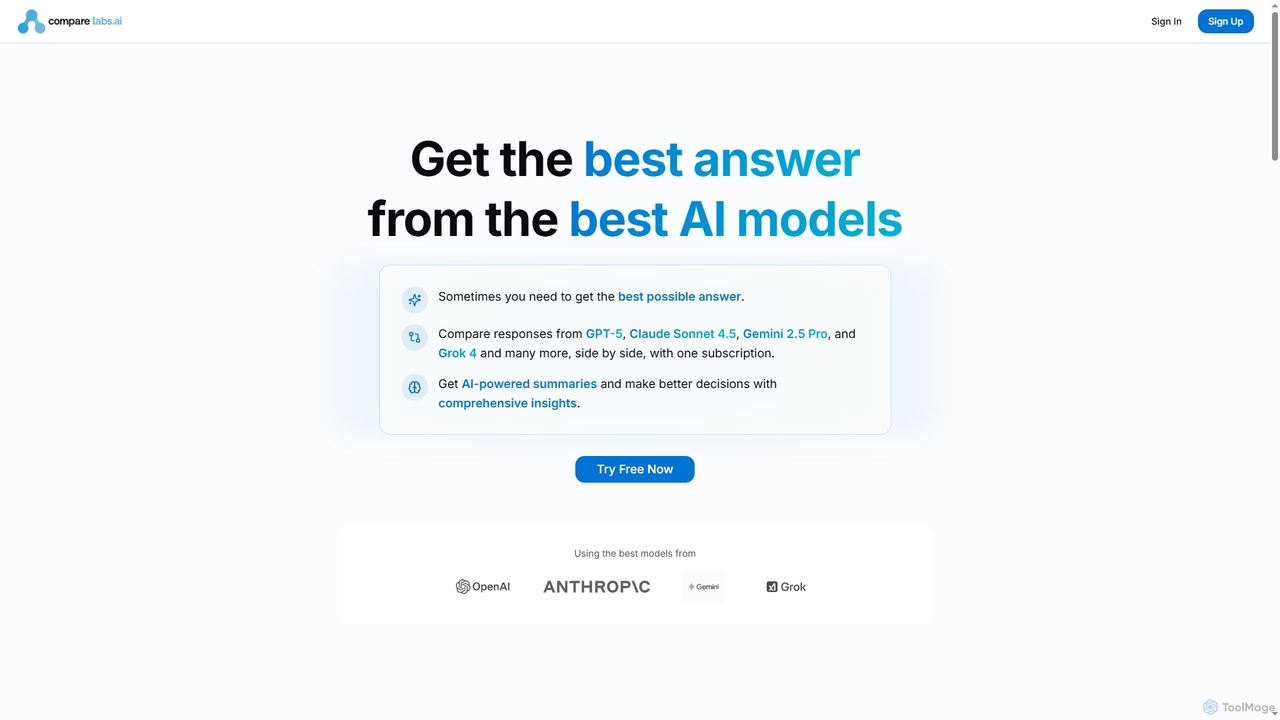
CompareLabs is an advanced AI platform that allows users to simultaneously query and compare responses from over 20 …

6.6K

About Large Language Models

Large Language Models (LLMs) are a class of artificial intelligence models trained on massive datasets to understand, generate, and process human-like text. They utilize complex neural network architectures, such as transformers, to recognize patterns, context, and semantic relationships in language. This capability allows them to perform a wide array of sophisticated tasks, from writing articles and generating code to answering complex questions, forming the core engine for many advanced AI assistants and applications.

Core Features

  • Text Generation: Creates coherent and contextually relevant text, from short sentences to long-form articles, based on a given prompt.
  • Natural Language Understanding (NLU): Interprets and comprehends the intent, sentiment, and entities within human language queries.
  • Code Generation: Writes functional code snippets in various programming languages based on natural language descriptions.
  • Text Summarization: Condenses long documents, articles, or conversations into concise and accurate summaries.
  • Few-Shot Learning: Adapts to new tasks with only a few examples, without requiring extensive retraining.

Use Cases

LLMs are primarily used by developers, data scientists, and researchers who need to build custom applications or integrate advanced language capabilities. They are foundational for creating specialized chatbots, content automation systems, internal knowledge base search engines, and data analysis tools. Businesses leverage them via APIs to power customer service bots, automate marketing copy, and analyze user feedback at scale.

How to Choose

When selecting a Large Language Model, consider the model's performance on specific benchmarks relevant to your task (e.g., coding, reasoning, writing). Evaluate the API's reliability, latency, and documentation quality. Analyze the pricing model, which is often based on token usage (input and output). Also, consider the availability of fine-tuning options to adapt the model to your specific data and the provider's commitment to data privacy and security.

Large Language ModelsUse Cases

1

Develop Custom AI-Powered Applications

A software developer uses an LLM's API to build a new application, such as a smart email client that automatically drafts replies or a research tool that summarizes academic papers. By integrating the LLM, the developer avoids building a complex language processing system from scratch. They can focus on the user interface and unique features of their app, while the LLM handles tasks like text generation, classification, and summarization, significantly accelerating the development cycle.

2

Automate Content Creation Workflows

A content marketing agency integrates an LLM into its workflow to scale content production. Marketers provide the model with a topic, keywords, and a desired tone to generate initial drafts for blog posts, social media updates, and product descriptions. This allows the human writers to focus on editing, refining, and adding strategic insights rather than starting from a blank page. The result is a significant increase in content output and consistency across different channels.

3

Perform Large-Scale Data Analysis and Extraction

A data scientist is tasked with analyzing thousands of customer reviews to identify common themes and sentiment. Instead of manual reading, they use an LLM to process the entire dataset. The model can perform sentiment analysis, classify reviews into categories (e.g., 'pricing', 'customer service'), and extract key phrases. This approach provides structured, actionable insights in a fraction of the time it would take manually, enabling the company to quickly respond to customer feedback.

4

Enhance Internal Knowledge Management

A large corporation uses an LLM to build a sophisticated search engine for its internal knowledge base, which includes thousands of documents, reports, and policy manuals. Employees can ask questions in natural language, such as "What is our policy on remote work for international staff?" The LLM understands the query, searches relevant documents, and synthesizes a direct, accurate answer, often citing the source documents. This replaces cumbersome keyword searches and helps employees find information instantly.

5

Accelerate Software Development with Code Generation

A programmer is working on a complex algorithm and needs a specific function written in Python. Instead of writing it from scratch, they describe the function's requirements to an LLM, such as "Write a Python function that takes a list of URLs and asynchronously checks their status codes." The model generates the complete, functional code snippet, including error handling and comments. This allows the programmer to focus on higher-level logic and architecture, significantly boosting productivity.

6

Create Personalized Educational Content

An e-learning platform uses an LLM to create adaptive learning materials. When a student struggles with a concept, like calculus, the system uses the LLM to generate personalized explanations, practice problems, and analogies tailored to the student's learning style and knowledge gaps. The model can rephrase complex definitions in simpler terms or create new quiz questions on the fly. This provides a dynamic and individualized learning experience that is difficult to achieve with static content.

Large Language ModelsFrequently Asked Questions