
Airlight
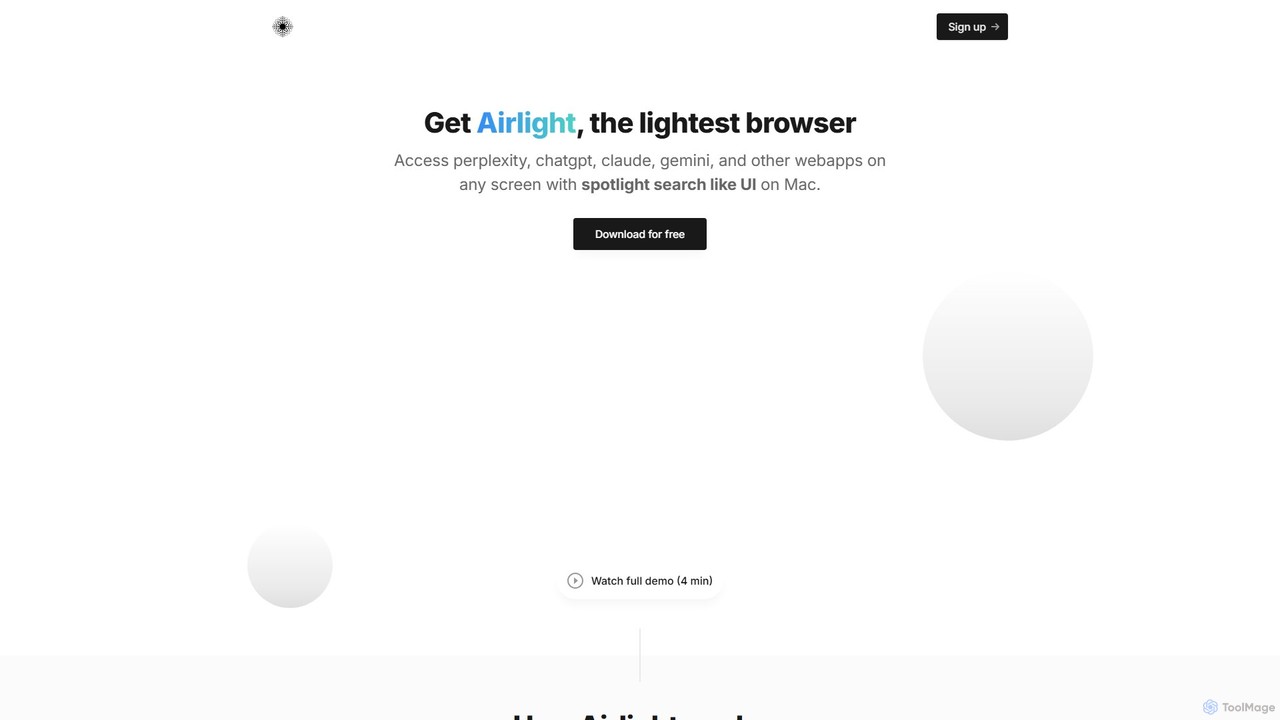
Airlight is a lightweight "superbrowser" for macOS that provides instant access to web apps like ChatGPT, Perplexity, and …
Airlight is a lightweight "superbrowser" for macOS that provides instant access to web apps like ChatGPT, Perplexity, and Claude via a Spotlight-like interface. Activated by a simple shortcut (option + space), it overlays on any screen, eliminating the need for constant tab switching and boosting productivity for developers, writers, and researchers.
About Chat
Chat AI tools are AI-powered applications designed for natural language interaction, enabling real-time conversations with users. Leveraging advanced natural language processing (NLP) and machine learning, they simulate human-like dialogue to provide information, automate tasks, and offer support. These tools enhance user engagement and streamline communication across various platforms, acting as intelligent conversational interfaces within the broader AI Assistant ecosystem.
Core Features
- Natural Language Understanding (NLU): Accurately interprets user intent and context from diverse linguistic inputs.
- Contextual Memory: Maintains conversation history to provide coherent and relevant responses over time.
- Automated Response Generation: Generates human-like text responses based on learned patterns and knowledge bases.
- Multi-channel Integration: Seamlessly deploys across websites, messaging apps, and voice platforms.
- Task Automation: Executes predefined actions like booking appointments or retrieving data through conversation.
Use Cases
Chat AI tools are indispensable for businesses seeking to automate customer support, provide instant information, or personalize user experiences. They are widely adopted in e-commerce for sales assistance, in healthcare for patient inquiries, and in education for learning support.
How to Choose
When selecting a Chat AI tool, consider its NLU capabilities for understanding complex queries, the ease of integration with existing systems, scalability to handle varying user loads, and the level of customization available for branding and specific use cases. Evaluate the accuracy of its response generation and its ability to learn from interactions.
ChatUse Cases
Automating Customer Support
For e-commerce businesses, Chat AI tools can handle routine customer inquiries 24/7, such as order status checks, product information, and FAQ answers. This reduces the workload on human agents, provides instant responses to customers, and improves overall satisfaction by resolving common issues quickly without human intervention.
Personalized Sales Assistance
Retailers can deploy Chat AI to guide shoppers through product catalogs, recommend items based on preferences, and answer specific questions about features or availability. This creates a personalized shopping experience, boosts conversion rates, and helps customers find exactly what they need efficiently.
Internal Employee Support
Large organizations use Chat AI as an internal helpdesk for employees, answering questions about HR policies, IT issues, or company procedures. This streamlines internal communication, provides immediate access to information, and frees up support staff for more complex tasks.
Lead Generation and Qualification
Marketing teams can leverage Chat AI on websites to engage visitors, ask qualifying questions, and capture contact information. The AI can then route qualified leads to sales teams, improving the efficiency of the lead generation process and ensuring sales efforts are focused on promising prospects.
Educational Tutoring and Q&A
Educational platforms can integrate Chat AI to provide instant answers to student questions, explain complex concepts, or offer practice exercises. This offers personalized learning support, makes educational content more accessible, and helps students grasp subjects at their own pace.
Healthcare Information and Appointment Booking
Healthcare providers can use Chat AI to answer common patient questions about symptoms, clinic hours, or insurance, and to facilitate appointment scheduling. This improves patient access to information, reduces administrative burden, and enhances the overall patient experience.