ToolMage
Sign in

Best 1 Personal Guidance AI tools for Decision Making

Popular Personal Guidance AI tools in Decision Making include Decider AI, helping you work more efficiently.

Decider AI

Decider AI

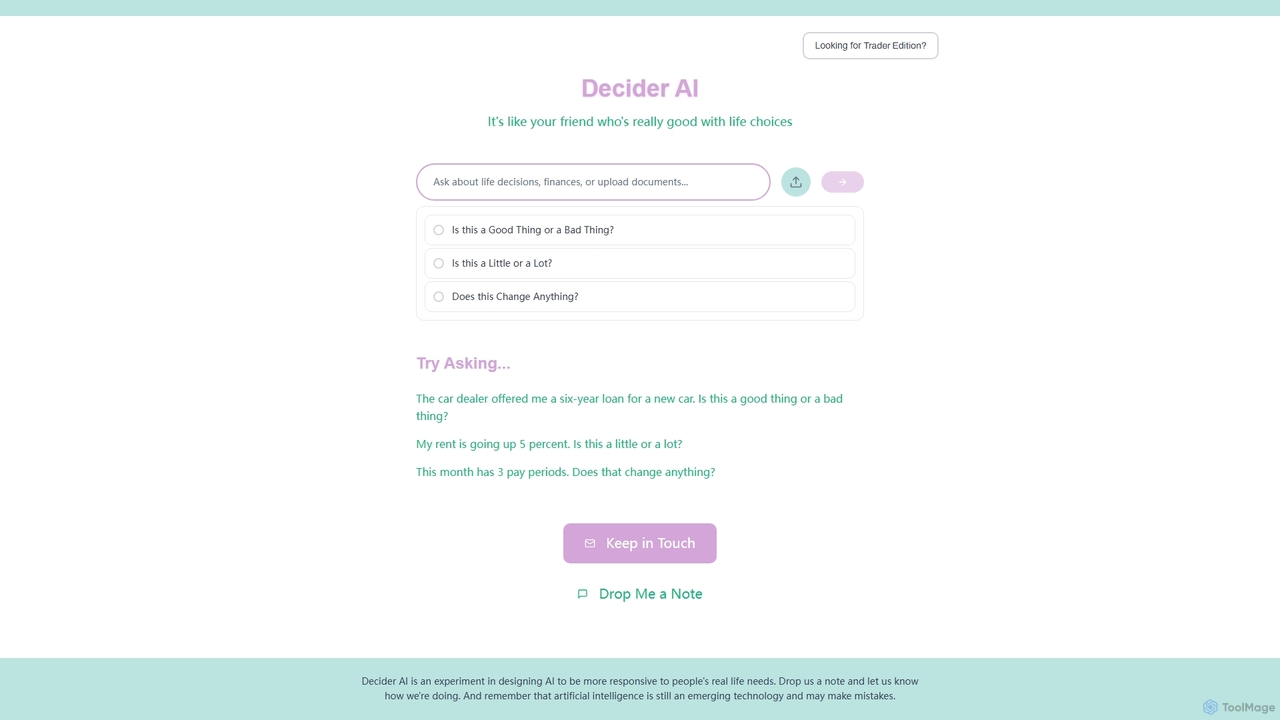
Decider AI is an experimental AI tool designed to assist individuals with everyday life choices by offering quick perspectives on dilemmas. It acts as a digital friend, helping users evaluate situations like "Is this a Good Thing or a Bad Thing?" or "Does this Change Anything?" to aid personal decision-making.

Personal Guidance
Visits 5.5KFavorites 128Likes 157

About Personal Guidance

Personal Guidance tools are AI-powered platforms designed to offer tailored advice, recommendations, and support to individuals across various aspects of their lives. As a specialized subset of decision-making tools, they leverage advanced AI algorithms, including natural language processing and machine learning, to analyze user data, preferences, and goals. These tools provide personalized insights, coaching, and actionable strategies, empowering users to make informed decisions, achieve personal growth, and navigate complex challenges more effectively.

Core Features

  • Personalized Recommendations: Delivers customized advice on career paths, learning resources, wellness routines, or financial planning based on individual profiles.
  • Goal Setting & Tracking: Assists users in defining specific, measurable goals and monitors progress, offering nudges and adjustments as needed.
  • Emotional & Mental Wellness Support: Provides AI-driven conversational support, stress management techniques, and mindfulness exercises.
  • Skill Development Plans: Generates structured learning paths and resource suggestions to help users acquire new skills or improve existing ones.
  • Decision Support Frameworks: Guides users through complex choices by outlining pros and cons, potential outcomes, and relevant data points.

Applicable Scenarios

Individuals seeking structured support for personal development, career transitions, or lifestyle improvements frequently utilize AI personal guidance tools. This includes professionals looking to upskill, students planning their academic future, or anyone aiming to enhance their well-being. These tools are particularly valuable for self-starters who benefit from objective, data-driven insights and consistent virtual coaching.

How to Choose

When selecting an AI personal guidance tool, consider its specialization (e.g., career, wellness, finance), the depth of its AI analysis, and its customization options. Evaluate the data privacy policies and how user information is handled. Look for tools that offer clear methodologies, integrate with other personal productivity apps, and provide transparent explanations for their recommendations, ensuring alignment with your personal values and goals.

Personal Guidance use cases

1

Career Path Planning

An individual seeking a career change uses an AI guidance tool to analyze their skills, interests, and market trends, receiving personalized recommendations for upskilling courses and potential job roles. This helps them make informed decisions about their professional future, saving time on research and identifying optimal growth opportunities.

2

Receiving Personalized Career Path Recommendations

A young professional feeling stuck in their career uses an AI personal guidance tool to analyze their skills, interests, and market trends. The tool provides tailored suggestions for new roles, required training, and networking opportunities, helping them make informed decisions about their next career move and fostering professional growth.

3

Developing a Customized Fitness and Wellness Plan

An individual aiming to improve their health inputs their current activity levels, dietary preferences, and wellness goals. The AI guidance system generates a personalized workout schedule, meal plan, and mindfulness exercises, adapting to their progress and providing motivational support to help them achieve their health objectives.

4

Financial Goal Setting

A young professional utilizes an AI financial advisor to set realistic savings goals, create a personalized budget, and receive investment recommendations tailored to their risk tolerance and income. The tool provides continuous monitoring and adjustments, ensuring the user stays on track towards their financial aspirations.

5

Optimizing Personal Financial Planning and Budgeting

Someone struggling with managing their finances connects their accounts to an AI personal guidance platform. The tool analyzes spending habits, identifies areas for savings, and suggests personalized investment strategies or debt reduction plans, guiding them towards financial stability and helping them make smarter money decisions.

6

Personalized Learning Journey

A lifelong learner employs an AI mentor to identify knowledge gaps in a new field, curating a customized curriculum of online courses, articles, and practice exercises to accelerate their learning. The AI adapts the content based on the user's progress and learning style, optimizing their educational experience.

7

Enhancing Learning and Skill Acquisition

A student or professional wanting to learn a new language or acquire a specific technical skill utilizes an AI guidance tool. The tool assesses their current proficiency, recommends tailored learning resources, sets study schedules, and tracks progress, providing feedback to optimize their learning journey and accelerate skill development.

8

Wellness & Habit Coaching

Someone aiming for a healthier lifestyle uses an AI wellness coach to track diet and exercise, receiving daily personalized tips, meal plans, and workout routines based on their progress and preferences. This consistent, data-driven guidance helps users build sustainable healthy habits and achieve their fitness goals.

9

Entrepreneurial Strategy Development

A startup founder consults an AI business guide to refine their business model, identify target markets, and develop a go-to-market strategy, benefiting from data-driven insights and competitive analysis. The AI helps them make critical strategic decisions, optimizing their chances of success in a dynamic market.

10

Navigating Complex Life Decisions with Objective Advice

An individual facing a significant life choice, such as relocating or changing lifestyles, uses the AI tool to explore potential outcomes. The tool helps articulate priorities, weigh pros and cons based on their values, and provides a structured framework for evaluating options, reducing decision-making stress and fostering clarity.

11

Skill Development & Mentorship

A mid-career professional uses an AI tool to identify critical skills for promotion, receiving tailored learning resources and virtual mentorship sessions to develop leadership or technical competencies. The AI provides structured guidance and feedback, accelerating their professional growth and readiness for new roles.

12

Managing Stress and Improving Mental Well-being

Someone experiencing daily stress or anxiety engages with an AI personal guidance tool focused on mental wellness. The tool offers guided meditation sessions, journaling prompts, cognitive behavioral therapy (CBT) inspired exercises, and provides a safe space for reflection, helping them develop coping mechanisms and improve overall mental resilience.

Personal Guidance FAQ

What are Personal Guidance AI tools?

Personal Guidance AI tools are applications that leverage artificial intelligence to provide individualized advice, recommendations, and support to users. They analyze personal data, goals, and preferences to offer tailored insights, acting as virtual coaches or mentors. These tools aim to empower users in making informed decisions across various life domains, from career and finance to health and personal development.

What are AI Personal Guidance tools?

AI Personal Guidance tools are intelligent platforms that leverage artificial intelligence to provide individualized advice, coaching, and support across various life domains. They analyze user data, goals, and preferences to offer tailored recommendations, helping individuals make better decisions, achieve personal growth, and improve their well-being. These tools act as virtual mentors, offering objective insights and structured guidance.

How do AI Personal Guidance tools differ from traditional human coaching?

AI Personal Guidance tools offer scalable, always-available, and data-driven insights, often at a lower cost than traditional human coaching. While human coaches provide empathy, nuanced understanding, and real-time emotional connection, AI tools excel in processing vast amounts of data, identifying patterns, and delivering consistent, objective recommendations. Many users find AI tools a valuable complement or an accessible entry point to personal development, especially for structured goal setting and data analysis.

How do Personal Guidance AI tools differ from general Decision Making tools?

While both assist in choices, Personal Guidance AI tools focus on individualized, context-aware advice for personal growth and specific life areas. General Decision Making tools often provide broader analytical frameworks, data visualization, or predictive modeling for complex organizational or strategic choices, rather than one-on-one tailored recommendations for an individual's unique circumstances.

What are the key benefits of using AI for personal guidance?

The main benefits include access to unbiased, data-driven advice 24/7, highly personalized recommendations that adapt over time, and the ability to process vast amounts of information to identify optimal paths. These tools can democratize access to expert-level guidance, making it more affordable and accessible than traditional human coaching or consulting.

What specific areas can AI Personal Guidance assist with?

AI Personal Guidance tools can assist with a wide range of areas, including career development (e.g., skill gaps, job search strategies), personal finance (e.g., budgeting, investment advice), health and wellness (e.g., fitness plans, stress management), learning and skill acquisition (e.g., personalized curricula), and general life decision-making. Their versatility allows them to adapt to diverse individual needs and goals, providing targeted support.

How do AI Personal Guidance tools ensure the advice is truly personalized?

AI Personal Guidance tools ensure personalization by collecting and analyzing various data points, such as user input (goals, preferences), historical behavior, progress tracking, and sometimes even biometric data or external integrations. Using machine learning algorithms, they continuously refine their understanding of the individual, adapting recommendations and strategies over time to remain relevant and effective. This iterative process allows for highly customized and evolving guidance.

What should I consider when choosing a Personal Guidance AI tool?

When selecting a tool, evaluate its domain specialization (e.g., career, finance, wellness), the level of personalization it offers, and its data privacy policies. Look for tools with transparent AI models, a user-friendly interface, and the ability to integrate with other platforms you use. Also, consider the accuracy of its recommendations and the quality of its underlying knowledge base.

Can Personal Guidance AI tools replace human mentors or coaches?

Personal Guidance AI tools are powerful complements to human mentors or coaches, but they are not direct replacements. While AI can provide data-driven insights, personalized plans, and consistent support, human mentors offer empathy, nuanced understanding of complex emotional situations, and the ability to build deep personal relationships that AI currently cannot replicate. They work best in synergy.

What should I consider regarding data privacy when using AI Personal Guidance?

Data privacy is a critical consideration for AI Personal Guidance tools, as they often handle sensitive personal information. Users should carefully review the tool's privacy policy to understand how their data is collected, stored, used, and shared. Look for platforms that employ robust encryption, adhere to data protection regulations (like GDPR), and offer clear controls over your personal information. Prioritize tools from reputable providers with a strong commitment to user privacy.