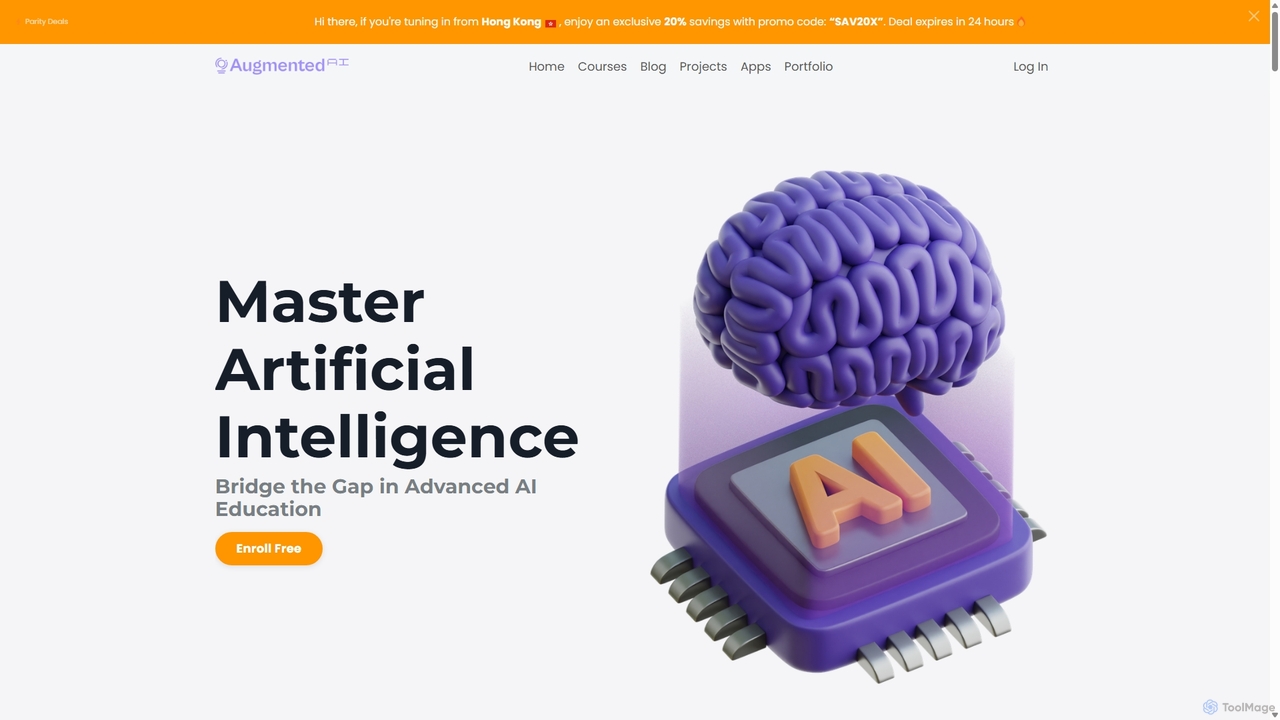
Augmented Startups
Augmented Startups is an online AI university offering practical, project-based courses for all skill levels. It specializes in …
Augmented Startups is an online AI university offering practical, project-based courses for all skill levels. It specializes in advanced topics like Computer Vision, Large Language Models (LLMs), Robotics, and Autonomous Vehicles. The platform provides comprehensive learning paths with code, datasets, and expert support to help students and professionals build real-world AI applications and bridge the gap between theory and practical implementation.

aionlinecourse
An interactive online learning platform offering free, hands-on AI projects, in-depth tutorials, and comprehensive resources. It covers Machine …
An interactive online learning platform offering free, hands-on AI projects, in-depth tutorials, and comprehensive resources. It covers Machine Learning, Generative AI, NLP, and Computer Vision, designed for learners of all levels, from beginners to experienced professionals, to build practical, industry-relevant skills.
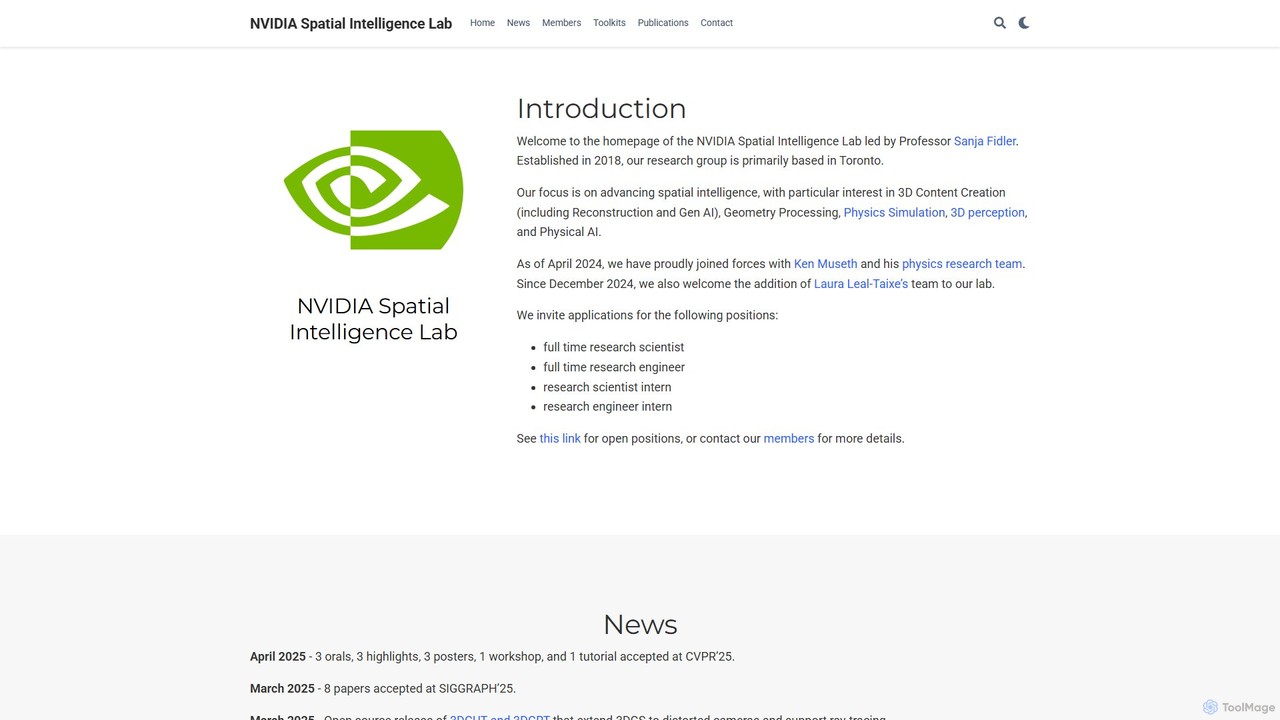
nv_tlabs
nv_tlabs is NVIDIA's research hub, showcasing a portfolio of cutting-edge AI projects. It provides access to pioneering research …
nv_tlabs is NVIDIA's research hub, showcasing a portfolio of cutting-edge AI projects. It provides access to pioneering research papers, interactive demos, and open-source code in fields like generative AI, computer vision, and neural graphics, targeting researchers and developers.
agpallav
A curated portfolio by developer Pallav Agarwal, showcasing a diverse collection of innovative AI-powered applications, open-source projects, and …
A curated portfolio by developer Pallav Agarwal, showcasing a diverse collection of innovative AI-powered applications, open-source projects, and creative web tools. Explore projects utilizing GPT-4o, Claude, Gemini, and more, ranging from AI chat clients and games to advanced developer resources.
About Code Libraries
AI Code Libraries are collections of pre-written, reusable code that enable developers to integrate complex AI and machine learning functionalities into their applications. These libraries provide high-level APIs that abstract away the intricate mathematics and algorithms behind tasks like natural language processing, computer vision, or predictive modeling. By using these libraries, developers can significantly accelerate the development process, build more sophisticated features, and leverage optimized performance without needing to be deep experts in AI theory. They form the foundational building blocks for creating custom AI-powered software.
Core Features
- Pre-trained Models: Offers access to models that are already trained on large datasets for common tasks like image classification or text sentiment analysis.
- High-Level APIs: Provides simplified functions and classes that make it easier to define, train, and deploy machine learning models.
- Performance Optimization: Includes built-in support for hardware acceleration (GPUs/TPUs) to speed up model training and inference.
- Data Handling Utilities: Contains tools for efficiently loading, transforming, and processing large datasets required for AI tasks.
- Extensible Architecture: Allows developers to customize existing components or build new ones to suit specific project needs.
Use Cases
AI Code Libraries are primarily used by software developers, data scientists, and machine learning engineers. They are essential for building custom AI applications, prototyping new algorithms in research, and adding intelligent features to existing software products across industries like tech, finance, healthcare, and e-commerce.
How to Choose
When selecting an AI Code Library, consider the programming language of your project (e.g., Python, C++, JavaScript). Evaluate the library's specific strengths—some excel at computer vision (OpenCV), while others focus on general deep learning (TensorFlow, PyTorch). Also, assess the quality of documentation, community support, and the availability of pre-trained models in its ecosystem.
Code LibrariesUse Cases
Building a Custom Image Classifier App
A mobile developer aims to create an application that identifies plant species from user-submitted photos. Instead of building a complex neural network from scratch, they use a computer vision library like TensorFlow Lite. The developer utilizes the library's tools to load a pre-trained image classification model, fine-tune it on a custom dataset of plant images for higher accuracy, and then package the optimized model within the mobile app. This allows for fast, on-device inference without requiring an internet connection, significantly reducing development time from months to weeks.
Developing a Chatbot with Natural Language Processing
A backend developer is tasked with creating an intelligent customer service chatbot. They integrate a Natural Language Processing (NLP) library like Hugging Face Transformers into their system. This library provides pre-trained models for understanding language context, sentiment, and user intent. The developer uses the library's API to process incoming user messages, identify key entities (like product names or order numbers), and route the query to the appropriate response logic. This approach avoids the immense complexity of building and training language models, enabling the rapid deployment of a capable chatbot.
Implementing a Product Recommendation Engine
A data scientist at an e-commerce company needs to build a system that suggests relevant products to users. They use a machine learning library like Scikit-learn, which offers a wide range of algorithms for tasks like this. The scientist uses the library's functions to preprocess user purchase history data, then applies a collaborative filtering algorithm (like Singular Value Decomposition) to find patterns. The library's streamlined workflow allows them to experiment with different algorithms and parameters efficiently, leading to a more accurate recommendation model that can be integrated into the website to boost sales and user engagement.
Automating Data Extraction from Documents
An enterprise developer needs to automate the process of extracting information from thousands of PDF invoices. They use a library that combines Optical Character Recognition (OCR) and NLP, such as spaCy with an OCR component. The developer writes a script that first uses the OCR functionality to convert the scanned invoice images into machine-readable text. Then, they leverage the library's NLP capabilities, specifically Named Entity Recognition (NER), to identify and extract key fields like 'Invoice Number', 'Total Amount', and 'Due Date'. This automates a previously manual and error-prone task, saving hundreds of hours of labor.
Accelerating Scientific Research with Machine Learning
A computational biologist is analyzing genomic data to find patterns related to a specific disease. The dataset is massive and complex. They use a scientific computing library like SciPy combined with a deep learning library like PyTorch. PyTorch provides flexible tools for building custom neural network architectures and leverages GPU acceleration for high-speed computation. The researcher can quickly prototype, train, and evaluate different models to analyze DNA sequences, significantly speeding up a research cycle that would be impractically slow using traditional statistical methods alone.
Creating Generative Art with Deep Learning
A creative technologist wants to generate unique visual art using AI. They choose a flexible deep learning library like JAX or PyTorch to build a Generative Adversarial Network (GAN). These libraries provide the low-level control needed to define custom network layers and loss functions, which is crucial for artistic experimentation. The technologist trains the GAN on a dataset of classical paintings. The library's automatic differentiation and GPU support handle the intensive computation, allowing the artist to focus on iterating the model's architecture to produce novel and aesthetically pleasing images in a specific style.