Research Best in category 2 results Ai Labs AI Tool

Popular AI tools in the Ai Labs field of Research include Nous Research、nv_tlabs, etc., helping you quickly improve efficiency.

Nous Research

Nous Research

Nous Research is an AI research organization dedicated to developing open-source, human-centric language models. They focus on democratizing …

3.9M
Free
nv_tlabs

nv_tlabs

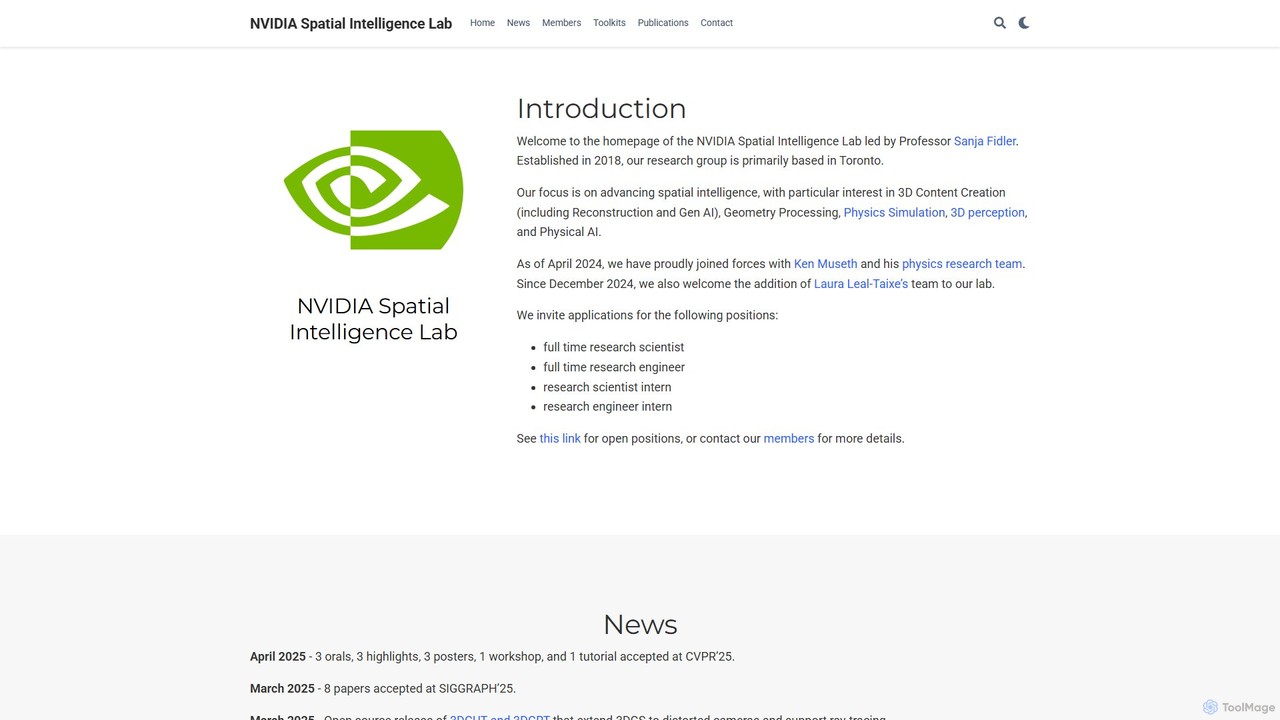
nv_tlabs is NVIDIA's research hub, showcasing a portfolio of cutting-edge AI projects. It provides access to pioneering research …

5.5K

About Ai Labs

AI Labs are integrated platforms designed to manage the entire lifecycle of machine learning and AI research projects. These tools provide a unified environment that combines code development, data management, experiment tracking, and model deployment. Their primary value lies in streamlining the complex workflow from initial hypothesis to a production-ready model, enhancing collaboration and reproducibility. AI Labs centralize resources, making it easier for teams to build, train, and monitor models at scale.

Core Features

  • Experiment Tracking: Log and compare parameters, metrics, and artifacts from different model training runs.
  • Compute Resource Management: Allocate and manage access to computational resources like GPUs and TPUs for model training.
  • Integrated Notebooks & IDEs: Provide web-based environments like JupyterLab for interactive coding and data exploration.
  • Model Registry: A centralized repository to version, store, and manage trained machine learning models.
  • Collaboration Tools: Features for sharing projects, code, and results among team members to facilitate joint research.

Use Cases

AI Labs are essential for academic research institutions, corporate R&D departments, and data science teams. They are used for developing novel algorithms, building custom AI solutions for business problems like fraud detection or customer churn prediction, and managing the MLOps pipeline for continuous model improvement.

How to Choose

When selecting an AI Lab, consider its integration with your existing cloud infrastructure (AWS, GCP, Azure), support for key machine learning frameworks (TensorFlow, PyTorch), scalability for large datasets and distributed training, collaboration features for your team size, and the pricing model (e.g., per-user vs. compute usage).


Ai LabsUse Cases

1

Academic Research and Experimentation

A university research group uses an AI Lab platform to develop a new computer vision model. Researchers can launch multiple training jobs in parallel on managed GPU clusters, with all hyperparameters and performance metrics automatically logged. This allows them to easily compare different architectures, track progress, and ensure their results are reproducible for publication. The platform's shared workspace facilitates collaboration between students and professors, streamlining the peer review process within the team.

2

Corporate AI Model Prototyping

A data science team at a financial services company is tasked with building a fraud detection model. Using an AI Lab, they can securely access and version large, sensitive datasets. The integrated notebook environment allows for rapid prototyping and feature engineering. Team members can share their notebooks and experiment results for review, and the model registry is used to store the best-performing models, creating a clear audit trail for compliance purposes before deploying the model into a production environment.

3

Managing MLOps Pipelines

An MLOps engineer uses an AI Lab to automate the end-to-end machine learning lifecycle. They build a pipeline that automatically retrains a natural language processing (NLP) model whenever new data becomes available. The platform's API is used to trigger training jobs, evaluate model performance, and promote the new model to the registry if it outperforms the current one. This automates the continuous integration and continuous deployment (CI/CD) process for machine learning, ensuring the production model is always up-to-date.

4

Fine-tuning Large Language Models (LLMs)

A startup aims to create a specialized chatbot for the legal industry. They use an AI Lab to fine-tune a pre-trained large language model (LLM) on a proprietary dataset of legal documents. The platform provides access to high-memory GPU instances required for this task. The experiment tracking feature is critical for logging different fine-tuning strategies and comparing the resulting model's performance on legal-specific benchmarks, ultimately helping them build a highly accurate and domain-specific AI assistant.

5

Comparative Model Benchmarking

A machine learning team needs to select the best algorithm for a time-series forecasting problem. Within their AI Lab, they implement several different models, such as ARIMA, Prophet, and a custom LSTM network. They run all models against the same dataset and use the platform's dashboard to visualize and compare key metrics like Mean Absolute Error (MAE) and Root Mean Square Error (RMSE). This side-by-side comparison provides clear, data-driven evidence to justify their final model selection to stakeholders.

6

Collaborative Data Science Projects

A distributed team of data scientists works on a customer segmentation project. The AI Lab serves as their central hub. They use its data versioning capabilities to ensure everyone is working with the same data. Team members can comment on each other's code within the platform's notebooks and share visualizations and findings easily. The project manager can track the progress of each experiment and see the overall project status on a central dashboard, improving communication and coordination for the remote team.

Ai LabsFrequently Asked Questions