ToolMage
Sign in

Best 3 Academic Research AI tools for Research

Popular Academic Research AI tools in Research include ResearchGPT, System Pro, and HallucinationBuster, helping you work more efficiently.

HallucinationBuster
Freemium

HallucinationBuster

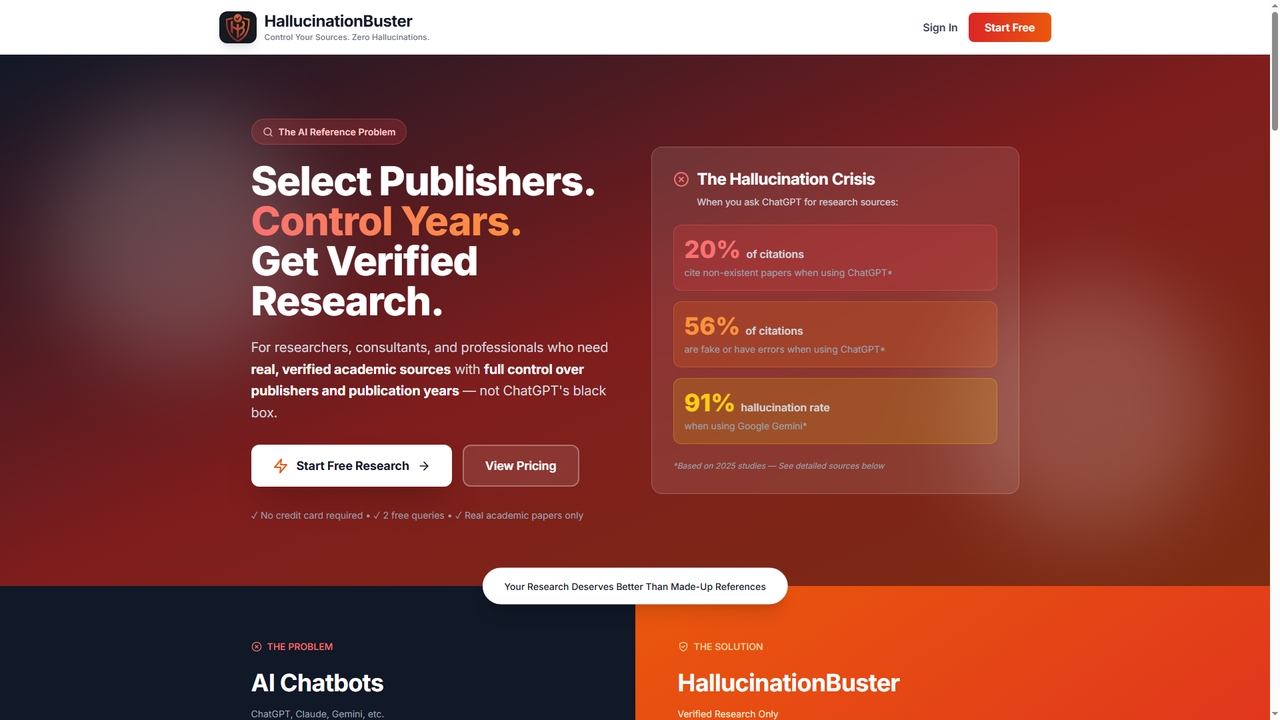
HallucinationBuster is a specialized AI tool for academic and professional research that guarantees 100% real, verified sources. It eliminates AI hallucinations by letting you control publishers and publication years, and search actual academic databases like IEEE and Springer, not a language model's memory.

Content Creation
Visits 5.5KFavorites 27Likes 23
System Pro
Freemium

System Pro

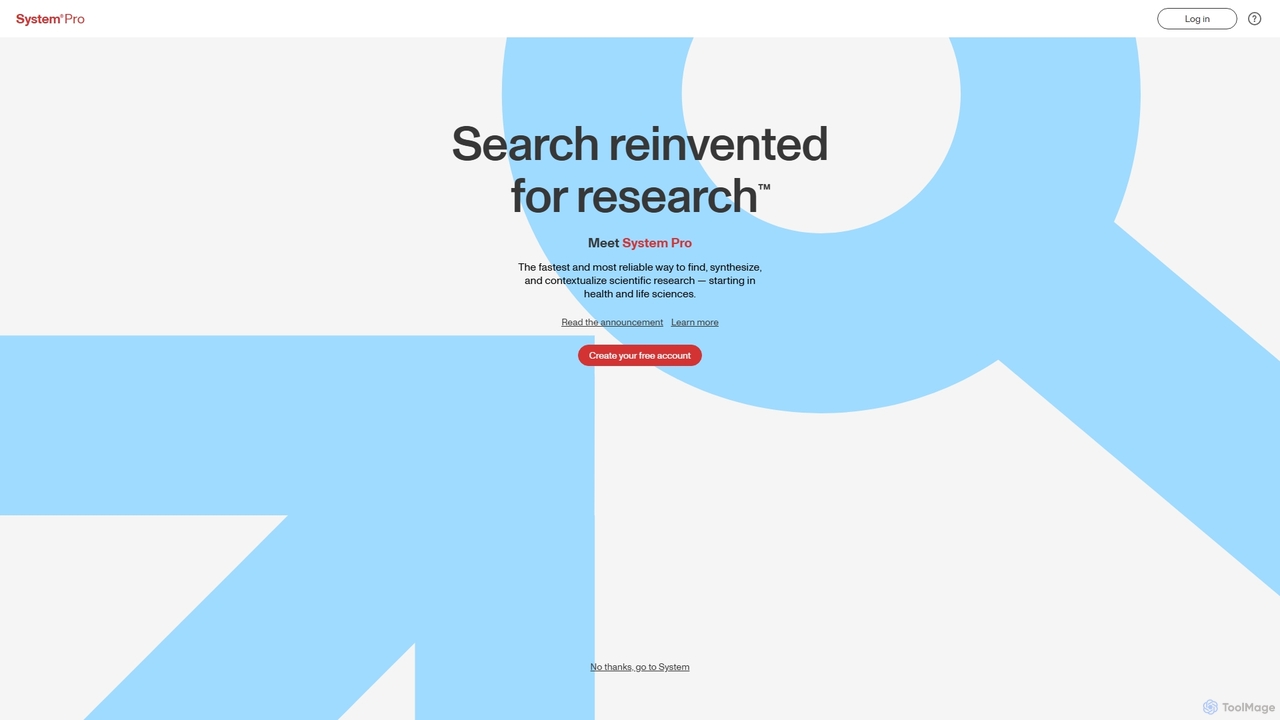
System Pro is an AI-powered search engine designed to reinvent scientific research, initially focusing on health and life sciences. It offers the fastest, most reliable way to find, synthesize, and contextualize complex research papers, helping researchers and professionals accelerate their literature review process and uncover critical insights from a vast body of scientific knowledge.

Medical Information
Visits 5.6KFavorites 118Likes 138
ResearchGPT
Paid

ResearchGPT

An AI research assistant built on ChatGPT, designed to streamline academic literature searches. It finds relevant papers, synthesizes information, and provides answers backed by direct citations, transforming the way researchers and students conduct literature reviews.

Learning
Visits 8.6KFavorites 103Likes 103

About Academic Research

AI Academic Research tools are specialized applications designed to streamline and enhance the scholarly research process for students, academics, and scientists. These tools leverage natural language processing (NLP) and machine learning to automate tasks like literature discovery, data analysis, and manuscript preparation. They help users quickly synthesize vast amounts of information, identify research gaps, and accelerate the path from hypothesis to publication. By handling tedious manual work, these platforms allow researchers to focus on critical thinking and innovation.

Core Features

  • Automated Literature Review: Quickly finds, summarizes, and categorizes relevant academic papers from vast databases.
  • Intelligent Data Analysis: Processes complex datasets to identify patterns, correlations, and statistical significance.
  • Citation Management: Automatically generates and formats citations and bibliographies in various academic styles (e.g., APA, MLA).
  • Academic Writing Assistance: Provides support for paraphrasing, grammar checking, and structuring scholarly articles.
  • Research Discovery: Helps uncover related concepts, emerging trends, and potential collaborators in a specific field.

Use Cases

These tools are invaluable for PhD candidates conducting literature reviews, university professors preparing grant proposals, and scientific researchers analyzing experimental data. They are also widely used by undergraduate and graduate students for writing term papers and theses, ensuring accuracy and proper citation.

How to Choose

When selecting a tool, consider its integration with academic databases (e.g., Scopus, Web of Science), the range of supported citation styles, its data analysis capabilities, and collaboration features for team-based projects. Also, evaluate the tool's data privacy policy, especially when working with sensitive research data.

Academic Research use cases

1

Accelerating Literature Reviews for Dissertations

A PhD student in cognitive science needs to review thousands of papers for their dissertation. Using an AI academic research tool, they can input their core research questions and keywords. The tool scans databases like PubMed and PsycINFO, returning a prioritized list of the most relevant articles, complete with summaries and thematic connections. This reduces the manual search and screening time from months to weeks, allowing the student to focus on synthesizing information and developing their own arguments.

2

Streamlining Grant Proposal Preparation

A university professor is applying for a competitive research grant. They use an AI tool to quickly analyze the existing literature in their field, identify knowledge gaps, and generate a strong rationale for their proposed study. The tool helps summarize key findings from dozens of foundational papers and ensures the bibliography is perfectly formatted according to the funding agency's requirements. This enhances the proposal's quality and demonstrates a thorough command of the subject area.

3

Analyzing Complex Scientific Data

A team of biologists has collected a large dataset from a genomics experiment. Instead of relying solely on traditional statistical software, they use an AI research tool to uncover hidden patterns and correlations. The platform visualizes the data in interactive charts, suggests potential hypotheses, and highlights statistically significant results that might have been missed. This accelerates the data interpretation phase and helps the team prepare their findings for publication in a high-impact journal.

4

Enhancing Undergraduate Term Paper Writing

An undergraduate student is writing a history term paper and struggles with organizing sources and citing them correctly. They use an AI academic assistant to manage their research notes, link sources to specific claims in their draft, and automatically generate in-text citations and a bibliography in Chicago style. The tool also helps paraphrase complex academic language and checks for grammatical errors, improving the overall quality and academic integrity of the paper.

5

Validating Research Hypotheses

A social scientist has a novel hypothesis about economic behavior. They use an AI research platform to test its validity against existing public datasets and published literature. The tool helps formulate the hypothesis into a testable query, searches for supporting or contradictory evidence across thousands of studies, and provides a summary of the current academic consensus. This pre-validation step saves significant time and resources before committing to a full-scale empirical study.

6

Keeping Up-to-Date with Field Advancements

A medical researcher needs to stay current with the latest breakthroughs in oncology. They set up personalized alerts in an AI research tool. The tool continuously monitors new publications, preprints, and clinical trials related to their specific interests. It delivers a daily or weekly digest with concise summaries, allowing the researcher to quickly absorb critical new information without being overwhelmed by the sheer volume of new papers published daily.

Academic Research FAQ

What are AI Academic Research tools?

AI Academic Research tools are software applications that use artificial intelligence to assist researchers, students, and academics with their scholarly work. They automate and enhance tasks such as finding relevant literature, summarizing articles, analyzing data, and managing citations. Unlike general search engines, they are specifically designed for the rigor and structure of academic inquiry.

How do I choose the right AI tool for my academic research?

To choose the right tool, consider these factors:

  • Discipline Focus: Does the tool cater to your field (e.g., STEM, humanities)?
  • Database Access: Does it integrate with key academic databases like Scopus, PubMed, or JSTOR?
  • Core Features: Does it excel at literature review, data analysis, or writing assistance, depending on your primary need?
  • Citation Styles: Ensure it supports the citation format required by your institution or journal (e.g., APA, MLA, Chicago).
  • Collaboration: If you work in a team, check for features that support shared projects and libraries.

What is the difference between AI academic tools and Google Scholar?

Google Scholar is a powerful search engine for finding academic literature, but its functionality largely stops there. AI academic research tools go much further by actively assisting in the research workflow. They can summarize papers, extract key data, identify thematic connections between studies, manage citations dynamically within a document, and even help analyze your own data. They are interactive research assistants, whereas Google Scholar is a static discovery tool.

Can AI tools write my research paper for me?

No, AI academic tools are designed to be research assistants, not replacements for the researcher. They can help with paraphrasing, grammar, summarizing sources, and structuring arguments, but they cannot perform the critical thinking, original analysis, or synthesis required for a scholarly paper. Using AI to generate entire papers is considered academic misconduct. Their ethical use is to augment and accelerate the research process, not to automate authorship.

Who benefits most from using AI for academic research?

A wide range of individuals in academia can benefit. PhD students and early-career researchers can significantly speed up their literature reviews. Established professors can stay current in their field and prepare grants more efficiently. Scientists and data analysts can uncover deeper insights from their data. Even undergraduate students can improve their research and writing skills by using these tools for organizing sources and checking their work.