AfterQuery
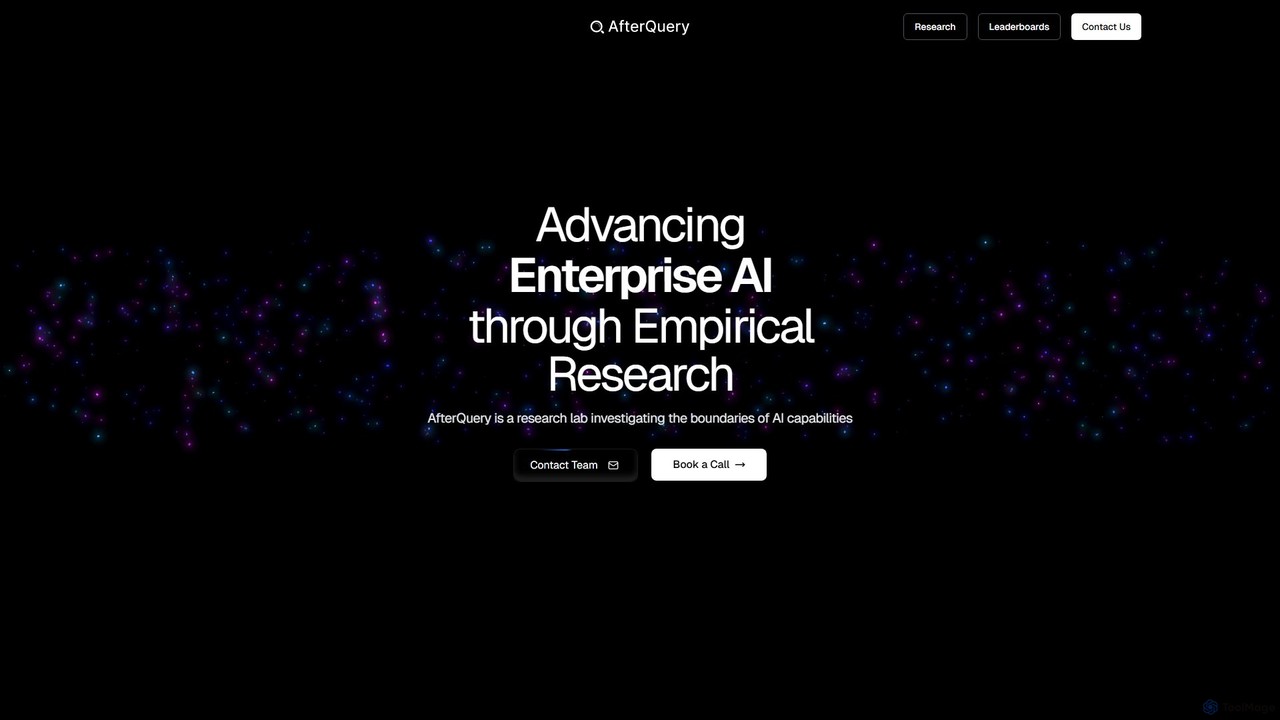
AfterQuery is an AI research lab dedicated to advancing foundational models by creating high-quality, human-generated datasets and contamination-free …
AfterQuery is an AI research lab dedicated to advancing foundational models by creating high-quality, human-generated datasets and contamination-free benchmarks. It focuses on improving model performance through superior training data and rigorous evaluation.
Sakana AI
A Tokyo-based AI research lab founded by industry pioneers, developing novel foundational models inspired by nature. Sakana AI …
A Tokyo-based AI research lab founded by industry pioneers, developing novel foundational models inspired by nature. Sakana AI focuses on creating advanced AI agents and solutions for complex optimization problems, catering to enterprise and public sector needs.
About Ai Lab
Ai Lab tools are specialized platforms designed for experimenting with, developing, and fine-tuning artificial intelligence models and applications. These environments provide researchers, developers, and data scientists with access to advanced AI frameworks, computational resources, and diverse datasets. They enable rapid prototyping, iterative testing, and performance optimization of AI solutions, fostering innovation and accelerating discovery within the broader field of AI research. This makes them crucial for pushing the boundaries of what AI can achieve.
Core Features
- Model Training & Experimentation: Provides environments and resources for training new AI models or fine-tuning existing ones.
- Data Management & Annotation: Tools for preparing, cleaning, and annotating datasets essential for AI model development.
- Computational Resources: Access to GPUs, TPUs, and cloud computing power for intensive AI workloads.
- Version Control & Collaboration: Features for tracking model iterations, code changes, and facilitating team collaboration.
- Performance Monitoring & Evaluation: Tools to analyze model accuracy, efficiency, and identify areas for improvement.
Use Cases
These tools are primarily used by AI researchers, machine learning engineers, and data scientists in academic institutions, R&D departments, and tech companies. They facilitate the exploration of novel AI algorithms, the development of custom predictive models, and the creation of intelligent systems for various industries.
How to Choose
When selecting an Ai Lab platform, consider the range of supported AI frameworks (e.g., TensorFlow, PyTorch), the availability and scalability of computational resources, the ease of data integration, and the collaboration features for team projects. Evaluate the pricing model based on usage and the level of technical support offered, ensuring it aligns with your project's complexity and budget.

Ai LabUse Cases
Developing Custom Predictive Models
Data scientists use Ai Lab platforms to build and train bespoke machine learning models for specific business problems, such as predicting customer churn or optimizing supply chain logistics. They leverage the lab's computational power and data management tools to iterate on model architectures and hyper-parameters, achieving high accuracy for unique datasets.
Experimenting with Novel AI Algorithms
AI researchers utilize Ai Lab environments to test and validate new artificial intelligence algorithms or neural network architectures. The flexible infrastructure allows them to quickly set up experiments, compare performance metrics across different approaches, and publish findings, contributing to advancements in AI theory.
Fine-tuning Large Language Models (LLMs)
Machine learning engineers employ Ai Lab tools to fine-tune pre-trained large language models on proprietary datasets for specialized tasks, like generating industry-specific content or improving chatbot responses. This process involves adapting the LLM's knowledge to a particular domain, enhancing its relevance and accuracy for enterprise applications.
Building AI-Powered Robotics Control Systems
Robotics engineers use Ai Lab platforms to develop and simulate AI algorithms that control robotic movements, object recognition, and decision-making. The lab provides the necessary computational resources and integration capabilities to train reinforcement learning models, enabling robots to perform complex tasks autonomously in real-world environments.
Creating Personalized Recommendation Engines
E-commerce and media companies leverage Ai Lab environments to develop sophisticated recommendation engines that analyze user behavior and preferences. Data scientists train collaborative filtering or deep learning models within the lab, continuously refining algorithms to deliver highly personalized product or content suggestions, boosting user engagement and sales.
Rapid Prototyping for AI Startups
AI startups utilize Ai Lab platforms for agile development and rapid prototyping of their core AI products. They can quickly spin up development environments, integrate various AI services, and conduct iterative testing with minimal infrastructure overhead, accelerating their time to market and validating product-market fit.