ToolMage
Sign in

Best 1 Ai Comparison AI tools for Research

Popular Ai Comparison AI tools in Research include LLM Models, helping you work more efficiently.

LLM Models

LLM Models

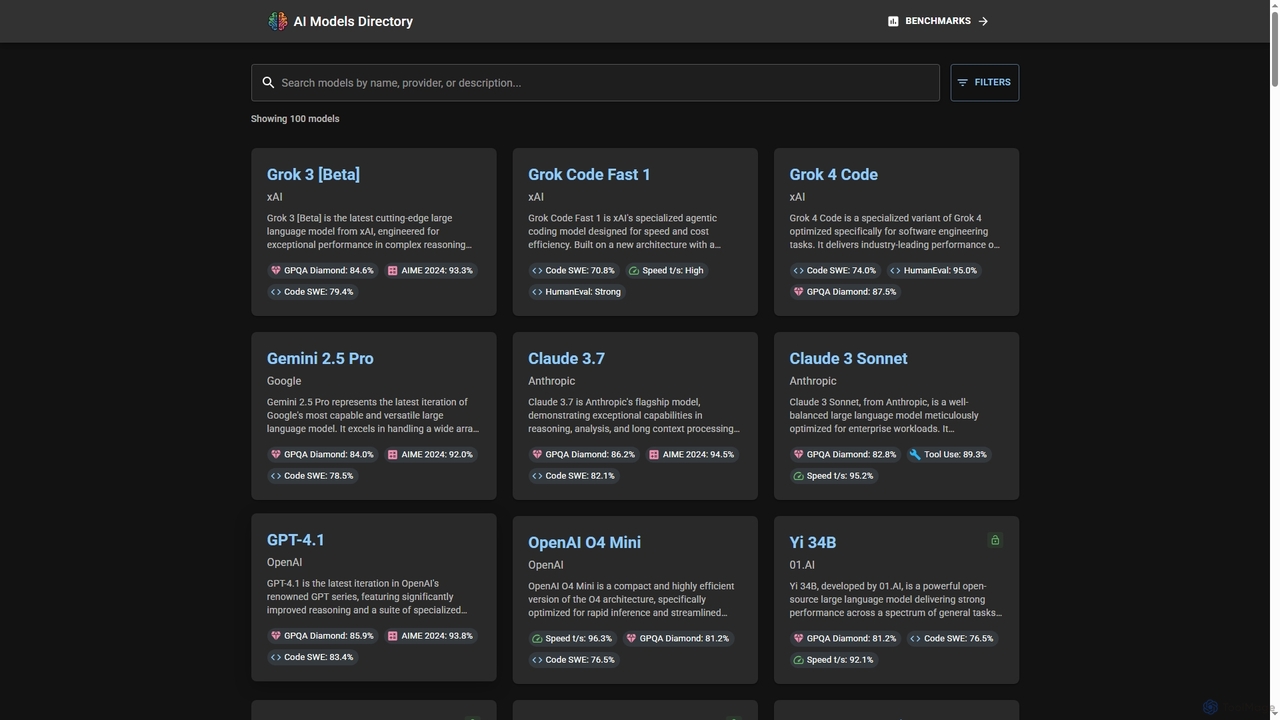
LLM Models is a comprehensive online directory and comparison platform for large language models and foundation models. It provides detailed technical specifications, benchmark performance, and feature comparisons to help developers, researchers, and businesses select the most suitable AI models for their needs.

Model Directory
Visits 5KFavorites 113Likes 130

About Ai Comparison

AI Comparison tools are specialized platforms designed to help users systematically evaluate and contrast various artificial intelligence models, services, or applications. These tools leverage data analysis and structured frameworks to highlight differences in performance, features, cost-effectiveness, and ethical implications. They empower researchers, developers, and businesses to make informed decisions when selecting the most suitable AI solution for their specific needs, streamlining the often complex process of AI adoption.

Core Features

  • Performance Benchmarking: Systematically tests and compares AI models on metrics like speed, accuracy, and resource consumption.
  • Feature Matrix Analysis: Provides a detailed breakdown and comparison of functionalities offered by different AI tools.
  • Cost-Benefit Analysis: Evaluates the economic implications, including pricing models and ROI, for various AI solutions.
  • Ethical & Bias Assessment: Helps identify and compare potential biases or ethical considerations across different AI systems.
  • User Review Aggregation: Gathers and synthesizes user feedback and ratings to offer a holistic view of tool satisfaction.

Use Cases

AI Comparison tools are invaluable for organizations and individuals navigating the complex AI landscape. They are used by AI strategists to evaluate vendor offerings, by developers to select optimal models for integration, and by researchers to benchmark new algorithms against existing ones. For instance, a company might use these tools to compare several large language models (LLMs) for a customer service chatbot project, assessing their natural language understanding capabilities, response generation quality, and API costs to ensure the best fit.

How to Choose

When selecting an AI comparison tool, consider its data sources and methodology to ensure reliability and comprehensiveness. Evaluate the range of AI categories it covers, such as LLMs, image generation, or data analytics, to match your specific needs. Look for customization options that allow you to define your own comparison criteria and weighting. Finally, assess its user interface and reporting features for clarity and ease of interpretation, ensuring the insights are actionable for your decision-making process.

Ai Comparison use cases

1

Selecting the Best LLM for Customer Service

A product manager needs to integrate a large language model into their customer service platform. They use AI comparison tools to evaluate various LLMs based on their natural language understanding accuracy, response generation speed, multilingual support, and API pricing, ensuring the chosen model aligns with budget and performance requirements for automated support.

2

Benchmarking AI Image Generators for Marketing

A marketing team requires an AI image generator for creating diverse campaign visuals. They utilize comparison platforms to assess different generators on image quality, style versatility, prompt adherence, commercial licensing terms, and generation speed, identifying the tool that best meets their creative and operational demands for visual content creation.

3

Evaluating AI Code Assistants for Development Teams

A software development lead aims to boost team productivity with an AI code assistant. They employ AI comparison tools to analyze various assistants' code completion accuracy, language support, integration with IDEs, security features, and subscription costs, ensuring the selected tool enhances coding efficiency without compromising code quality or security.

4

Comparing AI Data Analytics Platforms for Business Intelligence

A business intelligence analyst seeks an AI-powered platform to derive deeper insights from complex datasets. They use comparison tools to evaluate platforms based on their data processing capabilities, predictive modeling accuracy, visualization features, ease of use for non-technical users, and compliance with data privacy regulations, selecting a solution that empowers data-driven decision-making.

5

Assessing AI Translation Services for Global Content

A global content manager needs to localize website content and marketing materials across multiple languages. They turn to AI comparison tools to evaluate different AI translation services based on translation accuracy, fluency, support for specific language pairs, domain-specific terminology handling, and cost per word, ensuring high-quality and consistent global communication.

6

Choosing AI Video Generation Tools for Content Creators

An independent content creator wants to produce engaging video content efficiently using AI. They use comparison tools to assess various AI video generators based on their ability to create realistic avatars, synthesize natural-sounding voices, offer diverse templates, customize branding elements, and export in high resolution, finding a tool that accelerates their video production workflow.

Ai Comparison FAQ

What are AI Comparison tools?

AI Comparison tools are platforms designed to help users systematically evaluate and contrast different artificial intelligence models, services, or applications. They provide structured insights into various aspects like performance, features, cost, and ethical considerations, enabling informed decision-making. These tools are crucial for navigating the rapidly evolving AI landscape and selecting the most suitable solutions for specific tasks.

How do AI Comparison tools work?

AI Comparison tools typically work by aggregating data from various sources, including official documentation, benchmark tests, user reviews, and pricing information. They then apply standardized metrics and frameworks to analyze and present this data in a comparable format. Users can often customize criteria, filter results, and generate detailed reports to understand the strengths and weaknesses of different AI options side-by-side.

What are the key benefits of using AI Comparison tools?

The primary benefits of using AI Comparison tools include saving time and resources by automating the research process, reducing decision-making risk through data-driven insights, and ensuring optimal AI solution selection. They help users avoid vendor lock-in, identify cost-effective alternatives, and stay updated on the latest advancements and performance benchmarks across the AI ecosystem.

How do AI Comparison tools differ from general AI research platforms?

While general AI research platforms provide broad information about AI technologies and trends, AI Comparison tools specifically focus on direct, side-by-side evaluation of multiple AI products or models. General platforms might offer news and academic papers, whereas comparison tools provide structured data, performance metrics, and feature matrices to facilitate a clear choice between competing AI solutions, making them a subset of broader AI research.

What factors should I consider when comparing AI models or tools?

When comparing AI models or tools, consider several key factors: Performance Metrics (accuracy, speed, latency), Feature Set (specific functionalities, customization options), Cost-Effectiveness (pricing models, scalability, ROI), Integration Capabilities (APIs, compatibility with existing systems), Ethical Considerations (bias, transparency, data privacy), and Community Support/Documentation for ease of use and troubleshooting. Prioritizing these based on your project's needs is crucial.