LLM Models
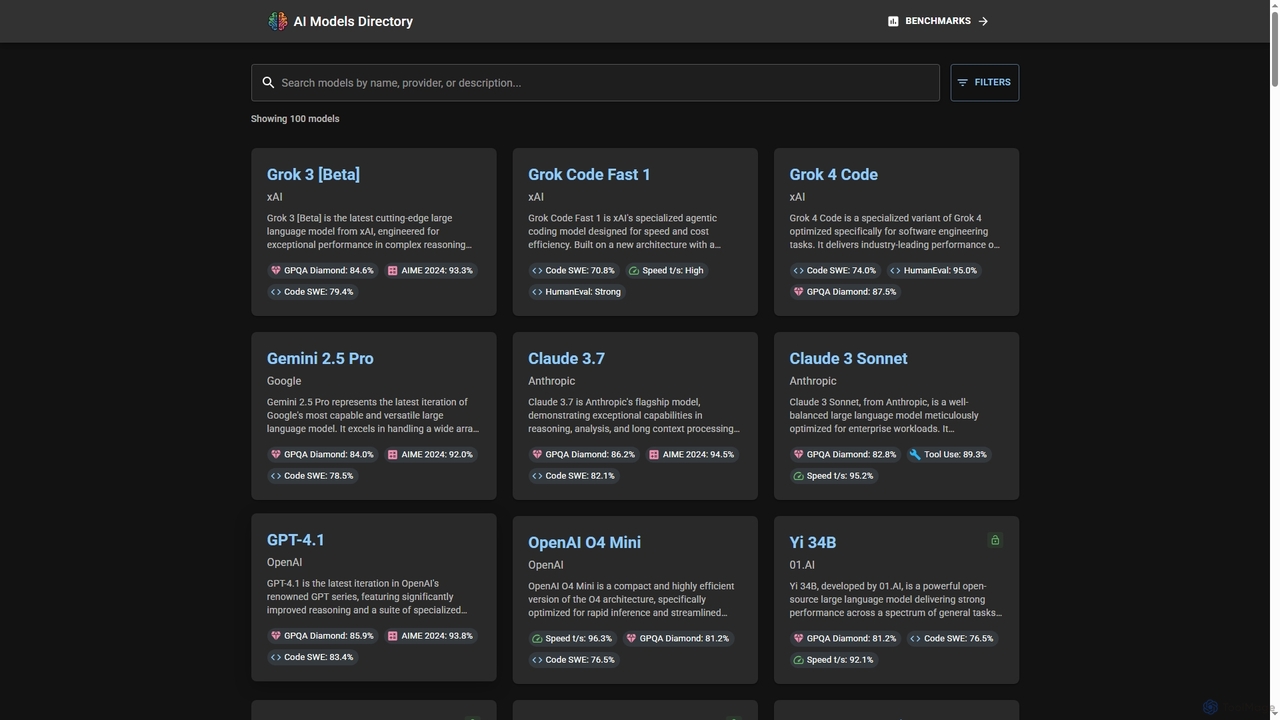
LLM Models is a comprehensive online directory and comparison platform for large language models and foundation models. It …
LLM Models is a comprehensive online directory and comparison platform for large language models and foundation models. It provides detailed technical specifications, benchmark performance, and feature comparisons to help developers, researchers, and businesses select the most suitable AI models for their needs.
About Model Directory
Model Directory is a specialized platform that catalogs and provides access to a vast array of pre-trained artificial intelligence models. These directories serve as central hubs, enabling developers, researchers, and businesses to discover, compare, and integrate AI models for various applications. By offering detailed information and access points, they streamline the process of leveraging advanced AI capabilities without needing to train models from scratch.
Core Features
- Model Discovery & Filtering: Advanced search and filtering options to quickly find models based on task, architecture, performance, and licensing.
- Detailed Model Information: Comprehensive descriptions, technical specifications, benchmark results, and dataset information for each listed model.
- API & Integration Access: Provides API endpoints, SDKs, or direct download links for seamless integration of models into applications and workflows.
- Performance Benchmarking: Offers standardized metrics and comparison tools to evaluate and select the most suitable model for specific requirements.
- Licensing & Usage Terms: Clearly outlines the licensing agreements and usage policies for each AI model, ensuring compliance and informed decision-making.
Use Cases
AI Model Directories are invaluable for accelerating innovation across various sectors. Developers utilize them to find foundational models for new applications, while researchers identify state-of-the-art architectures for academic studies. Businesses leverage these directories to source specialized models for tasks like natural language processing, computer vision, or predictive analytics, significantly reducing development time and costs.
How to Choose
When selecting an AI Model Directory, consider the breadth and depth of its model collection, ensuring it covers your specific domain needs. Evaluate the quality of documentation and ease of API integration, as well as the transparency of performance benchmarks. Additionally, assess the licensing terms and community support, which are crucial for long-term project viability and maintenance.

Model DirectoryUse Cases
Integrating Language Models into Chatbots
AI developers use model directories to find and integrate pre-trained large language models (LLMs) for building sophisticated conversational AI agents. This allows for rapid deployment of chatbots capable of understanding complex queries and generating human-like responses, significantly reducing development time compared to training a model from scratch.
Enhancing Computer Vision Applications
Researchers and engineers browse model directories to discover specialized computer vision models for tasks like object detection, image segmentation, or facial recognition. They can compare performance metrics and integrate the most suitable model into security systems, autonomous vehicles, or medical imaging analysis tools.
Developing Personalized Recommendation Systems
E-commerce businesses and content platforms utilize model directories to find recommendation engine models. By integrating these pre-trained models, they can analyze user behavior and preferences to deliver highly personalized product suggestions or content recommendations, improving user engagement and sales conversions.
Automating Content Generation for Marketing
Marketing teams and content creators access model directories to find text or image generation models. They can use these models to automate the creation of marketing copy, social media posts, or unique visual assets, accelerating content production and maintaining brand consistency across various campaigns.
Accelerating Scientific Research and Data Analysis
Data scientists and academic researchers leverage model directories to explore cutting-edge models for complex data analysis, predictive modeling, or scientific simulations. This enables them to quickly test hypotheses, validate findings, and build upon existing research without extensive model development efforts.
Building Custom AI Solutions for Enterprises
Enterprise architects and solution developers consult model directories to identify and evaluate various AI models that can be fine-tuned or combined to address specific business challenges, such as fraud detection, supply chain optimization, or predictive maintenance, leading to tailored and efficient AI deployments.