ToolMage
Sign in

Best 1 Academic Assistance AI tools for Research

Popular Academic Assistance AI tools in Research include Sciscoper, helping you work more efficiently.

Sciscoper
Freemium

Sciscoper

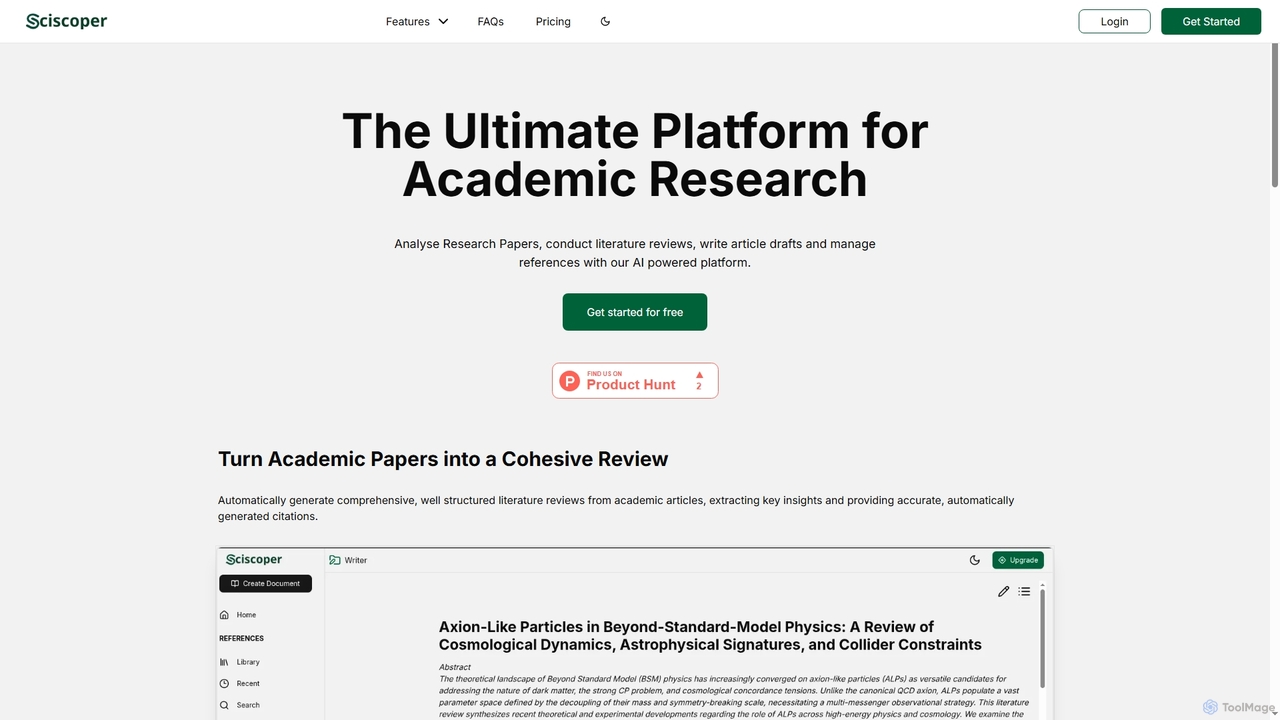
Sciscoper is an AI-powered platform designed to streamline academic research. It helps students and researchers analyze papers, conduct literature reviews, draft articles, and manage references efficiently. With features like PDF chat, semantic search, and an AI writer, it accelerates the entire research workflow.

Pdf Tools
Visits 5.7KFavorites 153Likes 148

About Academic Assistance

Academic Assistance tools are AI-powered platforms designed to streamline and enhance various aspects of academic work, from research and writing to organization and analysis. These tools leverage advanced natural language processing and machine learning to assist students, researchers, and educators in tasks that traditionally consume significant time and effort. They aim to improve the quality, efficiency, and originality of academic output, making complex scholarly processes more manageable.

Core Features

  • Academic Writing & Editing: Offers grammar checks, style suggestions, plagiarism detection, and rephrasing for academic tone.
  • Research Summarization: Automatically condenses long articles, papers, and reports into key points or abstracts.
  • Citation & Reference Management: Helps generate citations in various styles (APA, MLA, Chicago) and organize research sources.
  • Idea Generation & Brainstorming: Assists in developing research questions, essay topics, or presentation outlines.
  • Data Analysis Support: Provides guidance or automation for interpreting research data and generating insights.

Use Cases

Students preparing essays and dissertations, researchers drafting papers and grant proposals, and academics managing large volumes of literature can all benefit. These tools are particularly valuable for ensuring academic integrity, improving writing clarity, and accelerating the literature review process.

How to Choose

When selecting Academic Assistance tools, consider the specific features you need (e.g., writing, summarization, citation), the accuracy of their AI models, integration with existing academic software (like reference managers), the range of supported citation styles, and data privacy policies. Evaluate user reviews for reliability and ease of use.

Academic Assistance use cases

1

Drafting & Refining Research Papers

A graduate student uses an AI academic assistant to generate an initial outline for their thesis, then leverages its writing enhancement features to improve sentence structure, academic tone, and grammar, ensuring the paper meets publication standards.

2

Efficient Literature Review

A researcher needs to review hundreds of scientific articles for a meta-analysis. They use an AI tool to quickly summarize key findings from each paper, extract relevant data points, and identify emerging themes, significantly reducing manual reading time.

3

Ensuring Plagiarism-Free Content

An undergraduate student submits an essay through an AI academic tool that checks for originality against a vast database, providing detailed reports and suggestions for proper citation, thereby upholding academic integrity.

4

Automating Citation Management

An academic author writing a book needs to manage hundreds of references. They use an AI tool to automatically format citations and bibliographies in APA style, and to organize their research sources, saving hours of meticulous manual formatting.

5

Brainstorming & Structuring Essays

A high school student struggling with essay topic selection inputs a broad subject into an AI assistant, which then suggests various angles, provides a basic structure, and helps generate initial paragraphs, overcoming writer's block.

6

Simplifying Complex Data Interpretation

A social science researcher has collected qualitative data from interviews. An AI academic tool helps them identify patterns, categorize responses, and even suggest potential correlations, aiding in the interpretation and reporting of their findings.

Academic Assistance FAQ

What are Academic Assistance tools?

Academic Assistance tools are AI-powered applications designed to support students, researchers, and academics in various scholarly tasks. They utilize AI to help with writing, editing, summarizing research, managing citations, and generating ideas, aiming to enhance efficiency and quality in academic work.

How do Academic Assistance tools differ from general writing assistants?

While general writing assistants focus on grammar and style for broad audiences, Academic Assistance tools are specifically trained on academic texts and conventions. They offer specialized features like academic tone suggestions, plagiarism checks against scholarly databases, citation formatting, and research summarization, tailored for the unique demands of academic writing and research.

Can Academic Assistance tools help with plagiarism detection?

Yes, many Academic Assistance tools include robust plagiarism detection features. They compare submitted text against extensive databases of academic papers, journals, and web content to identify potential instances of unoriginal content and provide guidance on proper attribution and citation, helping users maintain academic integrity.

What types of academic tasks can AI tools assist with?

AI academic assistance tools can help with a wide range of tasks, including generating essay outlines, proofreading and editing papers for clarity and academic style, summarizing lengthy research articles, managing and formatting citations, brainstorming research topics, and even providing support for data analysis interpretation.

Are Academic Assistance tools reliable for generating citations?

Many Academic Assistance tools offer reliable citation generation, supporting various styles like APA, MLA, Chicago, and Harvard. They help users correctly format in-text citations and bibliographies, reducing errors and saving time. However, it's always recommended to double-check the generated citations against official style guides for absolute accuracy.