
AMiner
AMiner is an AI-powered academic search and technology intelligence platform from Tsinghua University. It provides access to a …
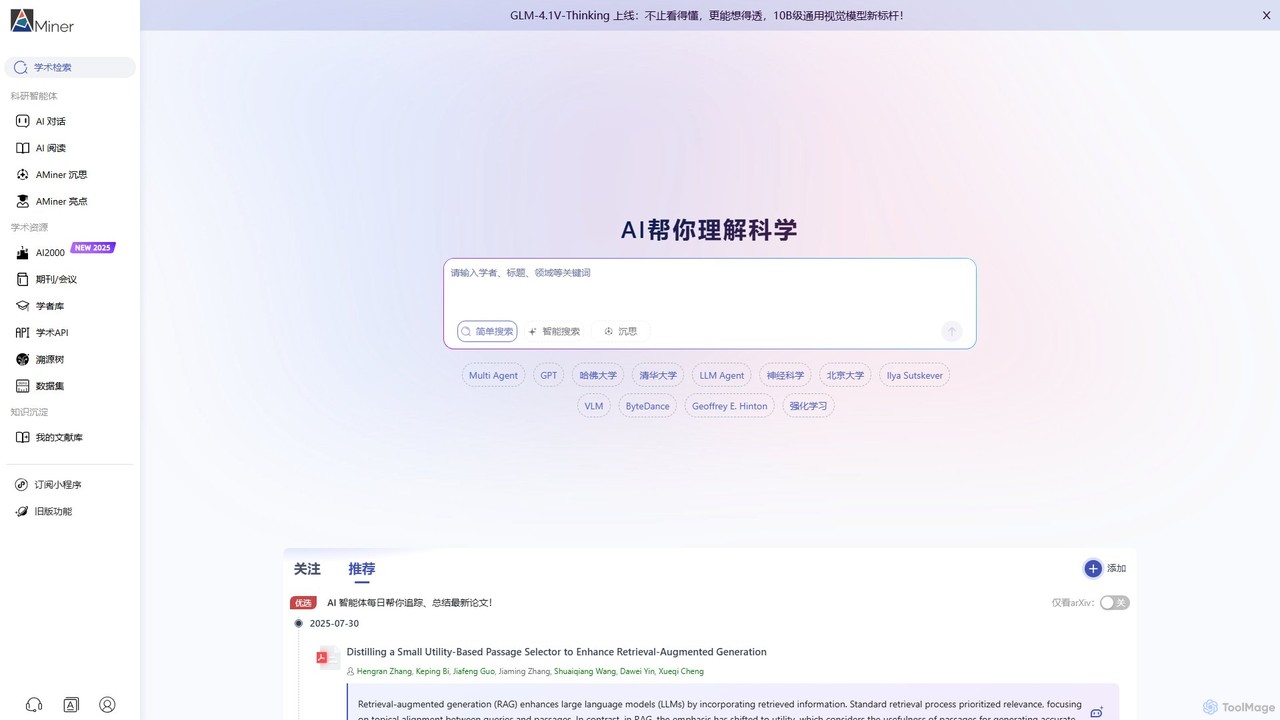
AMiner is an AI-powered academic search and technology intelligence platform from Tsinghua University. It provides access to a massive database of over 330 million papers and 135 million scholars. Featuring AI-driven tools like semantic search, one-click summarization, scholar profiling, and trend analysis, AMiner helps researchers and institutions accelerate scientific discovery.
About Academic Search
Academic Search tools are specialized AI platforms designed to streamline the discovery and analysis of scholarly literature. They leverage natural language processing (NLP) and semantic search to understand the context and concepts within research papers, going far beyond traditional keyword matching. These tools empower researchers, students, and professionals to accelerate literature reviews, uncover hidden connections between studies, and stay current with the latest advancements in their field. The core value lies in transforming a time-consuming search process into an efficient exploration of scientific knowledge.
Core Features
- Semantic Search: Finds relevant papers based on conceptual meaning and research intent, not just exact keywords.
- Citation Network Analysis: Visualizes connections between papers, identifying influential works and tracking the evolution of ideas.
- AI-Powered Summarization: Generates concise summaries of abstracts or full papers to speed up assessment of relevance.
- Personalized Recommendations: Suggests new and relevant articles based on your research interests and reading history.
- Data Extraction: Automatically identifies and extracts key information like methodologies, datasets, and main findings from articles.
Use Cases
These tools are indispensable for PhD students conducting literature reviews, principal investigators preparing grant proposals, and corporate R&D teams monitoring technological trends. They are also widely used by university librarians to assist with complex research queries and by medical researchers performing systematic reviews.
How to Choose
When selecting an Academic Search tool, consider the breadth and depth of its indexed database (e.g., journals, pre-prints). Evaluate its analytical capabilities, such as citation mapping and trend analysis. Check for integrations with reference management software like Zotero or Mendeley, and assess the user interface for ease of building complex queries and filtering results.
Academic SearchUse Cases
Accelerating PhD Literature Reviews
A doctoral student in cognitive science is tasked with writing a comprehensive literature review. Instead of spending weeks manually sifting through databases with keyword searches, they use an AI Academic Search tool. By inputting their core research question, the tool's semantic search identifies foundational papers and recent studies, even those using different terminology. The citation network feature helps them trace the intellectual lineage of key concepts and identify research gaps, reducing the time to build a thorough bibliography by over 50%.
Strengthening Grant Proposal Justifications
A biomedical researcher is preparing a grant proposal for a novel cancer therapy. To build a compelling background section, they use an AI search platform to quickly find the most recent and impactful studies related to their proposed mechanism. The tool's summarization feature allows them to rapidly assess dozens of papers. They can then cite cutting-edge evidence to demonstrate the novelty and significance of their research, significantly strengthening the proposal's scientific premise and increasing its chances of funding.
Tracking Innovations in Competitive R&D
An R&D team at a tech company needs to stay ahead of the latest advancements in machine learning. They configure an AI Academic Search tool to monitor specific research topics, key authors, and top conferences. The platform provides daily or weekly digests with personalized recommendations and summaries of new pre-prints and publications. This automated monitoring allows the team to track emerging trends and competitor research activities without dedicating hours to manual searches.
Conducting Systematic Medical Reviews
A team of clinical researchers is conducting a systematic review that requires screening thousands of published trials. An AI Academic Search tool with advanced filtering capabilities is used to apply complex inclusion and exclusion criteria automatically. Its data extraction feature helps pull specific information, such as patient demographics and outcome measures, from the selected studies into a structured format. This automates a significant portion of the manual screening and data entry process, ensuring accuracy and saving hundreds of hours.
Discovering Interdisciplinary Research Opportunities
A sociologist studying online communities wants to explore how their theories are being applied in other fields. Using an AI tool's visual exploration features, they can see how their research area connects to computer science, marketing, and political science through citation links. This reveals unexpected applications and collaborations, sparking ideas for novel, interdisciplinary research projects that bridge traditional academic boundaries.
Curating Course Reading Lists
A university professor is designing a new graduate seminar on sustainable energy policy. They use an AI Academic Search tool to identify the most cited and debated papers in the field from the last five years. The tool helps them find a balanced mix of foundational texts, recent case studies, and critical perspectives. The AI summaries help quickly evaluate each paper's suitability for the syllabus, enabling the creation of a relevant and engaging reading list in a fraction of the time.