
Chatbox AI
Chatbox AI is a powerful, cross-platform AI client for desktop and mobile. It integrates chat with documents, images, …
Chatbox AI is a powerful, cross-platform AI client for desktop and mobile. It integrates chat with documents, images, and code, offers real-time web search, AI image generation, and prioritizes user privacy with local data storage. Use your own API keys or subscribe to their all-in-one service.
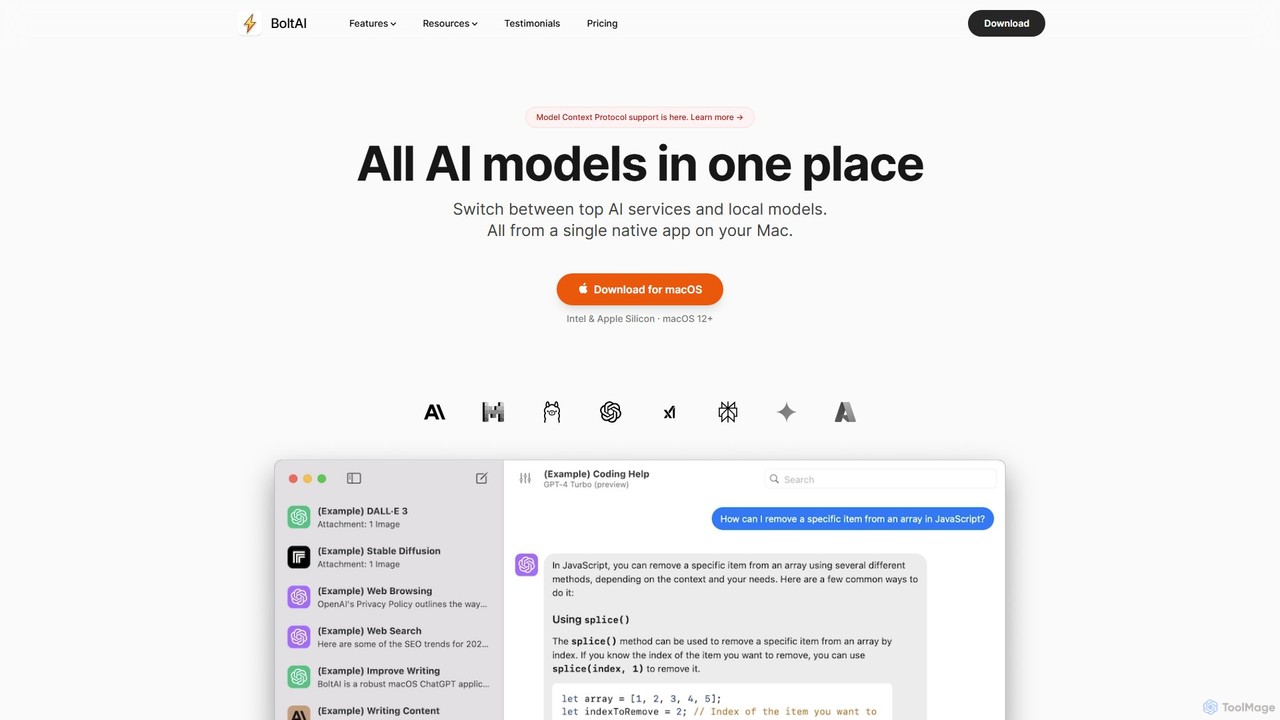
BoltAI
BoltAI is a native, high-performance AI assistant for macOS that integrates multiple AI models like GPT, Claude, and …
BoltAI is a native, high-performance AI assistant for macOS that integrates multiple AI models like GPT, Claude, and local models directly into your workflow. It offers features like an in-IDE coding assistant, custom AI assistants, a prompt library, and powerful plugins to boost productivity for developers, writers, and professionals.
About Coding
AI Coding tools are a category of AI-powered software designed to assist developers in writing, debugging, testing, and optimizing code. Leveraging advanced machine learning models, these tools can understand context, generate code snippets, identify errors, and suggest improvements, significantly accelerating the software development lifecycle. They empower developers to focus on complex problem-solving by automating repetitive and time-consuming coding tasks.
Core Features
- Code Generation: Automatically generates functions, classes, or entire scripts from natural language descriptions or existing code context.
- Intelligent Code Completion: Provides highly accurate and context-aware code suggestions beyond basic autocomplete, predicting developer intent.
- Automated Debugging & Error Detection: Identifies potential bugs, syntax errors, and logical flaws in real-time, often suggesting fixes.
- Code Refactoring & Optimization: Analyzes code for inefficiencies and suggests improvements for performance, readability, and maintainability.
- Test Case Generation: Creates relevant unit tests and integration tests based on existing code logic and expected behavior.
Applicable Scenarios
AI coding tools are invaluable for individual developers seeking to boost productivity, development teams aiming for faster iteration cycles, and enterprises looking to maintain high code quality. They are particularly useful in rapid prototyping, learning new programming languages, maintaining large legacy codebases, and ensuring consistent coding standards across projects.
How to Choose
When selecting an AI coding tool, consider its compatibility with your preferred programming languages and IDEs, the accuracy and relevance of its code suggestions, its security features for handling sensitive code, and its pricing model. Evaluate the learning curve, community support, and the tool's ability to integrate seamlessly into your existing development workflow to maximize its benefits.
CodingUse Cases
Rapid API Endpoint Generation
A backend developer needs to quickly create multiple REST API endpoints for a new service. Using an AI coding tool, they can describe the desired endpoint functionality in natural language (e.g., "create a GET endpoint for users with pagination"). The AI generates the boilerplate code, including routing, request handling, and basic data retrieval, allowing the developer to focus on business logic and significantly reduce setup time.
Automated Unit Test Creation
A QA engineer or developer is tasked with increasing code coverage for an existing module. Instead of manually writing numerous unit tests, they can use an AI coding assistant to analyze the module's functions and automatically generate a comprehensive suite of test cases. This ensures robust testing, catches edge cases, and frees up time for more complex testing scenarios.
Legacy Code Modernization
An experienced developer is working on updating an outdated application written in an older framework or language. An AI coding tool can assist by suggesting modern syntax equivalents, refactoring patterns, and identifying deprecated functions. This accelerates the migration process, reduces the risk of introducing new bugs, and improves the maintainability of the modernized codebase.
Learning New Programming Languages
A student or a developer transitioning to a new programming language (e.g., Python to Go) can leverage AI coding tools as an interactive learning aid. By describing desired functionality, the AI can generate code examples in the new language, explain syntax, and even suggest best practices, making the learning curve smoother and more efficient than relying solely on documentation.
Debugging Complex Applications
A software engineer is troubleshooting a subtle bug in a large, distributed application. An AI coding assistant can analyze stack traces, error messages, and surrounding code context to pinpoint potential root causes. It can suggest specific lines of code to examine, propose fixes, or even generate diagnostic code snippets, drastically reducing the time spent on debugging complex issues.
Code Refactoring for Performance
A senior developer identifies a performance bottleneck in a critical section of an application. An AI coding tool can analyze the code's execution path and resource consumption, then propose optimized algorithms or data structures. It can suggest more efficient ways to handle loops, memory allocation, or database queries, leading to significant performance improvements without extensive manual analysis.