Llama
Llama is a family of open-source large language models (LLMs) from Meta. The latest generation, Llama 4, features …
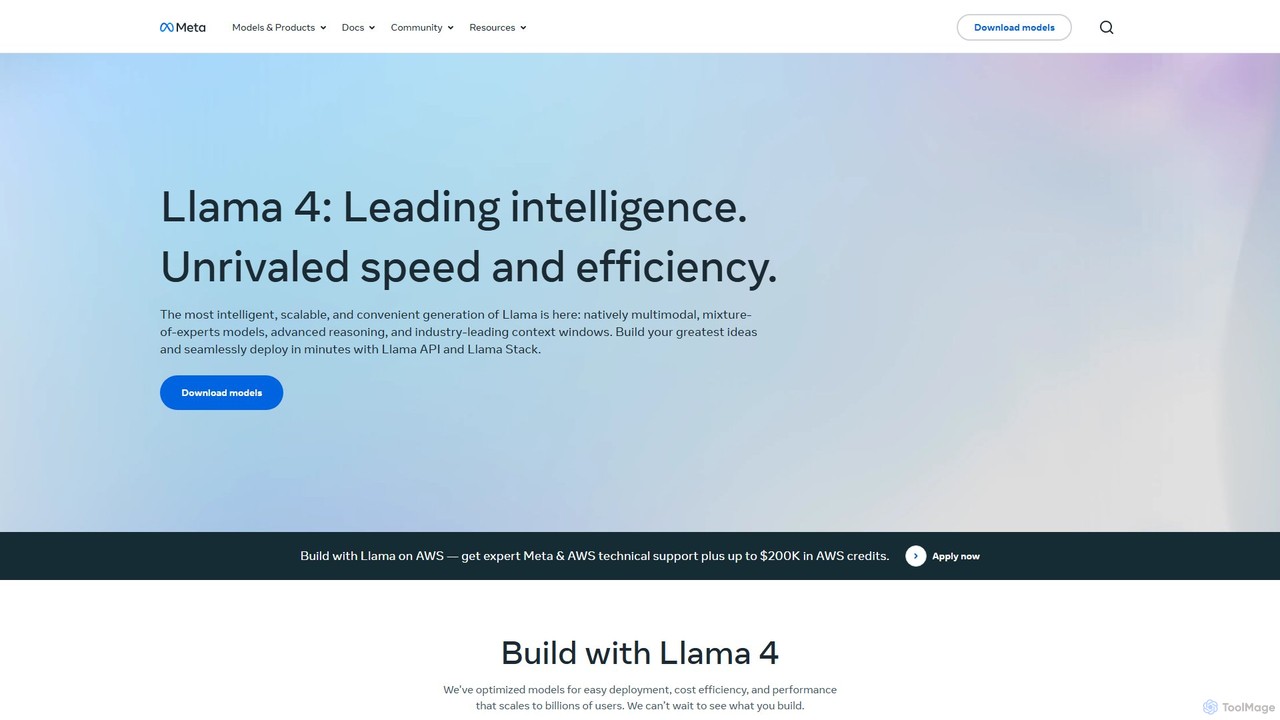
Llama is a family of open-source large language models (LLMs) from Meta. The latest generation, Llama 4, features industry-leading performance with native multimodality, a mixture-of-experts architecture for efficiency, and vast context windows. It's designed for developers and businesses to build and deploy advanced, scalable, and responsible AI applications through downloadable models and a streamlined API.
About Large Language Model
Large Language Models (LLMs) are advanced AI models trained on vast amounts of text data, capable of understanding, generating, and processing human language with remarkable fluency. Leveraging deep learning architectures like Transformers, these models enable developers to build highly intelligent applications. As a core component within developer tools, LLMs empower the creation of sophisticated solutions for content generation, intelligent automation, and complex data analysis.
Core Features
- Natural Language Understanding (NLU): Comprehending user intent, sentiment, and entities from diverse text inputs.
- Text Generation: Producing coherent, contextually relevant human-like text for articles, summaries, and creative content.
- Code Generation & Assistance: Generating code snippets, suggesting improvements, and explaining complex code logic.
- Information Extraction: Accurately identifying and extracting specific data points or facts from unstructured text.
- Summarization: Condensing lengthy documents or conversations into concise, key takeaways.
Applicable Scenarios
Developers integrate LLMs into various applications across industries. For instance, software engineers utilize LLM APIs to build intelligent chatbots for customer service, automating responses and improving user experience. Data scientists employ LLMs to analyze large textual datasets, extracting insights for market research or sentiment analysis. Content platforms leverage LLMs to automate the generation of marketing copy, product descriptions, or news articles, significantly boosting content production efficiency.
How to Choose
When selecting an LLM, developers should consider several key factors. Evaluate the model's performance and size, balancing capability with computational cost and latency requirements. Assess the availability and quality of APIs, SDKs, and documentation for seamless integration into existing development workflows. Consider the model's fine-tuning capabilities, which allow adaptation to specific domain knowledge or tasks. Finally, review the pricing model, data privacy policies, and security measures to ensure alignment with project needs and compliance standards.
Large Language ModelUse Cases
Develop Intelligent Customer Service Chatbots
Software developers and product managers leverage LLM APIs to build sophisticated customer service chatbots. By integrating LLMs, these bots can understand complex user queries, provide accurate and context-aware responses, and even handle multi-turn conversations. This automates a significant portion of customer support, reducing response times and freeing up human agents for more complex issues, leading to improved customer satisfaction and operational efficiency.
Automate Content Generation for Marketing
Content creators and marketing teams utilize LLM-powered tools to automate the generation of diverse marketing content. By providing prompts, they can quickly produce blog posts, social media updates, email newsletters, and product descriptions. This significantly accelerates content production cycles, allows for A/B testing of multiple content variations, and ensures a consistent brand voice across various platforms, ultimately boosting engagement and conversion rates.
Enhance Code Development with AI Assistance
Software engineers and data scientists integrate LLMs into their Integrated Development Environments (IDEs) or custom tools to receive intelligent coding assistance. This includes generating boilerplate code, suggesting relevant functions or variables, identifying and fixing bugs, and even explaining complex code blocks. This significantly boosts developer productivity, reduces the time spent on repetitive tasks, and helps in maintaining code quality and consistency across projects.
Power Semantic Search and Recommendation Systems
Data engineers and product teams utilize LLMs to build more intelligent search and recommendation engines. By understanding the semantic meaning of queries and content, LLMs can provide highly relevant search results and personalized recommendations, moving beyond simple keyword matching. This leads to a more intuitive user experience, increased content discoverability, and improved engagement metrics for e-commerce platforms, media sites, and internal knowledge bases.
Automate Data Analysis and Insight Extraction
Researchers and business analysts leverage LLMs to process and analyze large volumes of unstructured text data, such as customer feedback, legal documents, or scientific papers. LLMs can extract key entities, identify themes, summarize complex information, and even generate preliminary reports. This automation significantly reduces the manual effort required for data analysis, accelerates the discovery of critical insights, and supports data-driven decision-making across various departments.
Facilitate Multilingual Content Localization
Localization managers and global content teams use LLMs to streamline the process of translating and adapting content for different languages and cultures. LLMs can provide high-quality initial translations, identify cultural nuances, and even generate localized variations of marketing copy or product descriptions. This significantly reduces the time and cost associated with manual translation, enabling businesses to reach global audiences more efficiently and maintain brand consistency across diverse markets.