Open Muse Chat
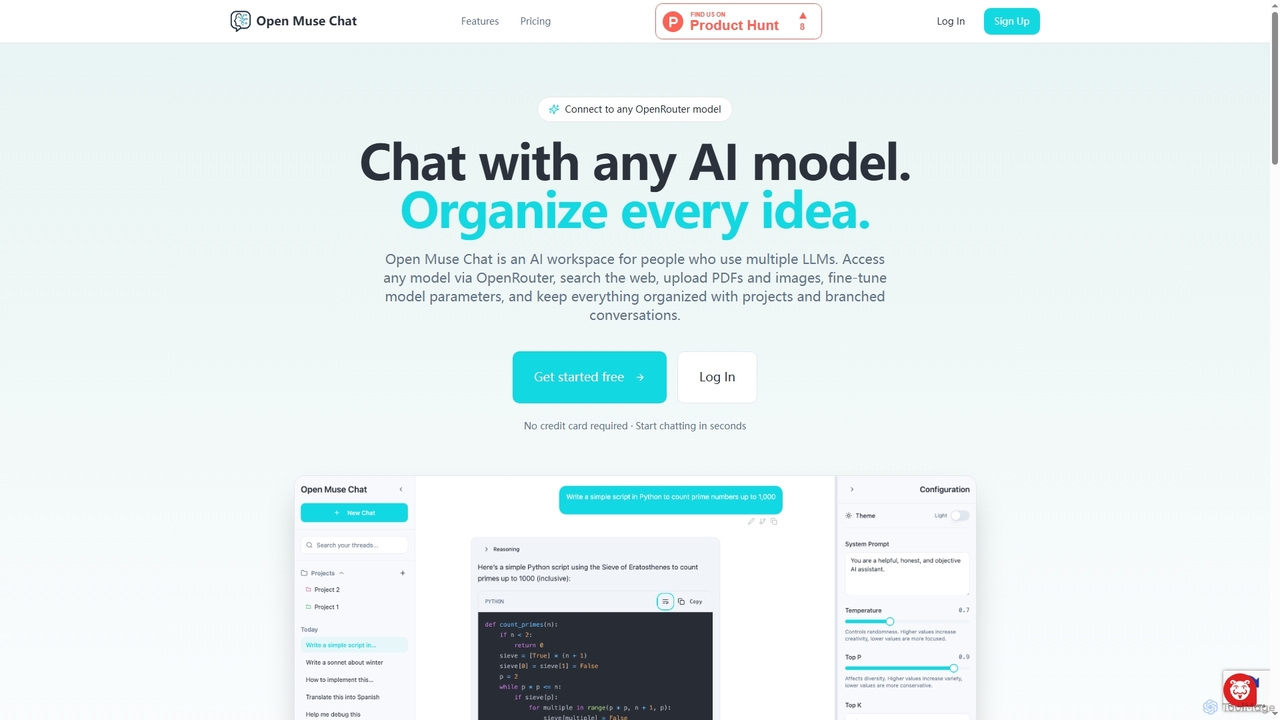
Open Muse Chat is an advanced multi-model AI chat interface designed for users who leverage various large language …
Open Muse Chat is an advanced multi-model AI chat interface designed for users who leverage various large language models. It connects to any OpenRouter model, offers web search, file uploads (PDFs, images) for context, and provides fine-grained control over model parameters, all within an organized workspace featuring projects and branched conversations.
Prompto
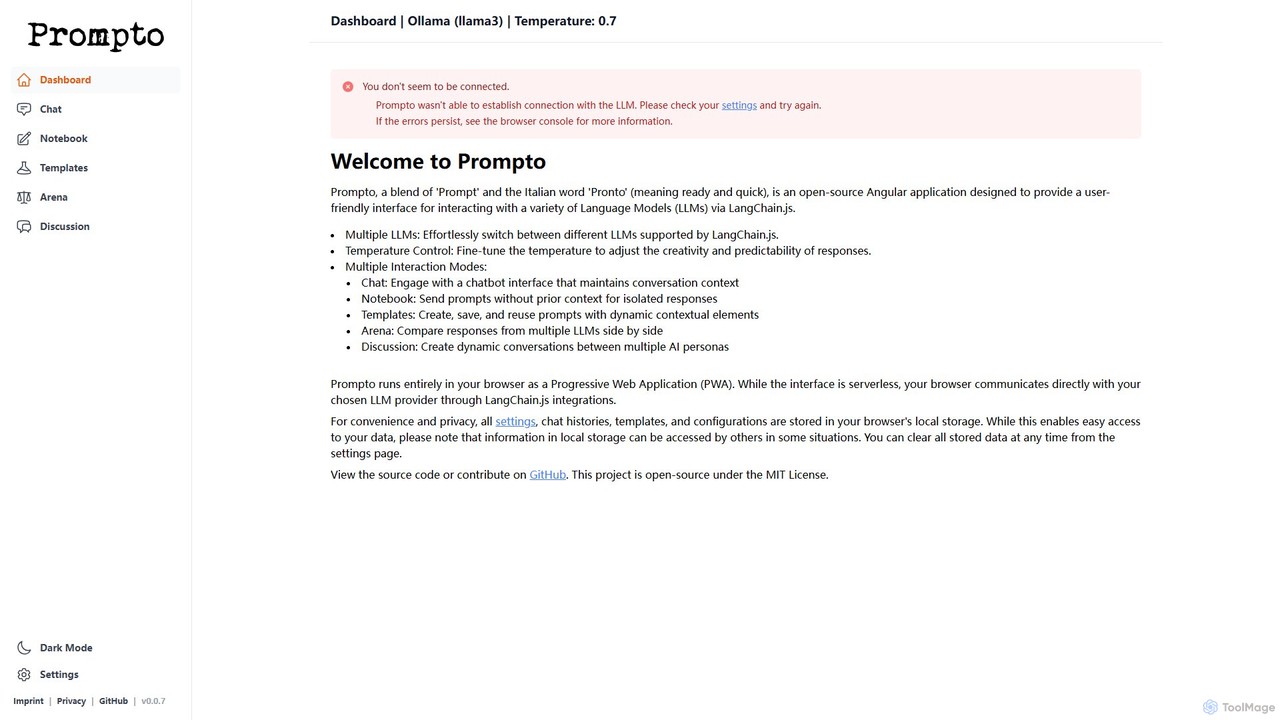
Prompto is a free, open-source, browser-based interface for interacting with a wide range of Large Language Models (LLMs). …
Prompto is a free, open-source, browser-based interface for interacting with a wide range of Large Language Models (LLMs). It leverages LangChain.js to connect directly to providers like OpenAI, Anthropic, and local models via Ollama, offering advanced features like a model comparison Arena, prompt templates, and multi-AI discussions, all while prioritizing user privacy by storing data locally.
About Llm Interface
An LLM Interface is a specialized developer tool that acts as a unified gateway for accessing multiple Large Language Models (LLMs). These tools provide a single, consistent API, allowing developers to interact with different models like GPT, Claude, or Llama without writing provider-specific code. This abstraction layer simplifies development, optimizes costs, and enhances application resilience by enabling seamless model switching and fallbacks. For developers building AI-powered applications, an LLM Interface is a crucial component for managing complexity and improving operational efficiency.
Core Features
- Unified API: Connect to various LLMs from different providers through a single, standardized API endpoint.
- Model Routing & Fallbacks: Automatically direct requests to the most suitable model based on cost or performance, with built-in fallback mechanisms.
- Cost & Usage Tracking: Monitor API expenses, token usage, and latency across all connected models in a centralized dashboard.
- Prompt Management: Create, test, version, and deploy prompt templates centrally for consistent application behavior.
- Request Caching: Store and reuse responses for identical requests to reduce latency and lower API costs.
Use Cases
LLM Interfaces are primarily used by software developers, AI engineers, and product teams building applications that require flexibility and reliability. They are ideal for creating multi-provider chatbots, content generation platforms that leverage the strengths of different models, or complex AI agents that need to dynamically select the best tool for a task. Enterprises also use them to standardize and govern LLM access across the organization.
How to Choose
When selecting an LLM Interface, consider the following: First, evaluate the list of supported LLMs and the speed at which new models are integrated. Second, assess performance metrics like latency overhead and reliability guarantees. Third, examine the observability features, such as the quality of logging, cost tracking dashboards, and analytics. Finally, review the developer experience, including the quality of documentation and the availability of SDKs for your preferred programming languages.
Llm InterfaceUse Cases
Building a Resilient AI Chatbot with Model Fallbacks
A customer service tech lead needs to ensure their support chatbot maintains high uptime. Using an LLM Interface, they configure a primary model like GPT-4 for high-quality responses and a secondary, cost-effective model like Claude 3 Sonnet as a fallback. If the primary model's API experiences an outage or high latency, the interface automatically reroutes all incoming requests to the fallback model. This ensures the chatbot remains operational and responsive to users, preventing service disruption without requiring manual intervention from the engineering team.
A/B Testing Prompts for a Marketing Copy Generator
A marketing technologist aims to find the most effective prompt for generating ad headlines. Using the LLM Interface's prompt management system, they create two variations of a prompt ('Prompt A' and 'Prompt B'). The interface is configured to route 50% of the generation requests to each prompt version. The integrated analytics dashboard tracks key metrics like click-through rates and user engagement for the headlines generated by each prompt. After analyzing the data, the team can confidently deploy the winning prompt to 100% of traffic with a single click, optimizing their campaign performance.
Optimizing API Costs for a Content Summarization Service
A startup's summarization tool needs to manage LLM API costs effectively. They use an LLM Interface to implement intelligent routing. Simple requests, like summarizing a short paragraph, are sent to a fast, low-cost model. More complex tasks, such as summarizing a 20-page document, are routed to a powerful, high-capability model. The interface's cost-tracking dashboard provides a real-time view of spending per model, allowing the team to fine-tune their routing rules and caching strategy to stay within budget while maintaining high-quality output for all users.
Standardizing LLM Access Across a Large Enterprise
An enterprise IT architect needs to provide developers with secure, governed access to various LLMs. They deploy a central LLM Interface as a gateway. This allows them to manage all API keys in one secure vault, set spending limits and usage quotas for different teams, and enforce data privacy policies. The interface logs every request, providing a complete audit trail for compliance purposes. This centralized approach empowers development teams to innovate with different models while ensuring the organization maintains control over security, costs, and governance.
Rapid Prototyping of an AI-Powered Feature
A product team is quickly building a prototype for a new AI feature. Instead of writing separate integrations for OpenAI, Anthropic, and Google, they use a single LLM Interface SDK. This allows them to switch between GPT-4, Claude, and Gemini by changing just one line of configuration code. They can rapidly test which model provides the best quality, speed, and cost-effectiveness for their specific use case. This dramatically accelerates the prototyping phase, enabling them to validate their idea and move to production much faster.
Caching Responses for a High-Traffic Q&A System
A developer is building a FAQ bot for a popular e-commerce site that receives many repetitive questions. They enable the caching feature in their LLM Interface. When a question like 'What is your return policy?' is asked for the first time, the LLM generates an answer, and the interface stores this question-answer pair in a cache. For all subsequent identical questions, the answer is served directly from the cache in milliseconds. This strategy significantly reduces API calls to the LLM provider, lowering costs by over 70% and providing near-instant responses to users for common queries.