
ToolMage
Sign in

Best 1 Multi Model AI tools for Ai Chatbot

Popular Multi Model AI tools in Ai Chatbot include Open Muse Chat, helping you work more efficiently.

Open Muse Chat
Freemium

Open Muse Chat

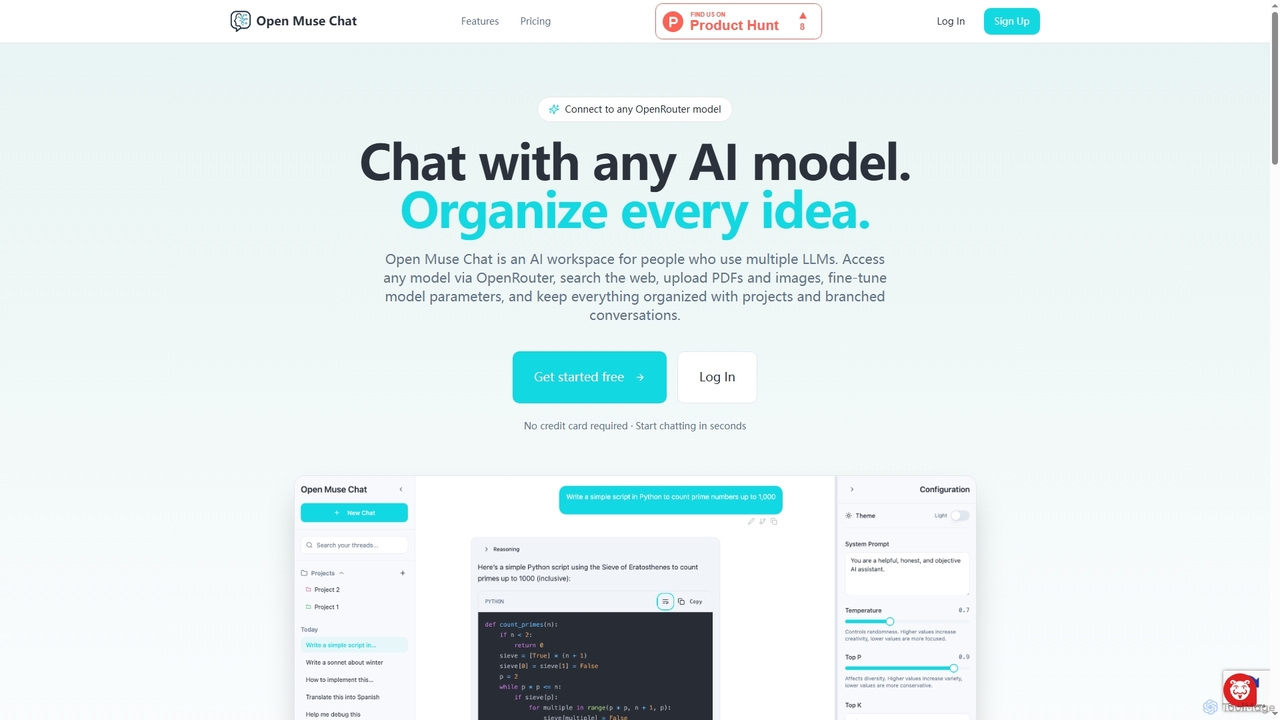
Open Muse Chat is an advanced multi-model AI chat interface designed for users who leverage various large language models. It connects to any OpenRouter model, offers web search, file uploads (PDFs, images) for context, and provides fine-grained control over model parameters, all within an organized workspace featuring projects and branched conversations.

Multi Model
Visits 3.7KFavorites 116Likes 118

About Multi Model

Multi-model AI tools are advanced AI chatbots capable of processing and generating information across various modalities, including text, images, audio, and video. These tools leverage sophisticated AI models to understand complex queries that combine different data types, offering richer and more contextually aware interactions. They represent a significant evolution in conversational AI, moving beyond text-only communication to enable more natural and comprehensive digital experiences.

Core Features

  • Multimodal Input Processing: Understands and integrates information from text, speech, images, and video simultaneously.
  • Multimodal Output Generation: Generates responses in various formats, such as text, synthesized speech, images, or even short video clips.
  • Cross-Modal Reasoning: Connects concepts and information across different modalities to provide coherent and relevant answers.
  • Contextual Understanding: Maintains a deeper understanding of user intent by analyzing diverse input types.

Applicable Scenarios

Multi-model AI tools are invaluable in creative industries for generating content ideas from text prompts and visual references. They assist customer service by analyzing spoken queries alongside uploaded images of issues. In education, they can explain complex topics using diagrams and spoken explanations based on text questions.

How to Choose

When selecting a multi-model AI tool, evaluate its supported modalities and the quality of its cross-modal understanding. Consider the specific output formats required for your applications and the tool's ability to integrate with existing workflows. Assess the accuracy and coherence of its generated content across different data types, along with its scalability and pricing structure.

Featured tool rankings

Multi Model use cases

1

Visual-Assisted Customer Support

A customer service agent uses a multi model chatbot to understand user issues. A user uploads a photo of a broken product part along with a text description of the problem. The chatbot instantly analyzes the image, identifies the part, and provides relevant troubleshooting steps or links to replacement parts, significantly speeding up resolution times and improving customer satisfaction.

2

Interactive Product Design & Prototyping

Product designers can use multi-model AI to rapidly iterate on concepts. By providing text descriptions, rough sketches, and voice commands, the AI generates detailed 3D models or visual mockups, allowing for real-time adjustments and exploration of design variations. This accelerates the initial design phase, reducing the time from concept to tangible prototype.

3

Generating Multimodal Marketing Content

A marketing specialist needs to create engaging social media posts. They provide the multi model AI with a text prompt describing a new product and a few reference images. The AI then generates not only compelling ad copy but also several unique product images and even a short promotional video clip, streamlining the content creation process and diversifying output formats.

4

Enhanced Customer Support with Visuals

For technical support or product troubleshooting, customers can describe their issue via text or voice while simultaneously uploading photos or videos of the problem. The multi-model AI analyzes all inputs to diagnose the issue more accurately, providing step-by-step text instructions, relevant diagrams, or even short video tutorials as a solution.

5

Personalized Learning and Tutoring

A student is struggling with a complex science concept. They can ask the multi model AI a question via voice, show it a diagram, and type additional context. The AI processes all inputs, explains the concept using text, generates a clarifying illustration, and even provides an audio summary, offering a highly personalized and comprehensive learning experience.

6

Dynamic Content Creation for Marketing

Marketing teams leverage multi-model AI to create diverse content from a single brief. Inputting a campaign theme and target audience, the AI generates social media posts (text + image), short promotional videos, and audio scripts for ads. This streamlines content production across multiple platforms, ensuring brand consistency and reducing manual effort.

7

AI-Powered Concept Design & Prototyping

A product designer wants to visualize a new furniture piece. They describe its style, materials, and dimensions in text, and upload a sketch. The multi model AI interprets these inputs to generate high-fidelity 3D renders or multiple 2D design variations, allowing for rapid iteration and exploration of design concepts without extensive manual effort.

8

Personalized Educational Tutoring

Students can interact with multi-model AI tutors by asking questions through text or voice, uploading images of homework problems, or even demonstrating concepts via video. The AI responds with explanations tailored to the student's learning style, using text, diagrams, spoken explanations, or interactive simulations to clarify complex subjects.

9

Bridging Communication Gaps

Individuals with communication challenges can use multi model tools to translate their intent across modalities. For example, a user might point to an object (image input) and speak a partial sentence (audio input), and the AI completes the sentence and provides a full textual or spoken response, facilitating more natural and effective communication.

10

Accessibility and Inclusive Communication

Multi-model AI tools enhance accessibility by converting information between modalities. A user with visual impairment can input text or voice queries and receive audio descriptions of images or video content. Conversely, a user with hearing impairment can receive text transcripts or visual summaries of spoken content, fostering more inclusive digital interactions.

11

Real-time Event Analysis and Reporting

During live events or surveillance, multi-model AI can process simultaneous streams of video, audio, and text (e.g., social media feeds). It identifies key activities, transcribes spoken dialogue, and summarizes textual discussions, generating comprehensive real-time reports or alerts. This is crucial for security monitoring, media analysis, and rapid incident response.

12

Real-time Multimodal Anomaly Detection

In a security context, a multi model AI monitors live video feeds and audio inputs. If it detects unusual visual patterns (e.g., unauthorized entry) combined with specific audio cues (e.g., breaking glass), it can instantly alert security personnel with a detailed report, including relevant video snippets and textual descriptions, enhancing proactive threat detection.

Multi Model FAQ

What are Multi Model AI tools?

Multi Model AI tools are advanced artificial intelligence systems that can understand, process, and generate information across multiple data types or "modalities," such as text, images, audio, and video. Unlike traditional AI chatbots that primarily handle text, multi model tools integrate these diverse inputs and outputs to create more comprehensive and human-like interactions. They aim to mimic human cognitive abilities to perceive and interpret the world through various senses.

What are Multi-model AI tools?

Multi-model AI tools are advanced artificial intelligence systems, often integrated into AI chatbots, that can understand and generate information across multiple data types simultaneously. Unlike traditional AI that might only process text, multi-model AI handles combinations of text, images, audio, and video, enabling more comprehensive and human-like interactions. They are designed to interpret complex, real-world scenarios where information is rarely confined to a single format.

How do Multi-model AI tools differ from standard AI Chatbots?

Standard AI chatbots primarily interact using text, processing written queries and generating text-based responses. Multi-model AI tools, while often functioning as chatbots, extend this capability by integrating and understanding non-textual inputs like images, audio, and video, and can also generate responses in these diverse formats. This allows them to tackle more complex problems that require cross-modal reasoning, offering a richer and more versatile conversational experience than text-only systems.

How do Multi Model AI tools differ from standard AI Chatbots?

Standard AI Chatbots primarily interact through text, understanding and generating written language. Multi Model AI tools, while often incorporating text, extend this capability by integrating other modalities like images, audio, and video. This means a multi model chatbot can interpret a user's spoken question while simultaneously analyzing an image they've uploaded, and then respond with a combination of text, a generated image, or even synthesized speech, offering a far richer and more versatile interaction than text-only chatbots.

What are the key benefits of using Multi-model AI tools?

The primary benefits include enhanced contextual understanding, as the AI can draw insights from diverse data types simultaneously. This leads to more accurate and relevant responses. They also enable more natural and intuitive user interactions, mirroring human communication. Furthermore, multi-model tools unlock new possibilities for content creation, problem-solving, and accessibility across various industries by breaking down modality barriers.

What are the key benefits of using Multi Model AI tools?

The primary benefits include enhanced understanding of complex user intent, more natural and intuitive user experiences, and the ability to generate diverse and creative outputs. They can solve problems that require cross-modal reasoning, such as describing an image in detail or generating an image from a textual description. This leads to increased efficiency in tasks like content creation, improved accessibility, and more effective communication across various applications.

What technical considerations are important when implementing Multi Model AI?

Implementing Multi Model AI requires robust infrastructure to handle large volumes of diverse data. Key considerations include the computational power needed for processing multiple modalities simultaneously, the complexity of model architecture for integrating different data types, and the quality of training data across all modalities. Data privacy and ethical considerations for generating content (especially images and audio) are also crucial, along with ensuring seamless integration with existing systems.

Who can benefit most from Multi-model AI tools?

A wide range of users and industries can benefit. Content creators can generate diverse media from single prompts. Marketers can create dynamic campaigns. Customer service teams can resolve complex issues with visual aids. Educators can offer personalized, interactive learning experiences. Developers can build more sophisticated and human-centric applications, and accessibility professionals can create more inclusive digital environments.

What should I consider when choosing a Multi-model AI platform?

When selecting a multi-model AI platform, assess its supported input and output modalities and the quality of its cross-modal integration. Evaluate the accuracy and coherence of its generated content across different formats. Consider its ease of integration with your existing systems, the availability of APIs, and its scalability to handle varying workloads. Finally, review its pricing model, data privacy policies, and the level of technical support offered.

Who can benefit most from Multi Model AI tools?

A wide range of users can benefit. Content creators and marketers can generate diverse media from single prompts. Designers and artists can rapidly prototype visual concepts. Educators can create interactive learning materials. Customer service departments can handle more complex queries involving visual or audio evidence. Developers can build more intuitive and powerful applications, and individuals with accessibility needs can find new ways to communicate and interact with technology.