BenchLLM
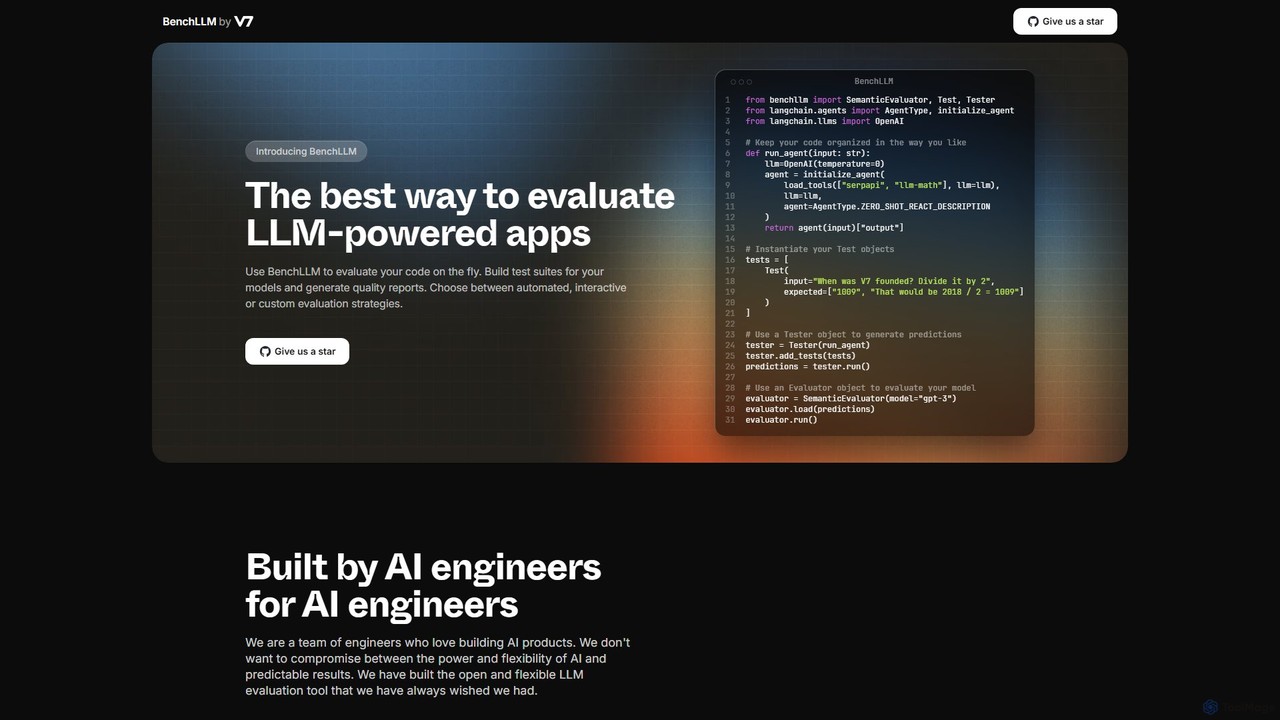
A powerful open-source framework for AI engineers to evaluate and test Large Language Model (LLM) applications. BenchLLM provides …
A powerful open-source framework for AI engineers to evaluate and test Large Language Model (LLM) applications. BenchLLM provides a flexible API and a robust CLI to build test suites, generate quality reports, and integrate model evaluation into CI/CD pipelines, ensuring predictable and high-quality results.
About Testing & Debugging
AI Testing & Debugging tools are a specialized category of developer utilities that use artificial intelligence to automate and enhance the software quality assurance process. These tools leverage machine learning models to analyze code, generate comprehensive test cases, predict potential bugs, and identify the root cause of errors more efficiently than traditional methods. Their primary value lies in accelerating development cycles, improving code reliability, and freeing up developers to focus on building features rather than manual bug hunting. They represent a significant evolution in how software is built and maintained, making the entire process more intelligent and proactive.
Core Features
- AI-Powered Test Case Generation: Automatically creates meaningful unit, integration, and end-to-end tests based on code analysis.
- Predictive Bug Analysis: Uses historical data and code patterns to identify areas most likely to contain future defects.
- Automated Root Cause Analysis: Pinpoints the source of failures by analyzing logs, crash reports, and code changes.
- Intelligent Log Analysis: Filters and categorizes vast amounts of log data to highlight critical errors and anomalies.
- Code Refactoring Suggestions: Recommends improvements to code structure and logic to enhance maintainability and performance.
Use Cases
These tools are essential for software development teams, QA engineers, and DevOps professionals working in fast-paced environments. They are commonly integrated into CI/CD pipelines to provide continuous quality checks. In large-scale enterprise applications, they help manage code complexity and reduce maintenance overhead. They are also valuable for performance engineers seeking to identify and resolve system bottlenecks before they impact users.
How to Choose
When selecting an AI Testing & Debugging tool, consider its integration capabilities with your existing IDE, version control, and CI/CD systems. Evaluate its support for your specific programming languages and frameworks. Assess the depth and accuracy of its analysis, and consider whether its focus aligns with your primary need, such as test generation, performance monitoring, or security vulnerability detection. Finally, review its scalability to handle the size and complexity of your codebase.

Testing & DebuggingUse Cases
Automating Unit Testing in CI/CD Pipelines
A DevOps engineer integrates an AI testing tool into their team's CI/CD pipeline. For every new code commit, the tool automatically analyzes the changes and generates relevant unit tests that cover new logic and edge cases. This process ensures that potential bugs are caught immediately after they are introduced, long before reaching production. The result is a significant reduction in manual test writing, faster feedback loops for developers, and a more stable and reliable build process.
Accelerating Root Cause Analysis for Production Issues
A Site Reliability Engineer (SRE) is alerted to a critical performance degradation in a live application. Instead of manually sifting through gigabytes of logs and metrics, they use an AI debugging tool. The tool automatically correlates user-reported issues with server logs, database queries, and recent code deployments. Within minutes, it highlights a specific inefficient database query introduced in the latest release as the likely root cause, providing the exact code block and suggesting an optimized version. This reduces the mean time to resolution (MTTR) from hours to minutes.
Proactive Security Vulnerability Detection
A DevSecOps team employs an AI-powered testing tool to continuously scan their application's codebase. The tool's machine learning model, trained on a vast dataset of known vulnerabilities and secure coding patterns, identifies potential security flaws that traditional static analysis might miss. For example, it flags a subtle cross-site scripting (XSS) vulnerability in a newly developed API endpoint. By catching this issue during the development phase, the team prevents a potentially serious security breach, saving significant remediation costs and protecting user data.
Identifying Performance Bottlenecks in Complex Systems
A performance engineer is tasked with optimizing a microservices-based e-commerce platform. They use an AI analysis tool that traces requests across multiple services. The tool builds a dynamic performance model of the entire system and identifies that a specific image processing service becomes a bottleneck during peak traffic. It provides detailed flame graphs and pinpoints the exact function causing high CPU usage. Based on this insight, the team optimizes the function, resulting in a 30% improvement in page load times during sales events.
Improving Code Review with AI-Assisted Suggestions
A software development team integrates an AI debugging tool into their code review workflow. When a developer submits a pull request, the AI assistant automatically reviews the code. It flags potential issues such as race conditions, inefficient algorithms, or deviations from best practices that human reviewers might overlook. For instance, it suggests replacing a nested loop with a more efficient data structure, providing a code snippet for the fix. This enhances the quality of peer reviews, educates junior developers, and ensures higher code quality is merged into the main branch.
Generating Realistic Test Data for Edge Cases
A QA automation engineer is testing a new feature in a financial application that processes complex transactions. Manually creating diverse and realistic test data that covers all edge cases is time-consuming and prone to gaps. They use an AI tool to generate a large dataset of synthetic but valid transaction data, including rare but critical scenarios like negative balances, special character inputs, and maximum value transfers. This allows for more thorough and robust testing, significantly increasing confidence in the feature's reliability before release.