ToolMage
Sign in

Best 1 Data Structuring AI tools for Document Processing

Popular Data Structuring AI tools in Document Processing include Octro, helping you work more efficiently.

Octro
Freemium

Octro

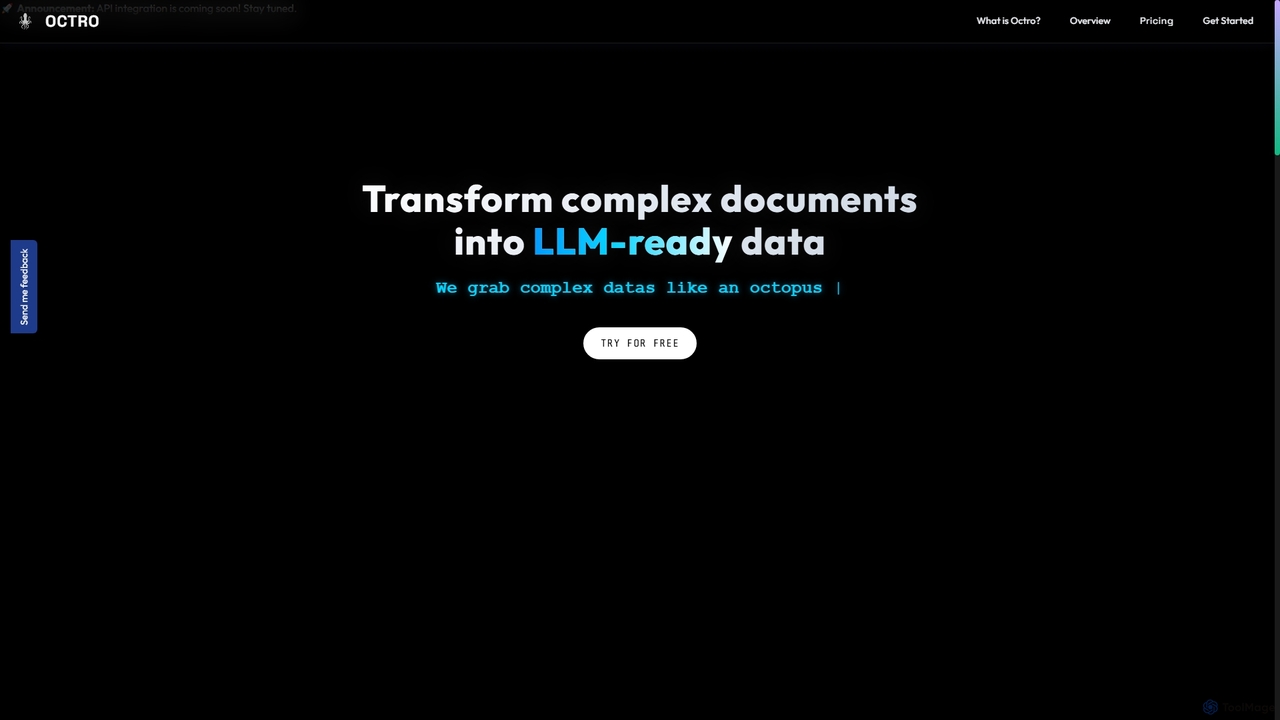
Octro is an AI-powered tool designed to transform complex documents, particularly PDFs, into structured, LLM-ready data formats like JSON and CSV. It specializes in accurate table extraction, enabling businesses across various industries to streamline data processing and enhance analytical workflows.

3D
Visits 3.4KFavorites 109Likes 107

About Data Structuring

Data Structuring AI tools are designed to transform unstructured or semi-structured data from documents into organized, machine-readable formats. These tools leverage advanced natural language processing (NLP) and machine learning algorithms to identify, extract, and categorize key information. Their primary value lies in enabling efficient data analysis, automation, and integration into databases or business systems, significantly streamlining document-centric workflows within the broader context of document processing.

Core Features

  • Intelligent Data Extraction: Automatically identifies and pulls specific data points (e.g., names, dates, amounts, addresses) from various document types like invoices, contracts, or reports.
  • Schema Mapping & Normalization: Maps extracted data to predefined schemas or templates, ensuring consistency and normalizing formats for database compatibility.
  • Table & List Recognition: Accurately detects and extracts data from complex tables, lists, and repetitive patterns within documents, preserving structural integrity.
  • Relationship Identification: Uncovers and structures relationships between different data entities within a document, such as linking an invoice number to line items.
  • Validation & Error Correction: Implements rules and AI models to validate extracted data against known patterns or external sources, flagging and suggesting corrections for inconsistencies.

Applicable Scenarios

Businesses across finance, legal, and healthcare sectors frequently use Data Structuring tools to automate the processing of high volumes of documents. For instance, a financial institution can automatically extract transaction details from bank statements, or a legal firm can structure clauses and entities from contracts for faster review and analysis. This significantly reduces manual data entry and improves accuracy.

How to Choose

When selecting a Data Structuring AI tool, consider its accuracy in extracting diverse data types, its ability to handle various document formats (PDF, images, handwritten), and its integration capabilities with existing enterprise systems. Evaluate the ease of defining custom extraction rules and the tool's scalability to process growing data volumes, alongside its security features for sensitive information.

Featured tool rankings

Data Structuring use cases

1

Extracting Key Contract Details

Legal professionals can use AI Data Structuring tools to automatically identify and extract critical information like party names, dates, clauses, and obligations from hundreds of legal contracts. This significantly reduces manual review time, ensures compliance, and facilitates rapid contract analysis, saving hours of tedious work per document.

2

Automating Invoice Data Entry

Finance departments or small businesses can use Data Structuring tools to automatically extract vendor names, invoice numbers, line items, and total amounts from incoming invoices. This eliminates manual data entry into accounting software, reducing errors and accelerating payment processing cycles, allowing staff to focus on reconciliation and analysis.

3

Structuring Legal Contract Clauses

Legal professionals and paralegals utilize these tools to parse complex legal contracts, identifying and structuring specific clauses, parties, dates, and obligations. This enables rapid contract review, comparison, and compliance checks, significantly cutting down the time spent on manual document analysis and improving legal due diligence processes.

4

Automating Invoice Processing

Finance departments leverage these tools to convert diverse invoice formats (PDFs, scanned images) into structured data. The AI extracts vendor names, line items, amounts, and dates, populating accounting systems directly. This eliminates manual data entry errors, accelerates payment cycles, and provides real-time financial insights.

5

Structuring Customer Feedback for Analysis

Marketing and product teams utilize Data Structuring to process large volumes of unstructured customer feedback from surveys, emails, and social media. The tools identify key themes, sentiment, and product features mentioned, transforming qualitative data into quantifiable insights for product improvement and strategic decision-making.

6

Extracting Patient Information from Medical Records

Healthcare providers and researchers can employ Data Structuring AI to extract critical patient data, such as diagnoses, medications, lab results, and treatment histories, from unstructured clinical notes and scanned medical records. This facilitates better patient management, supports clinical research, and ensures compliance with data privacy regulations.

7

Organizing Medical Records for Research

Healthcare researchers employ Data Structuring to extract specific patient demographics, diagnoses, treatments, and outcomes from clinical notes and medical reports. This structured data is then used for large-scale epidemiological studies, drug efficacy analysis, and identifying trends, accelerating medical discovery while maintaining patient privacy.

8

Digitizing and Structuring Research Papers

Academic researchers and librarians can leverage Data Structuring tools to convert scientific papers, journals, and reports into structured data. This involves extracting author details, abstracts, keywords, methodologies, and results, making the vast amount of research literature searchable, analyzable, and integrable into knowledge bases for meta-analysis.

9

Normalizing Product Data for E-commerce

E-commerce businesses use Data Structuring to standardize product attributes (e.g., size, color, material, specifications) from various supplier catalogs. This ensures consistent product listings across platforms, improves searchability, and enhances the customer shopping experience by providing accurate and uniform product information.

10

Streamlining Loan Application Processing

Financial institutions use Data Structuring AI to process various documents submitted with loan applications, such as bank statements, pay stubs, and identity documents. The tools extract relevant financial figures, personal details, and verification data, accelerating the underwriting process and improving decision-making accuracy by providing structured insights.

11

Converting Research Papers to Knowledge Graphs

Academic institutions and R&D departments apply Data Structuring to parse scientific papers, identifying key concepts, authors, methodologies, and findings. This allows for the creation of structured knowledge graphs, enabling researchers to quickly discover connections between studies, track research trends, and accelerate literature reviews.

12

Organizing Product Specifications from Manufacturer Manuals

E-commerce businesses or product managers can use Data Structuring tools to extract detailed product specifications, features, and technical data from manufacturer manuals or datasheets. This structured information can then be automatically populated into product databases, online catalogs, or comparison websites, ensuring consistent and accurate product listings.

13

Streamlining Compliance Document Review

Regulatory and compliance teams use Data Structuring tools to extract specific regulatory requirements, policy clauses, and audit findings from vast repositories of compliance documents. This automation ensures consistent adherence to regulations, reduces the risk of non-compliance, and significantly speeds up audit preparation and response times by providing structured, searchable data.

Data Structuring FAQ

What are AI Data Structuring tools?

AI Data Structuring tools are advanced software solutions that use artificial intelligence, particularly natural language processing (NLP) and machine learning, to convert unstructured or semi-structured data into a highly organized, machine-readable format. They are crucial for transforming raw information from documents like PDFs, images, and text files into structured data such as tables, databases, or JSON objects, making it ready for analysis, automation, and integration into business systems.

What are Data Structuring AI tools?

Data Structuring AI tools are software solutions that use artificial intelligence, primarily natural language processing (NLP) and machine learning, to convert unstructured or semi-structured data from documents into a highly organized, machine-readable format. They are essential for automating data extraction, categorization, and normalization, making information readily usable for analysis, database integration, and business process automation.

How do AI Data Structuring tools differ from general Document Processing tools?

While Data Structuring is a subset of Document Processing, its core focus is specifically on transforming data *within* documents into a structured format. General Document Processing encompasses a broader range of tasks like document classification, optical character recognition (OCR), and basic text extraction. Data Structuring goes further by not just extracting text, but understanding its context, identifying entities, and organizing it according to a predefined schema, making the data truly actionable and ready for advanced analytics.

How do Data Structuring tools differ from general Document Processing tools?

While Data Structuring is a subset of Document Processing, its unique focus is on transforming raw document content into structured data. General Document Processing tools might handle tasks like OCR, document classification, or basic search. Data Structuring specifically goes further by identifying specific data points, mapping them to schemas, and establishing relationships, enabling deeper analytical and automated uses beyond simple document management.

What are the key benefits of using AI for Data Structuring?

The primary benefits include significantly increased efficiency by automating manual data entry, improved accuracy by reducing human error, and enhanced data quality through normalization and validation. AI-powered tools can process vast volumes of data much faster than humans, extract complex information that might be overlooked, and adapt to varying document layouts, leading to better decision-making and operational cost savings.

What types of documents can Data Structuring AI tools process?

Data Structuring AI tools can process a wide array of document types, including invoices, contracts, legal documents, medical records, financial statements, research papers, forms, and reports. They are adept at handling various formats such as PDFs, scanned images, handwritten notes (with OCR integration), and digital text documents, extracting data regardless of its initial layout complexity.

What are the key benefits of using AI for Data Structuring?

The primary benefits include significantly increased efficiency by automating manual data entry, drastically reduced human error rates, and accelerated data processing speeds. These tools enable better data quality, facilitate faster decision-making through readily available structured insights, and allow for seamless integration with other business intelligence and automation systems, leading to substantial cost savings.

Which industries can benefit most from Data Structuring tools?

Virtually any industry dealing with large volumes of documents can benefit. Key sectors include finance (for contracts, invoices, reports), legal (for agreements, case files), healthcare (for patient records, clinical notes), insurance (for claims processing), and e-commerce (for product catalogs, customer feedback). These tools are essential wherever unstructured information needs to be converted into actionable insights or integrated into automated workflows.

How do I choose the best Data Structuring AI tool for my business?

To choose the best tool, assess its accuracy for your specific document types and data fields, its ability to integrate with your existing software (CRM, ERP, accounting systems), and its scalability to handle your data volume. Consider the ease of customization for unique document layouts, the level of technical expertise required, and the vendor's support and security features, especially for sensitive data.

What should I consider when evaluating AI Data Structuring solutions?

When evaluating solutions, consider the tool's accuracy in extracting data from your specific document types and languages, its scalability to handle your current and future data volumes, and its integration capabilities with your existing CRM, ERP, or database systems. Also, assess the ease of defining custom schemas, the level of human-in-the-loop validation, and the security features for sensitive data. Finally, compare pricing models and vendor support.