Kaggle
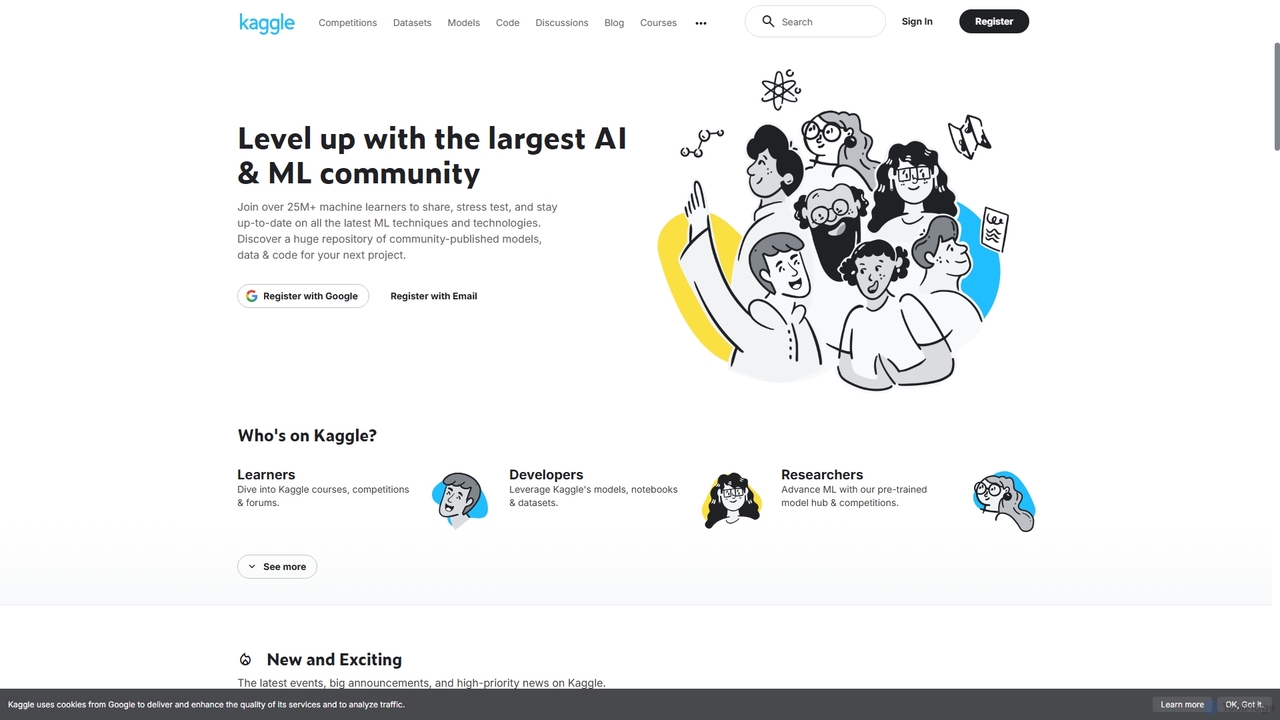
Kaggle is the world's largest online community for data scientists and machine learning practitioners. Owned by Google, it …
Kaggle is the world's largest online community for data scientists and machine learning practitioners. Owned by Google, it provides a platform to explore datasets, build models in a web-based environment, compete in machine learning challenges, and access educational resources. It offers free access to powerful computational resources, including GPUs and TPUs, making it an essential tool for anyone from beginners to seasoned experts in the AI and data science fields.
The Pudding
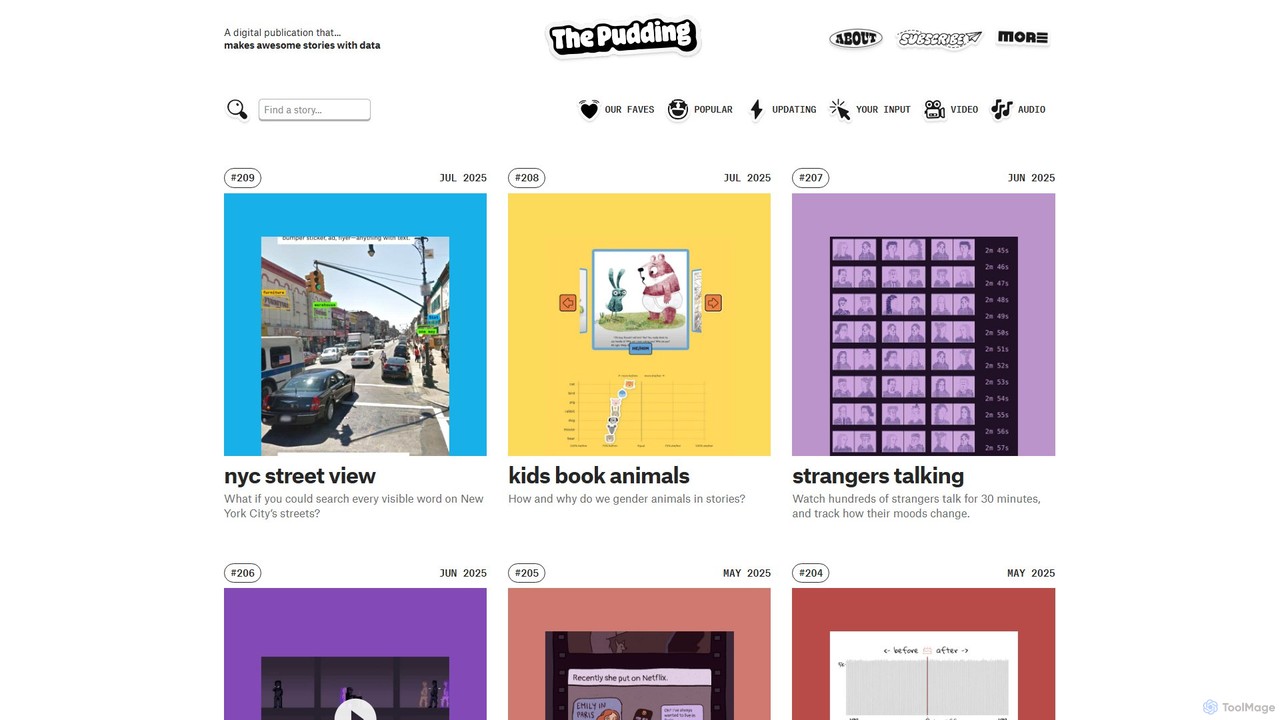
The Pudding is an award-winning digital publication that creates insightful visual essays on cultural topics. It leverages data …
The Pudding is an award-winning digital publication that creates insightful visual essays on cultural topics. It leverages data journalism, interactive visualizations, and AI-powered analysis to explain complex ideas in an engaging and accessible way, covering subjects from music and film to social trends.
About Data Science
AI Data Science tools are specialized platforms designed to make learning and applying data science concepts more accessible, particularly within an educational context. These tools often integrate interactive coding environments, automated machine learning (AutoML) workflows, and guided tutorials to simplify complex processes. They empower students, educators, and aspiring professionals to analyze data, build predictive models, and generate insights without a deep prerequisite in programming or statistics. This approach accelerates the learning curve and fosters practical, hands-on skills in the field of data science.
Core Features
- Interactive Notebooks: Cloud-based environments for writing and executing code (like Python or R) with real-time results.
- Guided Model Building: Step-by-step interfaces that walk users through data preprocessing, model training, and evaluation.
- Data Visualization Tools: Drag-and-drop builders for creating insightful charts and dashboards from datasets.
- Pre-loaded Datasets: Access to a library of clean, ready-to-use datasets for practice and projects.
- AI-Powered Code Assistance: Features that suggest, complete, or explain code snippets to aid the learning process.
Applicable Scenarios
These tools are ideal for academic settings, from university courses to high school STEM programs. They are also widely used by individuals for self-study, professionals seeking to upskill, and instructors creating engaging course materials for data literacy programs.
How to Choose
When selecting a tool, consider its target audience (beginner vs. advanced), the availability of learning resources like tutorials and projects, the programming languages it supports (e.g., Python, R, SQL), and its pricing model, especially the availability of free or student-focused plans.

Data ScienceUse Cases
Completing a University Machine Learning Assignment
A computer science student uses an AI data science platform to complete their final project on sentiment analysis. Instead of setting up a complex local environment, they use the platform's cloud-based notebook. The tool provides a pre-loaded dataset of customer reviews, a guided workflow for text preprocessing, and an AutoML feature to compare different classification models. They can easily visualize model performance metrics, select the best one, and export their findings into a report, all within a single, integrated environment.
Teaching Statistical Concepts in the Classroom
A statistics professor uses an interactive data science tool to demonstrate the concept of regression to the mean. In class, they upload a small dataset and use the tool's drag-and-drop visualization builder to create a scatter plot in real-time. By interactively adding a regression line and analyzing outliers, they provide a dynamic and intuitive explanation that is far more engaging than static slides. This hands-on approach helps students grasp abstract statistical ideas through direct manipulation and observation.
Building a Data Science Portfolio for Career Changers
An individual transitioning into a data analyst role uses an AI-powered platform to build a compelling portfolio. They select a project from the platform's library, such as analyzing public transportation data to predict delays. The tool guides them through data cleaning, feature engineering, and building a time-series forecast model. The integrated AI assistant helps explain complex code functions. Upon completion, they can publish a shareable, interactive dashboard showcasing their analysis, which serves as tangible proof of their skills to potential employers.
Automating Data Preparation for Academic Research
A social sciences researcher needs to analyze a large survey dataset with many missing values and inconsistent formatting. Using an AI data science tool, they apply automated data cleaning functions to impute missing data and standardize categorical variables. The tool's data profiling feature quickly identifies anomalies and provides summary statistics, saving dozens of hours of manual spreadsheet work. This allows the researcher to focus their time on hypothesis testing and analysis rather than tedious data preparation.
Upskilling a Marketing Team with Data Analytics
A marketing manager uses a user-friendly data science platform for a team training session. The goal is to teach the team how to analyze campaign performance data. The platform's no-code interface allows team members to upload a CSV file from their latest campaign, create visualizations to track key metrics like click-through rates, and even build a simple model to predict customer churn. This empowers the non-technical team to derive data-driven insights independently.
Exploring Neural Network Architectures Visually
A student new to deep learning uses a specialized educational tool to understand how neural networks work. The tool provides a visual, node-based editor where they can drag and drop layers (e.g., dense, convolutional) to build a network architecture. As they train the model on a sample dataset like MNIST, they can see the weights and biases updating in real-time and visualize how data flows through the network. This interactive simulation demystifies the 'black box' nature of deep learning.