
Education Best in category 1 results Machine Learning AI Tool

Popular AI tools in the Machine Learning field of Education include Teachable Machine, etc., helping you quickly improve efficiency.

Free
Teachable Machine

Teachable Machine

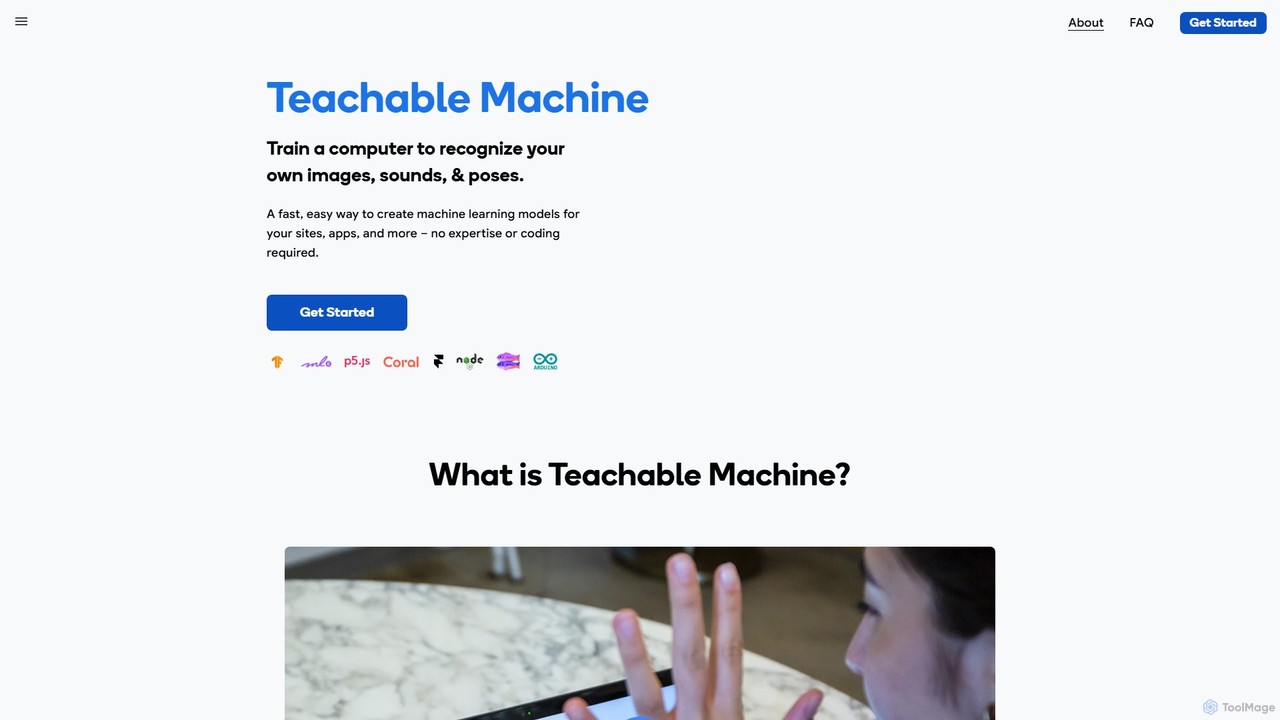
A fast, easy, web-based tool by Google that allows anyone to train a computer to recognize their own …

709.7K

About Machine Learning

Machine Learning tools are educational platforms and software designed to help users learn, build, and experiment with algorithms that enable systems to learn from data. These tools often provide visual interfaces, pre-built datasets, and interactive environments to simplify the complex processes of model training and evaluation. They are essential for students, researchers, and aspiring data scientists to gain practical skills and understand theoretical concepts without the steep initial setup of professional environments. By abstracting away some of the underlying code, these platforms accelerate the learning curve for data analysis and predictive modeling.

Core Features

  • Visual Model Builder: Drag-and-drop interfaces to construct and visualize machine learning pipelines.
  • Integrated Notebooks: Environments like Jupyter for interactive coding, documentation, and visualization.
  • Pre-loaded Datasets: Access to classic datasets for practice and experimentation without data sourcing hurdles.
  • Model Evaluation Metrics: Automated calculation and visualization of key performance indicators like accuracy, precision, and recall.
  • Simplified Deployment: Options to deploy trained models as APIs for testing and demonstration purposes.

Use Cases

These tools are primarily used in academic and self-learning settings. University students use them for data science courses and capstone projects. Researchers leverage them for rapid prototyping and experimentation. Self-taught developers and data enthusiasts use them to build portfolios and compete in data science competitions.

How to Choose

When selecting a Machine Learning tool for education, consider your current skill level; some tools are no-code and ideal for beginners, while others require Python or R proficiency. Evaluate the availability of tutorials and community support. Also, check the pricing model, as many platforms offer free or student-discounted tiers suitable for learning.

Machine LearningUse Cases

1

Building a First Classification Model

A university student in a 'Data Science 101' course uses a visual ML tool to understand the fundamentals of classification. They upload a customer churn dataset, use drag-and-drop modules for data cleaning and feature selection, and connect them to a logistic regression algorithm. The tool automatically visualizes the confusion matrix and ROC curve, helping the student interpret the model's performance without writing complex code. This hands-on experience solidifies their understanding of the end-to-end machine learning workflow.

2

Prototyping a Research Hypothesis

A postgraduate researcher in social sciences needs to test if there's a correlation between online discourse and public opinion trends. Using an ML platform with integrated notebooks, they quickly load text data, apply pre-trained sentiment analysis models, and train a simple regression model. This allows for rapid iteration and validation of their hypothesis before committing to a full-scale, code-intensive research project, saving weeks of development time.

3

Teaching an Interactive AI Workshop

A corporate trainer hosts a workshop to upskill marketing analysts in predictive analytics. They use a cloud-based ML environment where each participant gets a pre-configured workspace with datasets and guided exercises. The trainer can monitor progress and demonstrate concepts like A/B testing model performance in real-time. The interactive nature of the tool keeps participants engaged and ensures they can apply what they've learned directly to business problems.

4

Developing a Personal Portfolio Project

An aspiring data scientist wants to build a project for their portfolio to showcase their skills to potential employers. They use an ML tool to create a movie recommendation engine. They leverage a public dataset, experiment with collaborative filtering and content-based filtering algorithms, and deploy the final model as a simple web API using the tool's simplified deployment feature. This creates a tangible, demonstrable project that highlights their practical ML capabilities.

5

Exploring Computer Vision Concepts

A computer science enthusiast is curious about computer vision. They use an ML learning platform that offers pre-trained models like YOLO or ResNet. They can upload their own images to see object detection and image classification in action. The platform's tutorials guide them through the process of fine-tuning a model on a small, custom dataset, providing an accessible entry point into a complex and fascinating AI subfield.

6

Competing in a Data Science Competition

A team of students participates in a data science competition. They use a collaborative ML platform that allows them to share notebooks, track experiments, and version their models. The platform's powerful GPU resources accelerate the training of complex models like Gradient Boosting or Neural Networks. This collaborative and high-performance environment enables them to efficiently iterate on their solutions and compete effectively against other teams.

Machine LearningFrequently Asked Questions