Education Best in category 3 results Music Theory AI Tool

Popular AI tools in the Music Theory field of Education include songmeaning、WhatTheBeat、Virtuozy, etc., helping you quickly improve efficiency.

Virtuozy

Virtuozy

Virtuozy is an AI-powered music suite for musicians, composers, and producers. It offers tools for generating original compositions, …

3.2K
Free
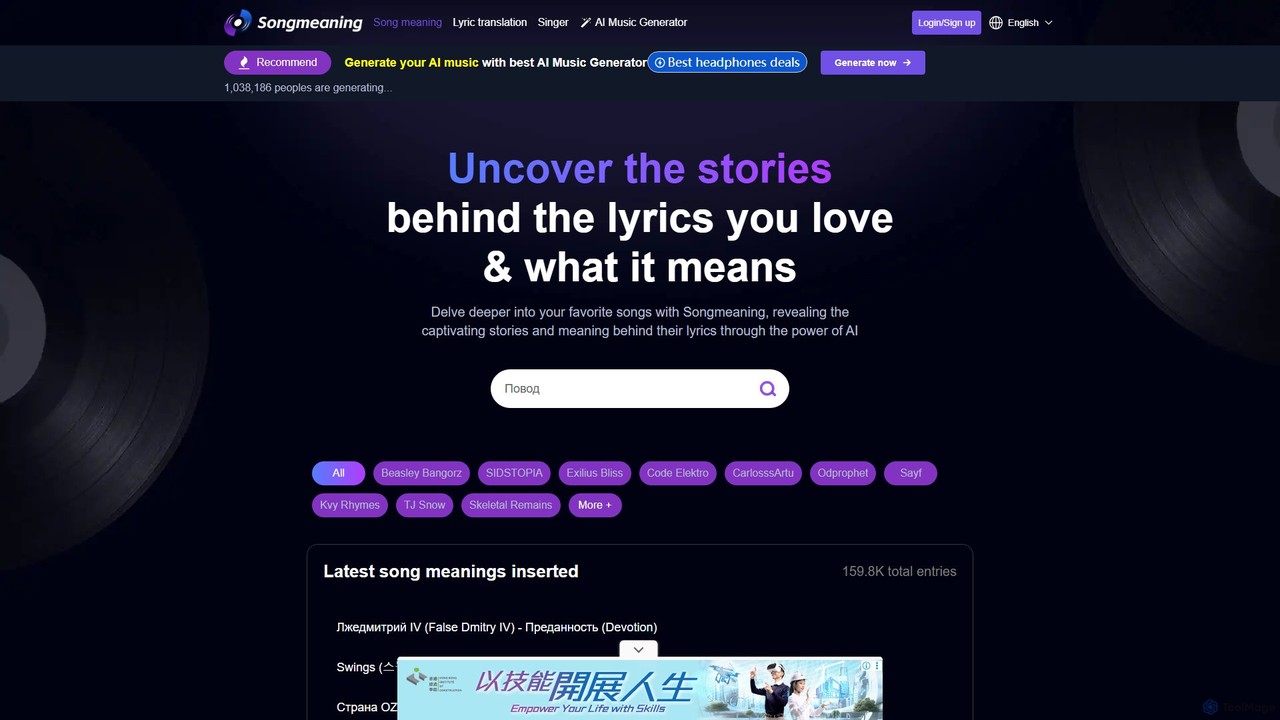
songmeaning

songmeaning

An AI-powered platform that delves into the deeper meaning and stories behind song lyrics. It offers detailed analysis …

46.9K
Free
WhatTheBeat

WhatTheBeat

An AI-powered platform that delves into the meaning of song lyrics, offering both insightful and humorous interpretations. Discover …

13.1K

About Music Theory

AI Music Theory tools are a specialized category of educational software designed to teach, analyze, and reinforce the principles of music. They leverage AI algorithms to provide interactive lessons, personalized feedback on exercises, and real-time analysis of harmony, melody, and rhythm. These tools are valuable for students, composers, and educators seeking to deepen their understanding of musical structures, from basic scales to complex harmonic progressions. They effectively bridge the gap between theoretical knowledge and practical application by offering an interactive learning environment.

Core Features

  • Interactive Harmony Analysis: Automatically identifies chords, analyzes progressions with Roman numerals, and highlights non-chord tones.
  • Personalized Ear Training: Generates adaptive exercises for interval, chord, and melody recognition based on user performance.
  • Algorithmic Composition Assistance: Suggests melodic lines or harmonic progressions that adhere to specific theoretical rules, such as counterpoint.
  • Visual Music Theory Models: Provides interactive visualizations of concepts like the circle of fifths, scale modes, and voice leading.
  • Rhythmic Practice Modules: Creates and evaluates rhythmic dictation and sight-reading exercises with instant feedback.

Use Cases

These tools are primarily used in educational contexts. Music students use them for self-paced learning and homework assistance. Composers and producers leverage them to explore new harmonic ideas or check their compositions against traditional rules. Music educators integrate them into their curriculum to create engaging assignments and provide students with instant, objective feedback.

How to Choose

When selecting an AI Music Theory tool, consider the depth of content, from beginner fundamentals to advanced topics like jazz harmony or species counterpoint. Evaluate the quality and immediacy of the feedback mechanism. Check for compatibility with other software, such as DAWs or notation programs. Finally, consider the user interface and whether its learning approach aligns with your personal study habits or teaching style.

Music TheoryUse Cases

1

Assisting Music Students with Harmony Homework

A university music student is tasked with analyzing a Bach chorale for their harmony class. Instead of relying solely on their textbook, they input the musical score into an AI Music Theory tool. The tool instantly provides a complete Roman numeral analysis, identifies all non-chord tones (like passing tones and suspensions), and visually highlights voice-leading errors such as parallel fifths. This allows the student to check their own work, understand mistakes in real-time, and experiment with chord substitutions, significantly deepening their practical understanding of four-part harmony before submitting the assignment.

2

Exploring Harmonic Ideas for Songwriting

A songwriter has a verse and chorus melody but is struggling to find a compelling chord progression for the bridge. They use an AI Music Theory tool by inputting their existing progression. The AI analyzes the key and harmonic context, then generates several alternative progressions for the bridge. It offers options based on modal interchange, secondary dominants, or Neapolitan chords. Each suggestion is playable, allowing the songwriter to instantly hear how it fits with their melody, breaking their creative block and introducing them to advanced harmonic concepts they might not have considered otherwise.

3

Personalized Ear Training for Musicians

An intermediate guitar player wants to improve their ability to recognize intervals and chords by ear to better learn songs. They use an AI-powered ear training app. The app starts with simple intervals and major/minor chords. Based on the player's accuracy, the AI adaptively introduces more complex challenges, such as diminished chords, seventh chords, and larger intervals. The system identifies specific areas of weakness (e.g., distinguishing between a major 7th and a minor 7th) and generates targeted drills to strengthen those skills, providing a much more efficient and personalized practice routine than generic exercises.

4

Automated Counterpoint Practice and Correction

A composition student is learning species counterpoint, a rigorous and rule-based discipline. They use an AI tool specifically designed for this purpose. The student writes a contrapuntal line against a given cantus firmus. The AI instantly checks the composition against hundreds of rules, flagging errors like parallel octaves, improper dissonance treatment, and incorrect melodic leaps. It provides specific feedback, such as 'Parallel fifths between soprano and bass in measure 4.' This allows for rapid iteration and practice, reinforcing the complex rules far more quickly than waiting for a weekly lesson with a professor.

5

Visualizing Complex Scale and Mode Relationships

A self-taught jazz guitarist is trying to understand how different modes of the major scale relate to each other and how they can be used over chords. They use an AI visualization tool. They can select a chord, like Dm7, and the tool instantly displays all compatible scales and modes (e.g., D Dorian, G Mixolydian, C Ionian). The tool visualizes the fretboard, highlighting the notes of each mode and explaining why it fits harmonically. This interactive approach transforms abstract theory into a practical, visual map on their instrument, accelerating their ability to improvise fluently.

6

Analyzing Jazz Improvisation Solos

A saxophonist wants to deconstruct a famous John Coltrane solo to understand his theoretical approach. They upload an audio recording of the solo into an AI analysis tool. The AI transcribes the solo into standard notation and provides a detailed harmonic analysis. It identifies the scales Coltrane used over specific chord changes (e.g., 'Coltrane superimposes a B major pentatonic scale over the G7 chord'), highlights recurring melodic patterns or 'licks', and maps out the solo's overall structure. This provides insights that would take hours of manual transcription and analysis to uncover, helping the musician learn and internalize advanced improvisational techniques.

Music TheoryFrequently Asked Questions