
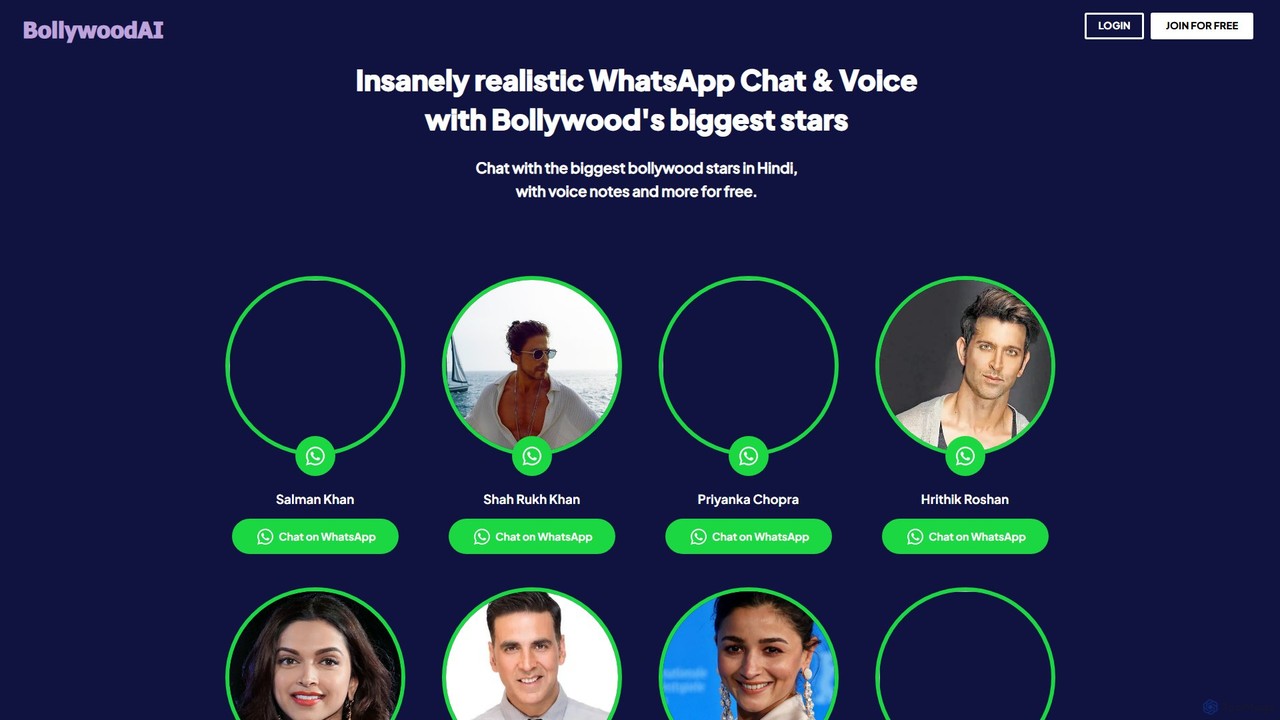
BollywoodAI
Engage in realistic WhatsApp chats and voice conversations with AI-powered avatars of your favorite Bollywood stars. Experience immersive interactions, discuss their movies, and get their opinions on various topics for free.
ChatbotsPopular Celebrity Simulators AI tools in Fun Tools include BollywoodAI, helping you work more efficiently.

Engage in realistic WhatsApp chats and voice conversations with AI-powered avatars of your favorite Bollywood stars. Experience immersive interactions, discuss their movies, and get their opinions on various topics for free.
ChatbotsCelebrity Simulators are AI-powered applications designed to let users interact with realistic virtual versions of famous people. These tools leverage large language models (LLMs), voice synthesis, and sometimes deepfake video technology to convincingly replicate a celebrity's personality, speech patterns, and mannerisms. Primarily used for entertainment, they allow users to engage in simulated conversations, create personalized messages, or generate unique social media content. Unlike generic chatbots, the core focus is on delivering an immersive and character-driven experience that captures the essence of a specific public figure.
These tools are ideal for content creators seeking novel ideas for skits, fans wanting a fun way to engage with their idols, or anyone looking to create personalized novelty content like birthday greetings. They are primarily used in social media, personal entertainment, and creative writing contexts rather than for business or productivity tasks.
When selecting a Celebrity Simulator, evaluate the level of realism in the voice and conversation. Check the roster of available celebrities to ensure your desired figure is included. It is also crucial to review the platform's privacy policy to understand how your interaction data is used and to check the pricing model, as many operate on a credit-based or subscription system.
A user wants to create a unique birthday gift for a friend who is a huge fan of a particular actor. Using a Celebrity Simulator, they input their friend's name and a few personal details. The tool then generates a short video message where the AI-powered actor delivers a personalized birthday wish, mentioning an inside joke. This creates a highly memorable and shareable surprise that feels more special than a standard greeting card.
A content creator on TikTok or Instagram aims to produce viral content. They use a Celebrity Simulator to stage a fictional, humorous conversation between two unlikely figures, such as Albert Einstein and a modern pop star discussing quantum physics. By screen-recording the witty, in-character AI dialogue, they can create a unique and engaging video skit that stands out and encourages shares and comments.
A journalism student needs to practice their interviewing techniques but lacks access to high-profile subjects. They use a Celebrity Simulator to conduct a mock interview with a virtual politician or tech CEO. This allows them to test different questioning strategies, learn to handle difficult or evasive answers, and refine their conversational flow in a low-pressure environment before conducting real interviews.
A screenwriter is struggling with writing authentic dialogue for a character based on a real historical figure. They engage in a conversation with the AI version of that person in a Celebrity Simulator. By asking questions about their motivations and perspectives, the writer can explore the character's voice and mannerisms, helping them overcome writer's block and craft more believable and compelling dialogue for their script.
Someone learning French wants to practice their conversational skills in a fun way. They use a Celebrity Simulator to chat with a virtual version of a famous French actor like Marion Cotillard. The AI responds in French, using common phrases and a natural conversational style. This interactive role-play makes language practice less intimidating and more motivating than traditional exercises.
A fan has always wondered what it would be like to talk to their favorite scientist, like Carl Sagan, about the universe. They use a Celebrity Simulator to ask questions about cosmic mysteries, philosophy, and scientific discovery. The AI, trained on Sagan's works and interviews, provides thoughtful, in-character responses, offering a unique and intellectually stimulating entertainment experience.
Celebrity Simulators are a type of AI application that allows you to have simulated conversations with virtual versions of famous individuals. They use advanced AI, including large language models and voice synthesis, to replicate a celebrity's personality and way of speaking. Their primary purpose is for entertainment, content creation, and novelty interactions, not for communicating with the actual person.
When choosing a Celebrity Simulator, consider these four factors:
No, the conversations are not with the real celebrity. They are entirely generated by an artificial intelligence model. The AI has been trained on vast amounts of public data (interviews, writings, social media) about that celebrity to learn their patterns of speech and personality. The responses are dynamic and generated in real-time, but they are a simulation and should not be considered authentic statements from the actual person.
The key difference lies in their purpose and design. A standard chatbot (like a customer service bot) is functional, designed to provide information or complete tasks efficiently. A Celebrity Simulator is experiential, designed for entertainment by mimicking a specific personality. It prioritizes character accuracy, conversational style, and voice replication over task-oriented functions.
Ethical considerations are significant. Key issues include the use of a person's name, image, and likeness without their explicit consent (related to deepfake technology). There is also a risk of creating and spreading misinformation if AI-generated content is presented as real. Reputable simulators typically include clear disclaimers stating that the interactions are AI-generated and have policies against creating harmful, deceptive, or defamatory content.