ToolMage
Sign in

Best 1 Joke Explainer AI tools for Fun Tools

Popular Joke Explainer AI tools in Fun Tools include canyouexplainthejoke, helping you work more efficiently.

canyouexplainthejoke
Free

canyouexplainthejoke

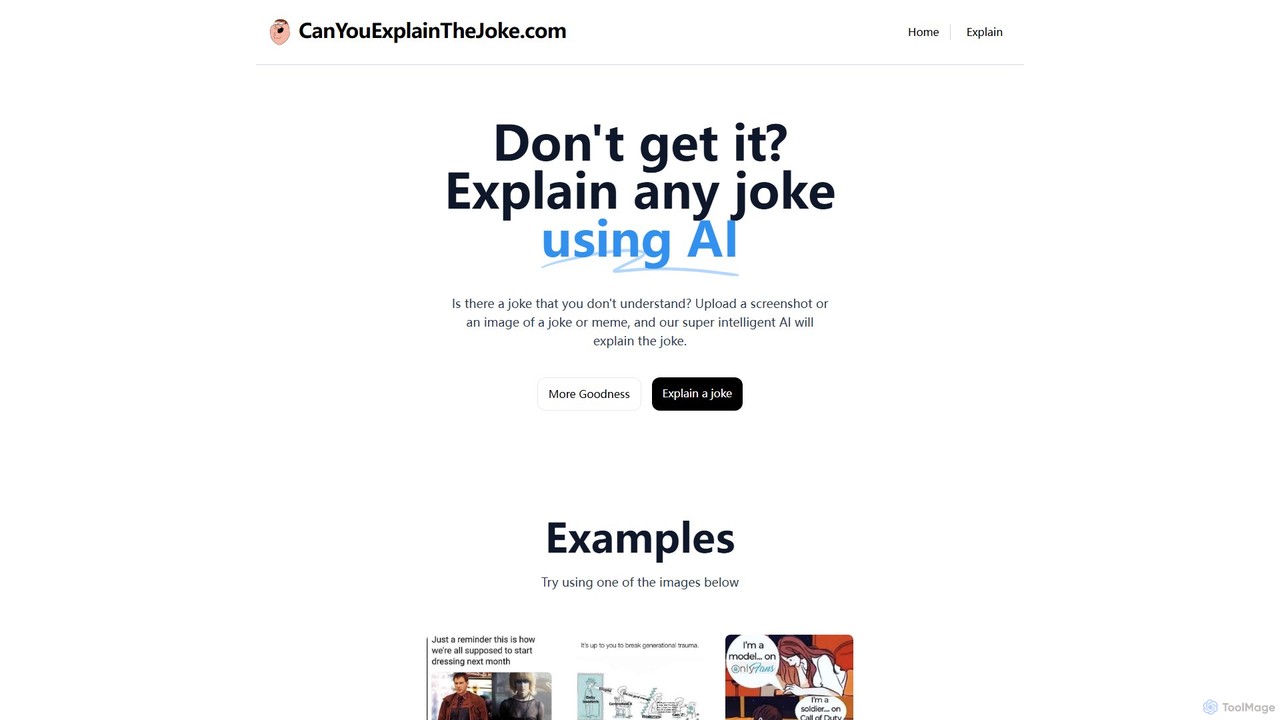
An AI-powered tool that explains the humor in jokes and memes. Simply upload an image of a joke you don't understand, and the AI will provide a detailed breakdown of the cultural context, puns, or visual gags, making humor accessible to everyone.

Language Learning
Visits 5.5KFavorites 94Likes 92

About Joke Explainer

Joke Explainer tools are AI-powered applications designed to analyze, deconstruct, and explain the humor in jokes, puns, and comedic narratives. Leveraging advanced natural language processing (NLP) and understanding of linguistic nuances, these tools break down the elements that make a joke funny, such as wordplay, cultural references, and contextual irony. They provide detailed insights into the mechanics of humor, helping users understand complex or unfamiliar comedic structures. This makes them invaluable for language learners, content creators, and anyone seeking a deeper appreciation of comedic artistry within the broader category of Fun Tools.

Core Features

  • Contextual Analysis: Identifies and explains the background information or specific situations crucial for understanding a joke.
  • Wordplay & Puns Detection: Pinpoints linguistic devices like double meanings, homophones, and clever phrasing that form the basis of many jokes.
  • Cultural Reference Explanation: Deciphers and clarifies cultural, historical, or social allusions that might be obscure to a non-native audience.
  • Humor Theory Breakdown: Explains the underlying comedic principles, such as incongruity, surprise, or superiority, contributing to a joke's effect.
  • Sentiment & Tone Analysis: Assesses the emotional tone and intended sentiment of a joke, helping to gauge its potential impact.

Applicable Scenarios

Joke Explainer tools are particularly useful for language learners trying to grasp idiomatic humor, content creators refining comedic scripts, and cross-cultural communicators ensuring their jokes land correctly. They also assist educators in teaching rhetoric or cultural studies by dissecting humor. Individuals can use them for personal entertainment to gain a deeper understanding of complex or obscure jokes.

How to Choose

When selecting a Joke Explainer, consider its accuracy in identifying humor elements and its ability to provide clear, concise explanations. Look for tools with broad language support and robust contextual understanding, especially for cultural nuances. Evaluate the depth of analysis offered, from simple definitions to detailed humor theory breakdowns. A user-friendly interface and the ability to handle various joke formats (text, short narratives) are also important factors for an optimal experience.

Featured tool rankings

Joke Explainer use cases

1

Understanding Cross-Cultural Humor for Global Communication

A global marketing specialist needs to ensure that a humorous slogan for a new product campaign resonates positively across diverse cultural markets. By using a Joke Explainer, they can input the slogan and receive a detailed breakdown of its potential interpretations, cultural sensitivities, and comedic mechanisms in different regions. This helps them avoid misunderstandings, adapt the humor appropriately, and ensure the message is effective and well-received by the target audience, preventing potential PR missteps.

2

Enhancing Language Learning by Deciphering Jokes

A language learner encounters a joke in their target language that they don't quite understand, perhaps due to idioms, cultural references, or complex wordplay. By feeding the joke into a Joke Explainer, they receive a line-by-line explanation, including definitions of unfamiliar terms, clarification of cultural context, and an analysis of the humor's linguistic structure. This not only helps them grasp the joke but also deepens their understanding of the language's nuances and cultural intricacies, accelerating their fluency and cultural competence.

3

Analyzing Comedy Scripts for Content Creation

A budding comedian or content creator is writing a stand-up routine or a humorous social media script and wants to ensure their jokes are well-structured and impactful. They can use a Joke Explainer to analyze their own material, receiving feedback on elements like punchline timing, setup effectiveness, and potential for misinterpretation. This allows them to refine their comedic timing, strengthen their jokes, and tailor their content to maximize audience engagement and laughter, improving their overall performance quality.

4

Educating on Rhetoric and Humor Theory

An educator teaching a course on rhetoric, linguistics, or cultural studies wants to use real-world examples of humor to illustrate complex theories. They can employ a Joke Explainer to dissect famous jokes, political cartoons, or satirical pieces, providing students with a structured analysis of the rhetorical devices, logical fallacies, or cultural contexts at play. This enhances the learning experience by making abstract concepts tangible and engaging, helping students develop critical thinking skills in analyzing persuasive and humorous communication.

5

Personal Enjoyment and Deeper Appreciation of Comedy

An individual enjoys watching stand-up comedy or reading humorous literature but occasionally encounters jokes or references that go over their head. Instead of simply moving on, they can use a Joke Explainer to gain a deeper understanding. By inputting the joke, they receive explanations of its setup, punchline, cultural context, and any subtle wordplay. This transforms a moment of confusion into an opportunity for learning and enhances their overall enjoyment and appreciation of the comedian's craft or the author's wit, making their entertainment experience more enriching.

6

Validating Humor in User-Generated Content

A platform moderator or community manager for a social media site or forum needs to assess the appropriateness and intent of humorous user-generated content, especially in diverse communities. By using a Joke Explainer, they can quickly analyze potentially ambiguous jokes or memes for underlying meanings, cultural sensitivities, or offensive elements. This helps them make informed decisions about content moderation, ensuring a safe and inclusive environment while still allowing for creative and humorous expression, maintaining community standards effectively.

Joke Explainer FAQ

What is an AI Joke Explainer?

An AI Joke Explainer is a specialized artificial intelligence tool designed to analyze and interpret the humor in jokes, puns, and comedic texts. It uses natural language processing (NLP) to break down linguistic elements, cultural references, and contextual cues that contribute to a joke's funniness. Its core purpose is to clarify why a joke is humorous, making it accessible to those who might not immediately grasp the humor due to language barriers, cultural differences, or complex wordplay. These tools offer detailed explanations, helping users understand the mechanics of comedy.

How do I choose the best AI Joke Explainer for my needs?

To choose the best AI Joke Explainer, consider several key factors. First, evaluate its accuracy in deconstructing various types of humor, including puns, irony, and cultural jokes. Second, check its language support; if you need to understand jokes in multiple languages, ensure the tool offers robust multilingual capabilities. Third, assess the depth of its explanations—does it just define terms, or does it delve into humor theory and cultural context? Finally, consider user-friendliness, integration options with other tools, and pricing models to find a solution that aligns with your specific requirements for learning, content creation, or personal enjoyment.

What types of humor can AI Joke Explainers analyze?

AI Joke Explainers are capable of analyzing a wide range of humor types, though their effectiveness can vary. They excel at deconstructing linguistic humor such as puns, wordplay, and double entendres by identifying semantic ambiguities. Many can also interpret situational irony, sarcasm, and even some forms of observational humor by understanding context. However, highly nuanced or abstract humor, inside jokes, or humor deeply embedded in specific non-verbal cues might still pose challenges. Advanced tools often include modules for cultural references, making them more adept at cross-cultural humor.

How do AI Joke Explainers differ from general AI text analysis tools?

While general AI text analysis tools focus on sentiment, topic extraction, or summarization, AI Joke Explainers are specifically trained and optimized for the unique complexities of humor. They go beyond surface-level meaning to identify linguistic devices (like puns and metaphors), cultural references, and contextual nuances that are crucial for understanding a joke's comedic effect. General tools might miss these subtle layers, whereas Joke Explainers are designed to deconstruct the specific mechanisms that make something funny, providing a much deeper and more targeted analysis of comedic content.

Can AI Joke Explainers understand sarcasm and irony?

Yes, many advanced AI Joke Explainers are increasingly capable of understanding sarcasm and irony, though it remains one of the more challenging aspects of natural language processing. These tools often rely on contextual cues, tone analysis (if audio is involved), and the identification of incongruity between literal meaning and intended meaning. While they may not always catch every subtle instance, their ability to process vast amounts of text and learn from patterns allows them to identify common sarcastic or ironic structures, providing explanations that highlight the intended humorous effect.