
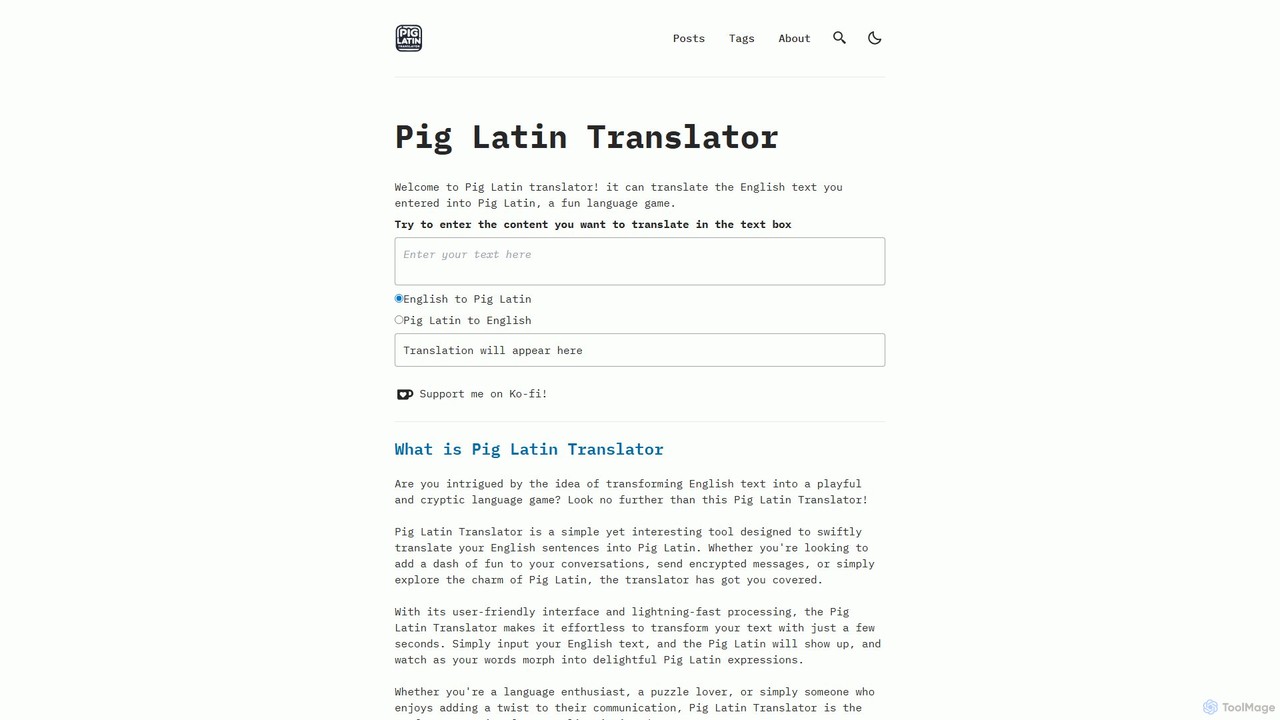
Fun Tools Best in category 1 results Language Games AI Tool

Popular AI tools in the Language Games field of Fun Tools include piglatintranslator, etc., helping you quickly improve efficiency.

Free
piglatintranslator

piglatintranslator

A free, fast, and user-friendly online tool for instantly translating text between English and Pig Latin. Perfect for …

4.6K

About Language Games

AI Language Games are interactive applications that use artificial intelligence to create engaging word-based challenges and narrative experiences. These tools leverage advanced natural language processing (NLP) models to understand player input and generate dynamic, context-aware content, transforming language into a playground. Unlike static puzzles, AI Language Games offer adaptive gameplay, making them ideal for entertainment, creative stimulation, and educational purposes. They represent a fun and accessible subset of AI-powered Fun Tools.

Core Features

  • Dynamic Narrative Generation: Creates unique stories, dialogues, or scenarios based on user prompts and choices.
  • Natural Language Understanding (NLU): Interprets complex or ambiguous text inputs to provide relevant and coherent responses.
  • Interactive Puzzle Solving: Generates and validates solutions for word riddles, logic puzzles, and ciphers.
  • Character Simulation: Adopts specific personas or characters for immersive role-playing experiences.

Use Cases

These tools are widely used by language learners for conversational practice, writers for overcoming creative blocks, and educators for creating engaging learning modules. Casual gamers also use them for intellectually stimulating entertainment that focuses on creativity and problem-solving rather than reflexes.

How to Choose

When selecting an AI Language Game, consider the primary game type (e.g., storytelling, puzzle, role-playing). Evaluate the quality and creativity of the AI's language model, the intuitiveness of the user interface, and the availability of customization options like difficulty settings or genre selection.

Language GamesUse Cases

1

Interactive Language Learning Practice

Language learners use these games to practice conversation in a safe, non-judgmental environment. For example, a student learning French can engage in a simulated dialogue with an AI cafe owner, practicing ordering food and asking for directions. The AI provides instant feedback and introduces new vocabulary contextually, making learning more intuitive and less intimidating than real-life practice.

2

Collaborative Storytelling for Writers

A fiction writer experiencing writer's block uses an AI language game to brainstorm plot points. By providing an initial premise like 'a detective in a futuristic city,' the AI generates compelling characters, unexpected twists, and descriptive settings. The writer can then guide the narrative, co-creating a story and exploring different creative avenues to break through their creative slump.

3

Creating Educational Classroom Activities

An English teacher designs a classroom activity using an AI word puzzle game. The teacher sets up a custom game focused on synonyms and antonyms for a specific vocabulary list. Students work in teams to solve the AI-generated riddles, turning a typically mundane lesson into a competitive and collaborative experience that reinforces their learning.

4

Immersive Text-Based Role-Playing

A fan of fantasy genres uses an AI language game as a virtual Dungeon Master for a solo role-playing adventure. They create a character and describe their actions in text, and the AI responds by describing the world, controlling non-player characters (NPCs), and managing the story's progression. This provides a deeply personalized and endlessly replayable RPG experience.

5

Brain Training with Linguistic Puzzles

An individual looking to keep their mind sharp uses an AI language game for daily cognitive exercise. They engage in complex logic puzzles and word association games that adapt in difficulty based on their performance. The AI's ability to generate novel puzzles ensures the challenges remain fresh and stimulating, helping to improve problem-solving and verbal reasoning skills.

6

Generating Ideas for Game Developers

A narrative designer for a video game company uses an AI language game to quickly prototype dialogue and quest ideas. They can input a character's personality and a situation, and the AI generates multiple dialogue options and potential quest lines. This accelerates the early creative process, allowing the team to explore more narrative possibilities before committing to development.

Language GamesFrequently Asked Questions