PuzzleGenerator.ai
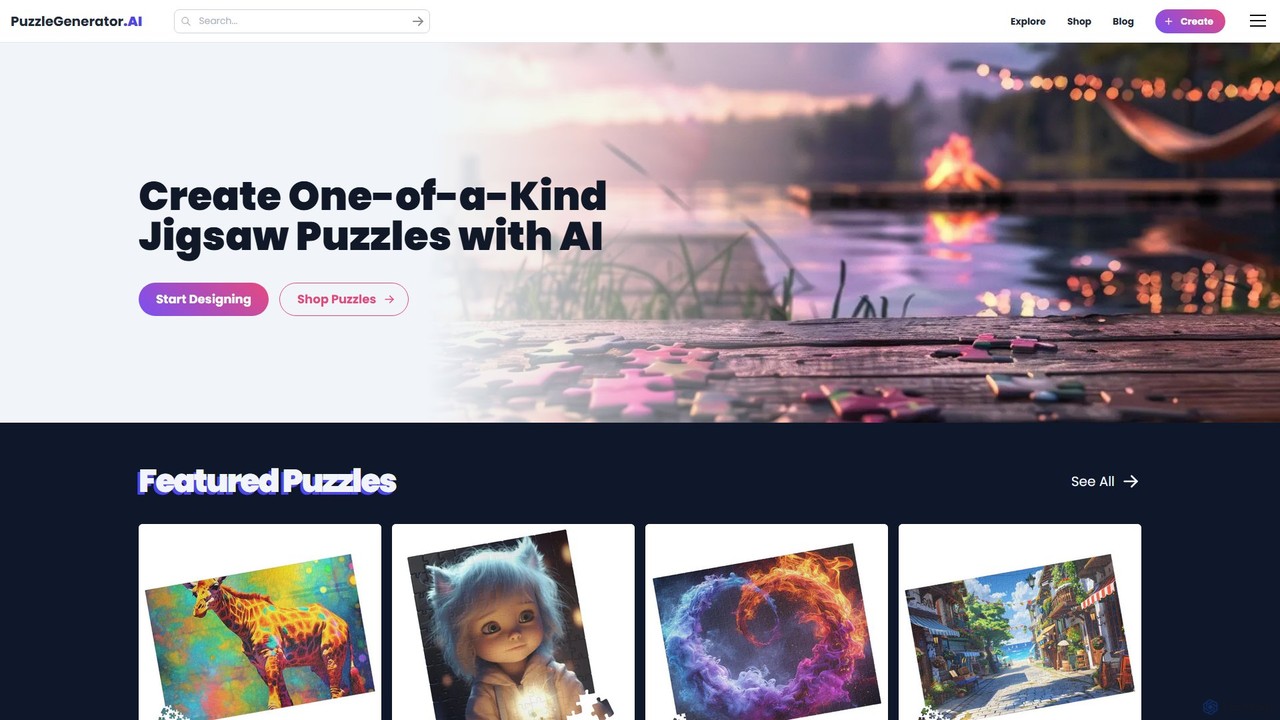
PuzzleGenerator.ai is an AI-powered platform that allows users to create unique, custom jigsaw puzzles. By simply entering a …
PuzzleGenerator.ai is an AI-powered platform that allows users to create unique, custom jigsaw puzzles. By simply entering a text prompt, you can generate one-of-a-kind artwork and have it transformed into a high-quality physical puzzle, perfect for gifts, education, or personal enjoyment.
About Puzzle Games
Puzzle Games are a captivating genre of games that primarily challenge players' cognitive abilities, including problem-solving, logic, memory, and critical thinking. Unlike action-oriented games, they focus on mental engagement, often requiring players to decipher clues, manipulate objects, or strategize moves to achieve a specific objective. These games offer a unique blend of entertainment and mental stimulation, making them ideal for sharpening the mind and providing a rewarding sense of accomplishment.
Core Features
- Logic & Deduction: Involve applying reasoning to solve intricate problems and uncover hidden solutions.
- Spatial Reasoning: Require players to visualize and manipulate objects or environments in two or three dimensions.
- Pattern Recognition: Focus on identifying sequences, recurring elements, or underlying structures to progress.
- Memory Challenges: Test players' ability to recall information, sequences, or positions over time.
- Strategic Planning: Demand foresight and careful sequencing of actions to overcome obstacles and reach goals.
Applicable Scenarios
Puzzle games are widely enjoyed across various contexts. Individuals use them for casual entertainment during commutes or breaks, seeking a quick mental workout. Educators integrate them into learning environments to teach critical thinking, mathematics, or scientific principles in an engaging way. Additionally, many find these games to be excellent tools for cognitive training, helping to improve focus, concentration, and overall mental agility in a fun and interactive format.
How to Choose
When selecting a puzzle game, consider the specific type of mental challenge you prefer, such as logic, word, spatial, or strategy puzzles. Evaluate the difficulty level to ensure it matches your desired engagement, from relaxing brain teasers to complex, multi-stage challenges. Check the game's replayability and content depth, especially if you seek long-term entertainment. Finally, consider the platform compatibility and user interface to ensure a smooth and enjoyable gaming experience on your preferred device.

Puzzle GamesUse Cases
Enhancing Logical Thinking Skills
Individuals seeking to sharpen their cognitive abilities can regularly engage with logic-based puzzle games. By solving complex riddles, deductive challenges, and sequential puzzles, players actively train their brains to identify patterns, make informed decisions, and develop systematic problem-solving approaches. This consistent mental exercise can lead to improved analytical skills applicable in daily life and professional settings, fostering a more agile and critical mind.
Casual Entertainment During Downtime
For commuters, students, or anyone with short bursts of free time, puzzle games offer an ideal form of casual entertainment. Mobile puzzle games, in particular, allow users to quickly dive into engaging challenges that provide mental stimulation without requiring a significant time commitment. This helps pass the time productively, offering a refreshing break from routine tasks and a satisfying sense of accomplishment even in brief play sessions.
Aiding Children's Cognitive Development
Parents and educators can utilize age-appropriate puzzle games as valuable tools for children's cognitive development. These games introduce concepts like shape recognition, number sequencing, and basic problem-solving in an interactive and fun format. By engaging with puzzles, children develop fine motor skills, improve concentration, and learn perseverance, laying a strong foundation for academic success and critical thinking from an early age.
Team Building and Collaborative Problem Solving
Certain puzzle games, especially escape rooms or cooperative digital puzzles, are excellent for team-building activities. Groups of friends, families, or corporate teams can work together to solve intricate challenges, requiring communication, shared logic, and collective strategy. This fosters collaboration, improves interpersonal skills, and strengthens bonds as participants combine their unique perspectives and problem-solving approaches to achieve a common goal.
Stress Relief and Mental Relaxation
Engaging with puzzle games can serve as an effective method for stress relief and mental relaxation. The focused nature of solving puzzles diverts attention from daily worries, allowing the mind to enter a state of flow. This immersive experience, combined with the satisfaction of overcoming challenges, can reduce anxiety and promote a sense of calm. Many find that the gentle mental stimulation of puzzle games provides a healthier alternative to passive entertainment for unwinding.
Developing Spatial Reasoning and Visualization
Puzzle games often involve manipulating objects, arranging pieces, or navigating complex environments, which are excellent for developing spatial reasoning and visualization skills. Players learn to mentally rotate objects, predict outcomes of movements, and understand how different components fit together. This skill is particularly beneficial for students in STEM fields, architects, designers, and anyone whose work requires strong visual-spatial intelligence, enhancing their ability to conceptualize and solve problems in three dimensions.