dictgame
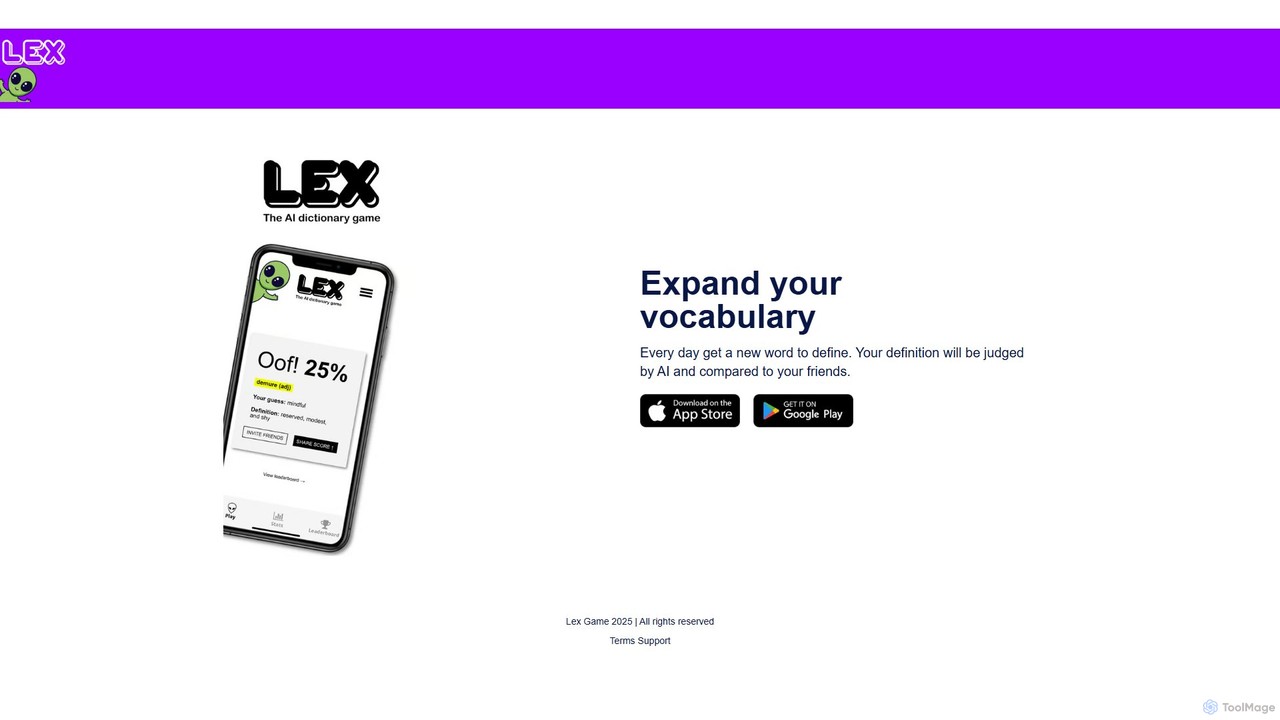
dictgame is a free, AI-powered daily word game designed to expand your vocabulary. Each day, you receive a …
dictgame is a free, AI-powered daily word game designed to expand your vocabulary. Each day, you receive a new word to define. Your custom definition is then evaluated by an intelligent AI, which provides a score and feedback. You can also compare your results with friends, making learning a fun and competitive social experience.
About Puzzle & Word Games
AI Puzzle & Word Games are a category of games that use artificial intelligence to create dynamic, engaging, and often personalized mental challenges. These tools leverage procedural content generation (PCG) to produce a virtually endless supply of unique puzzles, and utilize Natural Language Processing (NLP) to power sophisticated word-based games. The primary value lies in their ability to adapt difficulty in real-time based on player performance, ensuring a consistently challenging yet achievable experience. This makes them excellent tools for cognitive training, language learning, and entertainment.
Core Features
- Adaptive Difficulty: The AI adjusts the complexity of puzzles and challenges based on the player's skill level and progress.
- Procedural Content Generation (PCG): Automatically creates new and unique game levels, puzzles, or word challenges, offering high replayability.
- Natural Language Understanding (NLU): Enables games to interpret and respond to complex text inputs, creating more interactive and nuanced wordplay.
- Intelligent Hint Systems: Provides contextual hints that guide players toward the solution without simply giving away the answer.
- Personalized Challenges: Tailors game content to a user's specific learning goals or cognitive training needs, such as focusing on certain vocabulary or logic patterns.
Use Cases
These games are widely used for educational entertainment (EdTech), cognitive skill enhancement, and language acquisition. Students and language learners use AI word games to practice vocabulary in a gamified context. Professionals use logic puzzles for mental stimulation and stress relief, while developers in the education sector integrate these tools to create adaptive learning platforms.
How to Choose
When selecting an AI Puzzle & Word Game, consider the primary goal: is it for casual fun, serious brain training, or language learning? Evaluate the effectiveness of its adaptive difficulty system—does it create a smooth learning curve? Also, assess the variety of puzzles or game modes offered to ensure long-term engagement. Finally, check platform compatibility (web, mobile) and the data privacy policy, especially for games used by children.

Puzzle & Word GamesUse Cases
Reinforcing Language Vocabulary
A language learner preparing for an proficiency exam uses an AI-powered word game daily. The tool presents them with anagrams, crosswords, and word association puzzles using vocabulary relevant to their study level. The AI tracks which words they struggle with and reintroduces them in different puzzle formats, reinforcing memory through varied repetition. This gamified approach transforms tedious vocabulary drills into an engaging activity, helping the user master hundreds of new words more effectively than traditional flashcards.
Daily Cognitive Training for Seniors
An elderly individual uses an AI puzzle app on a tablet to keep their mind active. The app offers a variety of logic puzzles, such as Sudoku, spatial reasoning challenges, and memory games. The AI's adaptive difficulty feature is crucial here; it starts with simple challenges and gradually increases complexity as the user's performance improves, preventing frustration. This provides a safe and encouraging environment for cognitive maintenance, helping to improve memory, attention, and problem-solving skills in a gentle, consistent manner.
Educational Tool for Developing Logic Skills
A middle school teacher incorporates an AI puzzle game into their mathematics curriculum to teach logical deduction and algorithmic thinking. The game presents students with progressively harder logic grid puzzles. The AI provides instant feedback and a smart hint system that doesn't give away the answer but instead asks guiding questions, encouraging students to think through the problem. The teacher can access a dashboard to see common mistakes across the class, allowing them to tailor their next lesson to address specific logical fallacies or problem-solving strategies.
Creative Prompt Generation for Writers
A fiction writer experiencing writer's block uses an AI word association game to spark new ideas. They input a core theme, like 'loneliness in a futuristic city'. The AI generates a web of related but unexpected words and concepts, such as 'sentient advertisements', 'echo gardens', or 'memory black markets'. By exploring these AI-generated connections, the writer discovers novel plot points and character motivations, effectively using the game as a brainstorming partner to overcome their creative hurdle and add unique layers to their story.
Mental Break and Stress Relief for Professionals
A software developer takes a 10-minute break between coding sessions to play a procedurally generated logic puzzle. The game offers an infinite stream of unique challenges, so it never gets repetitive. Engaging with a non-work-related logical problem helps them clear their mind, reduce mental fatigue, and return to their complex coding tasks with a fresh perspective. The game's quick, self-contained sessions are a perfect fit for a busy work schedule, providing a constructive way to de-stress without breaking focus for too long.
Interactive Storytelling with AI-Driven Puzzles
A player engages in a narrative-driven game where progress is gated by solving AI-generated word puzzles. For example, to unlock a secret message, they must solve a riddle posed by an AI non-player character (NPC). The AI understands semantic nuances, allowing for multiple correct answers and creative solutions beyond simple keyword matching. This creates a more immersive and intelligent narrative experience, where the player's wit and language skills are directly integrated into the story's progression, making them feel like a true detective or cryptographer.