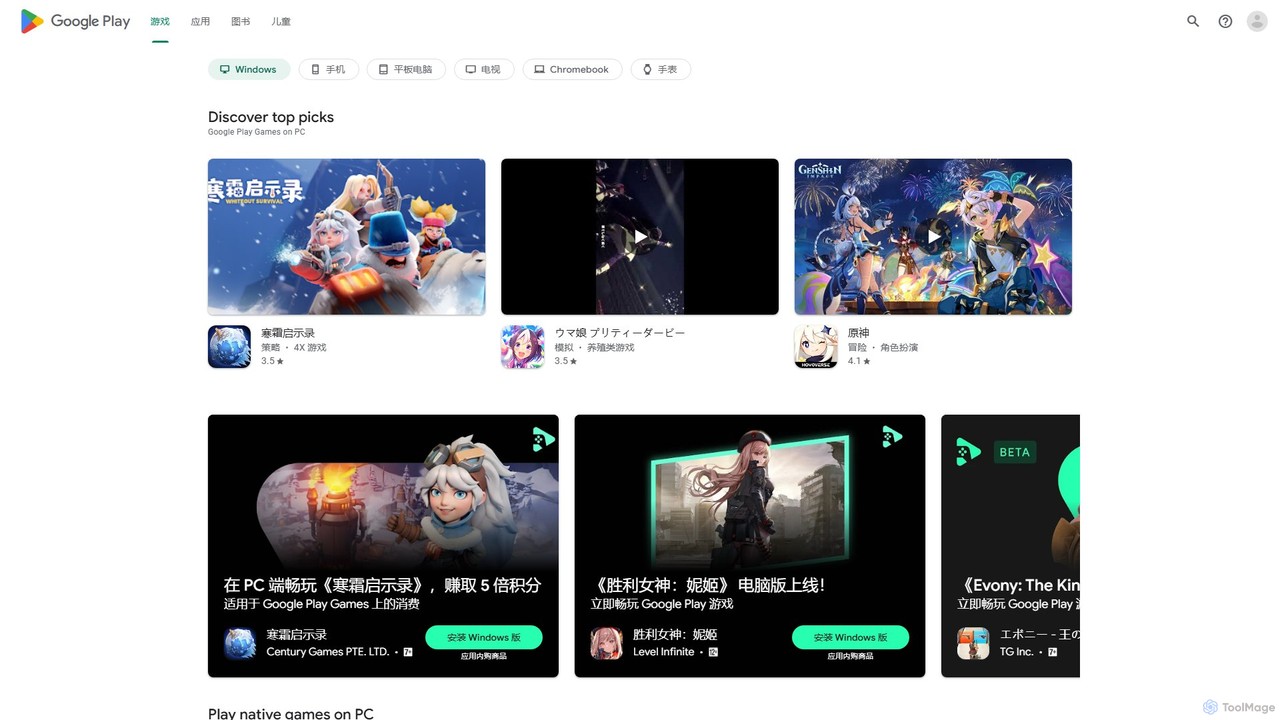
Google Play Games on PC
Google Play Games on PC is a free platform that allows you to play your favorite Android mobile …
Google Play Games on PC is a free platform that allows you to play your favorite Android mobile games on a Windows desktop or laptop. Enjoy a larger screen, enhanced controls with keyboard and mouse, seamless cross-device progress synchronization, and integration with Google Play Points for rewards. Experience mobile gaming like never before with optimized performance and graphics on your PC.
About Game Platform
AI Game Platforms are integrated development environments that use artificial intelligence to accelerate and enhance the game creation process. These platforms leverage generative AI models and machine learning algorithms to automate tasks like asset creation, level design, and character behavior scripting. They empower developers to build more complex, dynamic, and immersive worlds with greater efficiency, significantly reducing development time and costs. This allows creative teams to focus on core gameplay mechanics and narrative design rather than repetitive production tasks.
Core Features
- AI-Powered Asset Generation: Creates 2D/3D models, textures, characters, and environments from text prompts or style inputs.
- Procedural Content Generation (PCG): Automatically generates vast and varied game levels, maps, quests, and item distributions.
- Intelligent NPC Behavior: Enables the creation of non-player characters (NPCs) with dynamic, adaptive, and believable actions and dialogue.
- Automated Game Testing: Deploys AI agents to playtest games, discover bugs, identify exploits, and provide data for game balancing.
- Generative Game Logic: Assists in scripting game mechanics, character abilities, and interactive systems, speeding up prototyping.
Use Cases
AI Game Platforms are primarily used by game development studios of all sizes, from solo indie developers to large AAA teams. They are invaluable for rapid prototyping of new game concepts, creating expansive open-world games with unique content, and developing games with highly realistic and intelligent NPCs. Educational institutions also use these platforms to teach modern game design principles.
How to Choose
When selecting an AI Game Platform, consider its integration with your primary game engine (e.g., Unity, Unreal Engine). Evaluate the scope and quality of its AI features—whether you need asset generation, NPC logic, or both. Assess the platform's learning curve, documentation quality, community support, and pricing model (e.g., subscription-based, pay-per-asset) to ensure it aligns with your project's budget and team's technical skills.

Game PlatformUse Cases
Rapid Prototyping for Indie Developers
An indie developer with a unique game idea but limited resources can use an AI Game Platform to quickly build a playable prototype. Instead of spending weeks modeling characters or designing levels, they can generate placeholder assets and a basic game world in a matter of hours. This allows them to test core mechanics, validate the concept's fun factor, and create a compelling demo for potential investors or crowdfunding campaigns, drastically shortening the pre-production phase.
Creating Dynamic Open-World Environments
A studio developing an open-world RPG can leverage an AI platform's Procedural Content Generation (PCG) capabilities. The AI can generate vast landscapes, forests, and cave systems, populating them with unique points of interest, enemy encampments, and resource nodes. This not only saves thousands of hours of manual design work but also ensures that the world feels organic and less repetitive. The development team can then focus their efforts on hand-crafting key story locations and quests, blending bespoke design with AI-generated scale.
Developing Realistic NPC Interactions
For a narrative-driven game, creating believable Non-Player Characters (NPCs) is crucial. A writer or designer can use an AI platform to generate dynamic dialogue and behaviors. Instead of static, looping conversations, NPCs can react to the player's actions, remember past interactions, and have conversations that evolve over time. This allows for the creation of a living world where characters feel like individuals rather than simple quest-givers, significantly enhancing player immersion and replayability.
Automated Quality Assurance (QA) Testing
A QA team can deploy AI agents from a game platform to perform automated testing 24/7. These agents can be instructed to explore every corner of a map, test every game mechanic, and attempt to break the game in ways human testers might not consider. The AI can systematically find bugs, performance bottlenecks, and collision issues, logging them automatically for the development team. This frees up human QA testers to focus on more subjective aspects like game feel, fun factor, and user experience.
Balancing Multiplayer Game Mechanics
For a competitive multiplayer game, balance is paramount. Designers can use an AI platform to run thousands of simulated matches between AI agents using different characters, abilities, and strategies. The platform analyzes the data from these simulations to identify overpowered combinations or underperforming elements. This data-driven approach allows designers to make precise adjustments to game mechanics, ensuring a fairer and more engaging competitive experience for players before the game is even released to the public.
Educational Game Design Projects
Students in a game design course can use an accessible AI game platform to bring their ideas to life without needing extensive programming or art skills. The platform can handle the generation of basic assets and environments, allowing students to focus on learning core design principles like level layout, game loops, and narrative structure. This lowers the barrier to entry for game development, enabling a more diverse group of creators to experiment and build their first interactive experiences, fostering the next generation of game designers.