

Paid
Popular Wearables AI tools in Hardware include Limitless, Project Aria, Mentra, Copilot, Omi AI, and amuring, helping you work more efficiently.

Project Aria is a research initiative by Meta designed to accelerate the development of contextual AI, augmented reality (AR), and robotics. It utilizes advanced research glasses, like the Aria Gen 2, to capture first-person perspective data, providing researchers with a comprehensive platform including hardware, open-source datasets, and development tools to build the future of machine perception.
Datasets
Limitless is a personal AI system featuring a wearable Pendant that captures what you've seen, said, and heard. It acts as an external memory, transcribing conversations, generating summaries, and allowing you to query your past experiences with HIPAA-grade privacy.
Wearables
Omi AI is a revolutionary AI hardware platform designed to turn thought into action. Centered around a wearable device, it functions as an all-encompassing personal assistant. With customizable omiGPT Personas and a vast ecosystem of apps for productivity, health, and companionship, Omi AI seamlessly integrates artificial intelligence into your daily life, offering a hands-free, context-aware experience.
Wearables
amuring is a revolutionary wearable AI companion featuring a unique dual form factor, multilingual support, and a Community-driven, Open-Source Software (COSS) platform. It can be worn as a stylish ring or a discreet pendant, offering seamless access to a personal AI assistant for real-time translation, voice commands, health tracking, and more, without needing to look at a screen.
Real Time Translation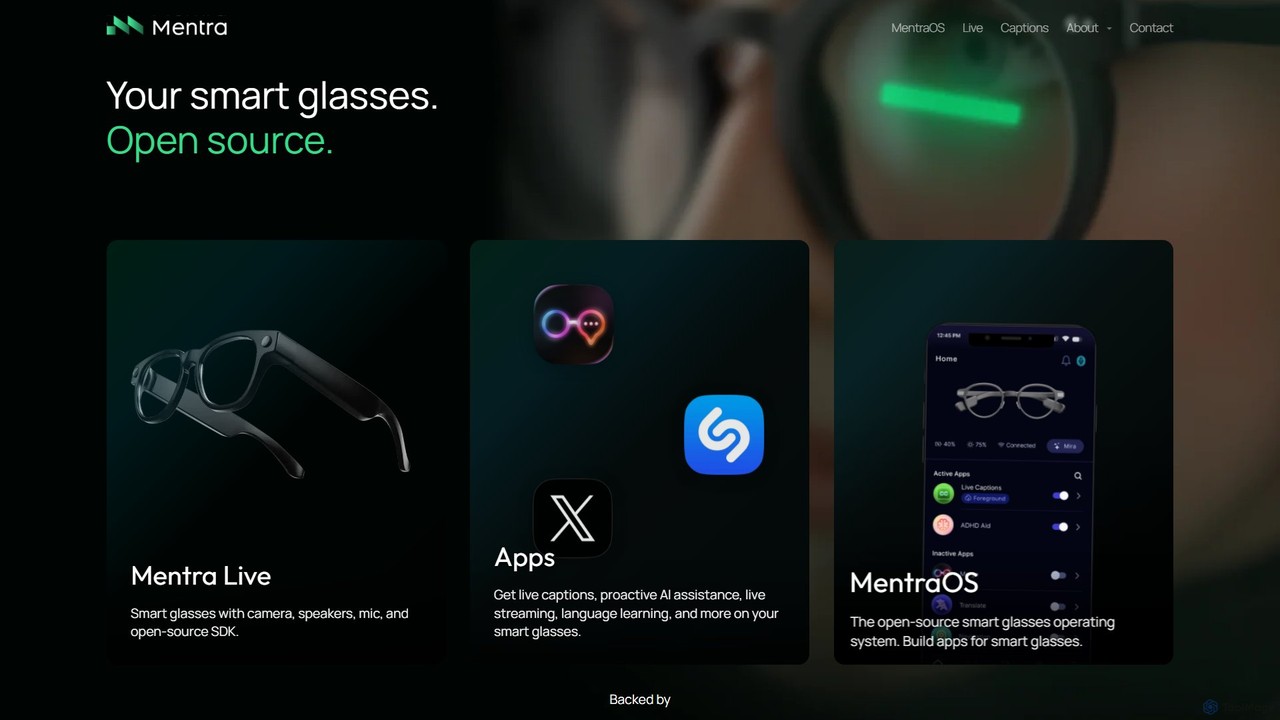
Mentra is a pioneering platform building the future of personal computing with open-source AI smart glasses. It features Mentra Live hardware and the MentraOS operating system, designed for proactive AI assistance, unrestricted live streaming, real-time translation, and a robust developer ecosystem. It aims to be the 'Android for smart glasses'.
Personal AssistantAI Wearables are smart electronic devices worn on the body that leverage artificial intelligence to process sensor data and provide personalized insights. These devices integrate advanced biometric and environmental sensors with machine learning algorithms to interpret real-time information. Their primary value lies in transforming raw data into actionable advice, personalized coaching, and seamless, context-aware assistance. This continuous monitoring and intelligent feedback help users optimize their health, fitness, and daily productivity.
AI Wearables are widely used in personal health and wellness for proactive monitoring and fitness optimization. In professional sports, athletes use them for performance analysis and injury prevention. Additionally, in industrial settings, smart glasses provide field technicians with hands-free augmented reality guidance, improving efficiency and safety.
When selecting an AI wearable, first consider its primary purpose—whether for advanced fitness tracking, medical monitoring, or productivity. Evaluate its ecosystem compatibility (e.g., iOS or Android) and the accuracy of its sensors. Battery life is a critical factor for continuous use, as is the comfort and design of the device's form factor (watch, ring, glasses).
An individual aiming to improve their marathon time and sleep quality uses an AI-powered smartwatch. The device continuously tracks heart rate variability (HRV), sleep stages (REM, deep, light), and running dynamics like cadence and vertical oscillation. The AI analyzes this data to provide a daily 'readiness score,' suggesting whether to push hard in training or focus on recovery. It offers personalized workout suggestions based on past performance and real-time fatigue levels, helping the user train smarter and avoid overtraining, ultimately leading to better race performance and improved overall well-being.
An industrial technician wears AI-powered smart glasses while performing complex machinery repairs. The glasses overlay digital schematics and step-by-step instructions directly onto the technician's field of view. Using voice commands, the technician can pull up manuals, view instructional videos, or initiate a video call with a remote expert. The AI can also visually identify components and flag potential hazards, significantly reducing repair time, minimizing errors, and improving workplace safety without requiring the technician to put down their tools.
A tourist in a foreign country uses AI-powered earbuds for seamless communication. When someone speaks to them in a different language, the earbuds capture the audio, send it to an AI model for translation, and play the translated audio back to the user in near real-time. The user can then speak in their own language, and the translation is played aloud through their phone's speaker for the other person to hear. This AI wearable breaks down language barriers, enabling more natural and fluid conversations for travelers, business professionals, and aid workers in multilingual environments.
An elderly person living alone wears a smartwatch with AI-powered fall detection. The device's accelerometers and gyroscopes constantly monitor movement patterns. The AI algorithm is trained to distinguish between a genuine, hard fall and everyday abrupt movements. If a fall is detected, the watch vibrates and displays an alert, asking if the user is okay. If the user doesn't respond within a minute, the device automatically calls pre-selected emergency contacts and emergency services, providing them with the user's precise GPS location. This provides peace of mind for both the user and their family.
A professional uses a smart ring to manage focus and stress. The ring tracks subtle changes in heart rate, body temperature, and movement to gauge the user's cognitive load and stress levels. When the AI detects signs of waning focus or rising stress, it can send a gentle vibration as a prompt to take a short break. It can also integrate with the user's digital calendar and communication apps to automatically silence non-urgent notifications during periods of deep work, creating a 'focus shield'. This helps the user maintain concentration, manage energy levels, and prevent burnout throughout the workday.
A tourist exploring a new city wears AR smart glasses for navigation. Instead of constantly looking down at a phone map, the glasses project virtual arrows and pathways directly onto the streets in their line of sight, guiding them to their destination. The AI can also identify landmarks and points of interest, displaying relevant historical facts or user reviews as the person looks at them. This creates a more immersive and safer exploration experience, allowing the user to stay aware of their surroundings while receiving rich, contextual information hands-free.
AI Wearables are smart electronic devices, such as watches, rings, or glasses, that are worn on the body. They use built-in sensors and artificial intelligence algorithms to collect, analyze, and interpret data about the user and their environment in real-time. Unlike standard wearables that just display data, AI wearables provide personalized insights, predictive alerts, and actionable recommendations to help users improve their health, fitness, safety, and productivity.
Choosing the right AI wearable depends on your primary goals. Consider the following factors:
The key difference lies in data processing and insights. A standard fitness tracker primarily collects and displays raw data like steps taken, distance covered, and basic heart rate. An AI wearable goes a step further by using machine learning algorithms to analyze this data in context. It can identify complex patterns, provide predictive insights (like a 'readiness score'), offer personalized coaching based on your performance, and detect anomalies that might require attention, transforming data into actionable intelligence.
AI wearables can track a wide array of data points, which often include:
Security and privacy are critical considerations for AI wearables. Reputable manufacturers employ several measures to protect user data, such as end-to-end encryption for data transmission and storage. Users typically have control over their privacy settings, allowing them to decide what data is collected and shared. However, it is always important for users to review the privacy policy of any wearable device and its associated app to understand how their data is handled, stored, and used before making a purchase.