Lavo
Lavo is an AI-powered platform for the life sciences industry, specializing in accelerating drug development through accurate crystal …
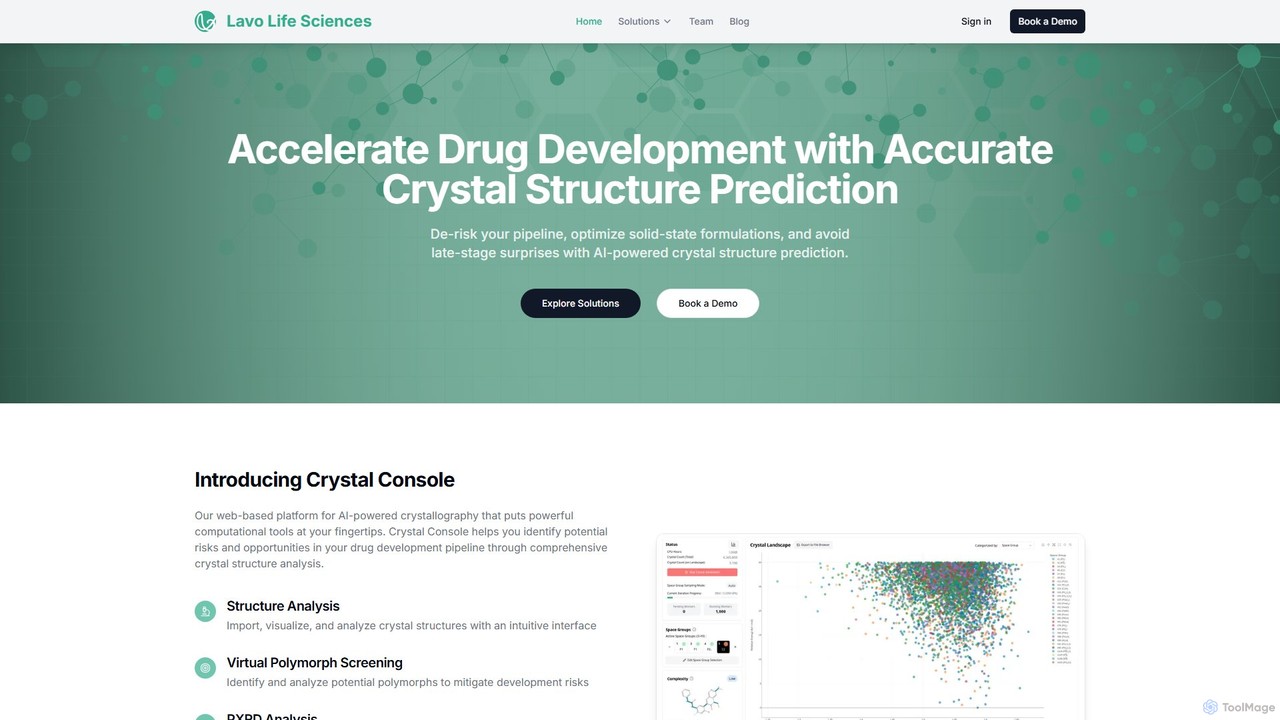
Lavo is an AI-powered platform for the life sciences industry, specializing in accelerating drug development through accurate crystal structure prediction. It helps pharmaceutical companies de-risk their pipelines, optimize solid-state formulations, and avoid late-stage surprises by identifying and analyzing potential polymorphs with unprecedented speed and accuracy.
About Pharmaceutical
AI Pharmaceutical tools are a specialized category of software that uses machine learning to accelerate the entire drug development lifecycle, from initial discovery to post-market surveillance. These tools analyze vast and complex datasets, including genomic, proteomic, and clinical trial data, to identify novel drug candidates and predict their efficacy and safety. Their primary value is in significantly reducing the time and cost associated with bringing new therapies to market while improving the precision of research and development. They represent a critical application of AI within the broader healthcare field, focusing specifically on therapeutic innovation.
Core Features
- Predictive Modeling: Analyzes biological and chemical data to identify promising drug candidates and predict their interactions with disease targets.
- Clinical Trial Optimization: Uses data to improve patient recruitment, design more efficient trial protocols, and predict patient outcomes.
- Pharmacovigilance Automation: Monitors and analyzes adverse event reports from various sources to enhance drug safety monitoring.
- Biomarker Discovery: Identifies genetic or molecular signatures that can predict disease risk or response to a specific treatment.
- Manufacturing Process Control: Applies AI to optimize production yields, ensure quality control, and predict maintenance needs in drug manufacturing.
Use Cases
These tools are primarily used by pharmaceutical companies, biotechnology firms, contract research organizations (CROs), and academic research institutions. They are applied in R&D departments for target identification, in clinical operations for managing trials, and in manufacturing for process optimization, fundamentally reshaping how new medicines are developed.
How to Choose
When selecting an AI Pharmaceutical tool, consider its specific application area (e.g., discovery, clinical, manufacturing). Evaluate its data integration capabilities with existing lab or clinical systems, the transparency and validation of its predictive models, and its compliance with industry regulations such as GxP and HIPAA. The required level of in-house data science expertise is also a key factor.

PharmaceuticalUse Cases
Accelerating Drug Candidate Screening
A computational chemist at a biotech firm is tasked with identifying potential inhibitors for a newly discovered cancer protein target. Instead of manually synthesizing and testing thousands of compounds, which could take years, they use an AI pharmaceutical platform. The chemist inputs the 3D structure of the protein target and specifies desired chemical properties. The AI model then screens a virtual library of millions of molecules, predicting their binding affinity and potential toxicity in a matter of hours. This process narrows the field down to a few hundred high-potential candidates for laboratory synthesis and validation, drastically reducing R&D time and resource expenditure.
Optimizing Clinical Trial Design and Recruitment
A clinical operations manager at a large pharmaceutical company is planning a Phase III trial for a new Alzheimer's drug. Using an AI tool, they analyze historical trial data and real-world evidence from electronic health records. The AI identifies key patient subpopulations most likely to respond to the drug and predicts which clinical sites will have the highest enrollment rates. It also helps simulate different trial protocol designs to find the optimal balance between statistical power, duration, and cost. This data-driven approach helps de-risk the trial, accelerate patient recruitment, and increase the probability of a successful outcome.
Automating Pharmacovigilance Case Processing
A pharmacovigilance team is overwhelmed by the volume of adverse event reports coming from call centers, emails, and social media. They implement an AI-powered safety platform that uses natural language processing (NLP) to automatically extract key information from unstructured text. The system identifies the patient, the drug, the adverse event, and other critical data points, populating a standardized safety report. It also flags duplicate cases and prioritizes serious events for human review. This automation reduces manual data entry by over 70%, allowing safety specialists to focus on signal detection and risk assessment rather than administrative tasks.
Predicting Protein Structures for Drug Design
A structural biologist at a university research lab needs to understand the 3D shape of a novel protein implicated in a rare disease to design a drug that can bind to it. Using a state-of-the-art AI tool, they input the protein's amino acid sequence. The AI model, trained on a vast database of known protein structures, generates a highly accurate 3D structural prediction within minutes. This in-silico model allows the team to immediately begin computational drug design and virtual screening, bypassing months of difficult and expensive experimental work like X-ray crystallography. This accelerates the very first step of structure-based drug discovery.
Identifying Novel Biomarkers from Genomic Data
A research team at a cancer institute is analyzing genomic data from thousands of patient tumors to find new biomarkers for predicting treatment response. They use an AI platform to process this massive dataset, which includes DNA sequences and gene expression levels. The AI algorithm identifies subtle patterns and correlations that are invisible to human analysts, pinpointing a specific gene mutation that is highly correlated with resistance to a standard chemotherapy drug. This discovery allows for the development of a new diagnostic test to stratify patients, ensuring that only those likely to benefit receive the drug, paving the way for personalized medicine.
Optimizing Pharmaceutical Manufacturing Processes
A process engineer at a biopharmaceutical manufacturing plant needs to improve the yield of a complex biologic drug produced in a bioreactor. They deploy an AI system that continuously monitors hundreds of real-time sensor data points (e.g., temperature, pH, nutrient levels). The AI model, trained on historical batch data, predicts the final yield hours in advance and recommends precise adjustments to control parameters to keep the process in its optimal state. This proactive control minimizes batch failures, increases overall yield by 15%, and ensures consistent product quality, leading to significant cost savings and a more reliable supply chain.