
ToolMage
Sign in

Best 1 Drug Discovery AI tools for Science

Popular Drug Discovery AI tools in Science include Lavo, helping you work more efficiently.

Lavo
Paid

Lavo

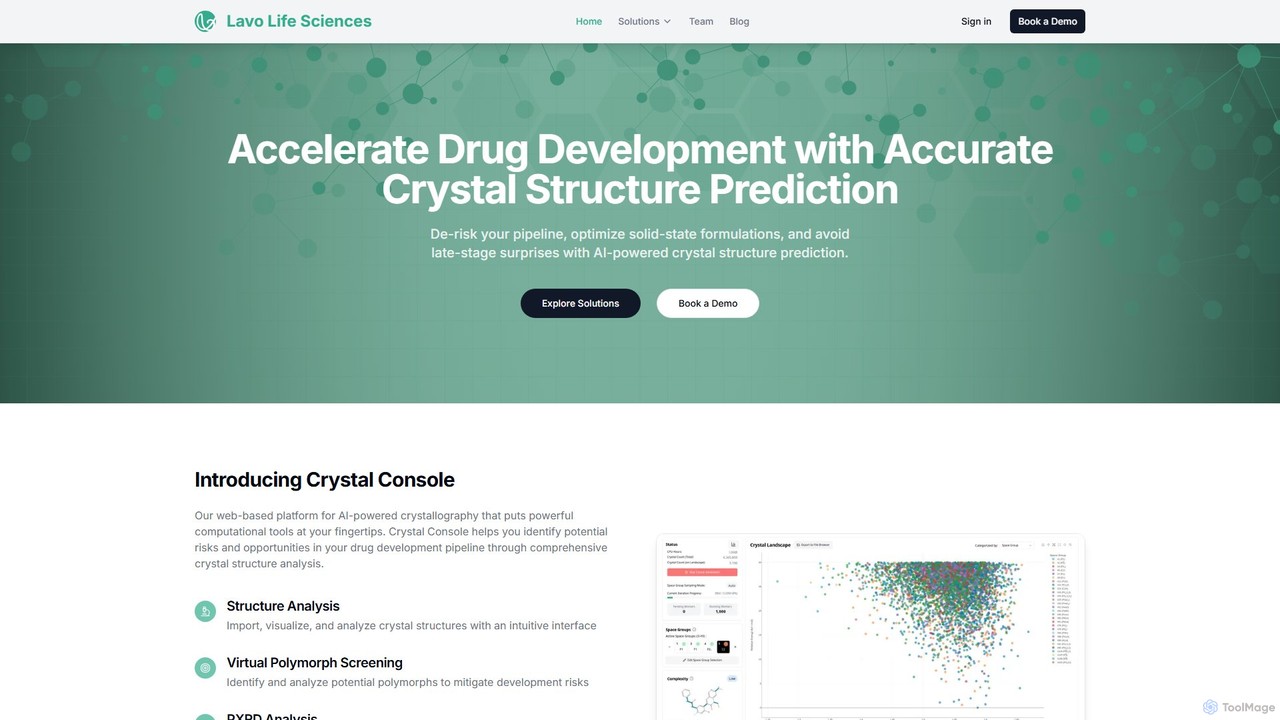
Lavo is an AI-powered platform for the life sciences industry, specializing in accelerating drug development through accurate crystal structure prediction. It helps pharmaceutical companies de-risk their pipelines, optimize solid-state formulations, and avoid late-stage surprises by identifying and analyzing potential polymorphs with unprecedented speed and accuracy.

Scientific Simulation
Visits 5.7KFavorites 137Likes 154

About Drug Discovery

AI Drug Discovery tools are a specialized class of scientific software that uses machine learning to accelerate the identification and development of new medicines. These platforms analyze vast biological and chemical datasets to predict molecular interactions, identify potential drug targets, and design novel compounds. Their primary value lies in significantly reducing the time and cost of traditional pharmaceutical research, from initial hypothesis to preclinical testing. By uncovering complex patterns in data, these tools open new avenues for treating diseases.

Core Features

  • Target Identification: Uses genomic and proteomic data to pinpoint proteins or genes involved in a disease, suggesting them as potential drug targets.
  • Virtual Screening: Digitally screens millions or billions of chemical compounds to predict which ones are most likely to bind to a target.
  • ADMET Prediction: Forecasts a drug candidate's Absorption, Distribution, Metabolism, Excretion, and Toxicity profile early in development.
  • De Novo Drug Design: Generates novel molecular structures with desired properties from scratch using generative AI models.
  • Drug Repurposing: Identifies new therapeutic uses for existing, approved drugs by analyzing biological pathway data.

Use Cases

These tools are essential for pharmaceutical companies, biotechnology firms, and academic research institutions. Computational chemists and bioinformaticians use them to design and screen molecules, while clinical researchers leverage them to analyze trial data and identify patient biomarkers. They are applied across the entire R&D pipeline, from basic research to late-stage development.

How to Choose

When selecting an AI Drug Discovery tool, consider the specific stage of your research pipeline (e.g., target discovery vs. lead optimization). Evaluate the types of data it supports (genomic, chemical, clinical) and the predictive accuracy of its underlying models. Also, assess its integration capabilities with existing lab information systems and its overall ease of use for your research team.

Drug Discovery use cases

1

Identifying Novel Drug Targets for Oncology

A cancer research team uses an AI platform to analyze multi-omics data (genomics, transcriptomics) from thousands of tumor samples. The tool identifies a previously overlooked protein kinase as a potential driver in a specific lung cancer subtype. This provides a validated new target for therapeutic development, saving months of manual data analysis and hypothesis testing that would otherwise be required.

2

Virtual Screening for Small Molecule Inhibitors

A biotech company needs to find an inhibitor for a viral enzyme. Instead of physically screening millions of compounds, they use an AI tool for virtual high-throughput screening. The platform predicts the binding affinity of billions of virtual molecules to the enzyme's active site, shortlisting the top 100 candidates for lab synthesis and testing. This approach drastically reduces costs and accelerates the hit-finding phase.

3

Predicting ADMET Properties of Drug Candidates

During lead optimization, a pharmaceutical chemist has several promising compounds but needs to assess their safety profiles. They use an AI-powered ADMET prediction tool to forecast each compound's potential toxicity, metabolic stability, and bioavailability. The results help prioritize candidates with the best safety profiles, preventing costly failures in later preclinical and clinical stages by weeding out problematic compounds early.

4

Designing De Novo Molecules with Desired Properties

A medicinal chemist needs to design a molecule that can cross the blood-brain barrier and has high selectivity for a specific neural receptor. Using a generative AI model, they input the desired chemical properties and constraints. The tool generates thousands of novel, synthesizable molecular structures that meet the criteria, providing innovative starting points that might not be conceived through traditional methods.

5

Repurposing Existing Drugs for New Indications

A research institution wants to find new uses for approved drugs to shorten development timelines. They employ an AI tool that analyzes networks of drug-target interactions, disease pathways, and clinical data. The system identifies that a drug approved for autoimmune disorders shows a strong potential mechanism of action against Alzheimer's disease, suggesting a high-potential drug repurposing strategy.

6

Optimizing Patient Stratification for Clinical Trials

A pharmaceutical company is planning a Phase II clinical trial. An AI platform analyzes patient electronic health records and genomic data to identify biomarkers that predict a high response rate to the new drug. This allows them to design a more targeted trial, recruiting patients most likely to benefit. This increases the trial's statistical power and chance of success while potentially reducing its required size and cost.

Drug Discovery FAQ

What are AI Drug Discovery tools?

AI Drug Discovery tools are software platforms that use machine learning and computational biology to make the process of finding new medicines faster and more efficient. They analyze complex biological and chemical data to perform tasks like identifying disease targets, screening potential drug compounds, and predicting a drug's effectiveness and safety. The main goal is to reduce the high costs and long timelines associated with traditional pharmaceutical R&D.

How do AI tools accelerate the drug discovery process?

AI accelerates drug discovery in several key ways. It can analyze massive datasets in hours that would take humans years, rapidly identifying potential drug targets. It performs virtual screening of billions of molecules, replacing slow and costly physical experiments. Furthermore, AI models can predict a drug's properties (like toxicity) early on, reducing the risk of late-stage failures. This data-driven approach significantly shortens the timeline from initial research to clinical trials.

What's the difference between AI Drug Discovery and traditional computational chemistry?

While both use computers, their approaches differ. Traditional computational chemistry often relies on physics-based simulations (like molecular dynamics) which are computationally intensive. AI Drug Discovery tools are data-driven; they use machine learning models trained on vast experimental datasets to learn complex patterns and make predictions. This often allows AI tools to be much faster, especially for tasks like large-scale screening and property prediction where massive amounts of data are available.

Who should use AI Drug Discovery tools?

These tools are designed for professionals in the life sciences and pharmaceutical industries. Key users include:

  • Medicinal and Computational Chemists: For designing molecules and predicting their properties.
  • Biologists and Bioinformaticians: For identifying and validating new drug targets.
  • Pharmacologists: For predicting drug efficacy and safety profiles (ADMET).
  • Clinical Research Scientists: For analyzing trial data and optimizing patient selection.
How do I choose the right AI Drug Discovery tool?

Choosing the right tool depends on your specific needs. Consider these factors:

  • Discovery Stage: Does the tool specialize in target identification, hit-to-lead, or preclinical analysis?
  • Data Compatibility: Can it process your specific data types (e.g., genomic, chemical structures, clinical data)?
  • Model Validation: Is the underlying AI model's performance well-documented and validated on relevant benchmarks?
  • Usability and Integration: Is the interface intuitive, and can it integrate with your existing lab software and databases?