Data Analysis Best in category 1 results Scientific Simulation AI Tool

Popular AI tools in the Scientific Simulation field of Data Analysis include Lavo, etc., helping you quickly improve efficiency.

Lavo

Lavo

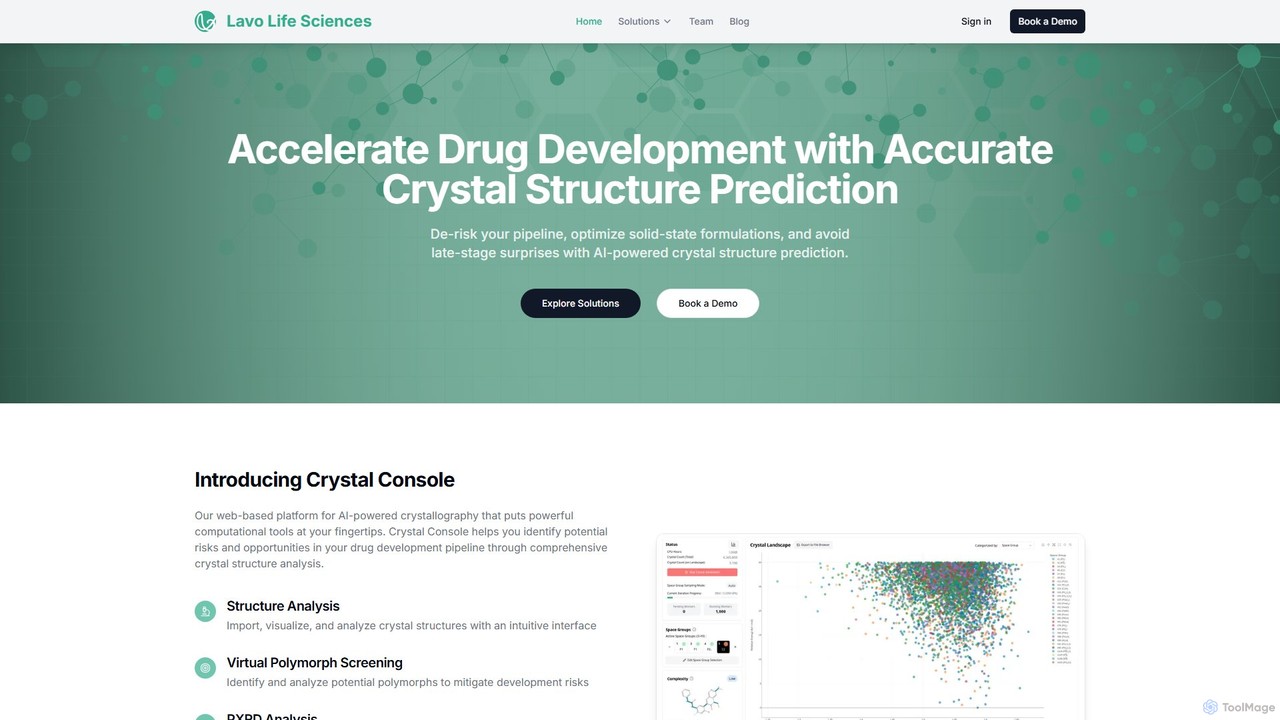
Lavo is an AI-powered platform for the life sciences industry, specializing in accelerating drug development through accurate crystal …

2.2K

About Scientific Simulation

AI Scientific Simulation tools are a specialized class of software that uses artificial intelligence to create and run virtual models of complex real-world systems. They leverage machine learning algorithms and vast datasets to simulate physical, chemical, or biological processes with high accuracy and speed. This allows researchers and engineers to conduct virtual experiments, predict outcomes, and gain insights that would be too costly or time-consuming to obtain through physical testing. As a key application within Data Analysis, these tools focus on generating predictive data by modeling system dynamics, rather than just analyzing existing information.

Core Features

  • Complex System Modeling: Build multi-variable models that capture the dynamic interactions within physical, biological, or economic systems.
  • Predictive Simulation: Forecast future states or outcomes of a system based on a set of initial conditions and governing rules.
  • Parameter Optimization: Utilize AI to automatically find the optimal input parameters that lead to a desired simulation result.
  • High-Performance Computing (HPC) Integration: Natively support or integrate with cloud and local computing clusters to handle large-scale, computationally intensive simulations.
  • Data Visualization: Generate interactive 2D and 3D visualizations, charts, and graphs to interpret complex simulation outputs effectively.

Use Cases

These tools are essential in research-intensive fields such as pharmaceuticals, materials science, aerospace engineering, and climate science. They are used by computational scientists, R&D engineers, and academic researchers to model phenomena like protein folding for drug discovery, airflow over an aircraft wing for aerodynamic analysis, or the long-term effects of carbon emissions on global climate patterns.

How to Choose

When selecting a Scientific Simulation tool, consider its domain specificity—whether it has pre-built models for your field (e.g., molecular dynamics, fluid dynamics). Evaluate its scalability and support for parallel computing to handle complex models. Assess the methods used for model validation and accuracy. Finally, check its integration capabilities with standard data analysis ecosystems, such as Python libraries (NumPy, SciPy) or MATLAB, for post-simulation analysis.

Scientific SimulationUse Cases

1

Accelerating Drug Discovery with Protein Folding Simulation

A computational biologist is tasked with identifying promising drug candidates by understanding how molecules bind to target proteins. Using an AI simulation tool, they can model thousands of protein folding configurations and binding interactions in a virtual environment. This process, which could take years with traditional lab methods, is reduced to weeks. The AI rapidly simulates complex molecular dynamics, predicting binding affinity and efficacy. As a result, the research team can prioritize a small number of highly promising compounds for physical lab testing, significantly reducing costs and accelerating the drug development pipeline.

2

Optimizing Aircraft Design with Aerodynamic Simulation

An aerospace engineer needs to improve the fuel efficiency of a new aircraft wing design. Instead of relying solely on expensive and time-consuming wind tunnel tests, they use an AI simulation tool to perform computational fluid dynamics (CFD) analysis. The engineer creates a digital model of the wing and simulates airflow over its surface under hundreds of different flight conditions. The AI helps to rapidly iterate through minor design modifications, predicting the impact on lift and drag for each change. This allows the team to identify the most aerodynamic shape before building a physical prototype, saving months of development time and millions in testing costs.

3

Developing New Materials by Simulating Atomic Structures

A materials scientist aims to create a new alloy with a unique combination of strength and heat resistance for use in jet engines. Manually testing every possible combination of elements is impossible. By using an AI simulation platform, the scientist can model the atomic interactions of different elemental mixtures. The tool predicts macroscopic properties like tensile strength, melting point, and corrosion resistance based on these micro-level simulations. This virtual screening process allows the scientist to explore a vast design space and identify a few dozen highly promising candidates for physical synthesis and testing, reducing the R&D cycle from years to months.

4

Forecasting Climate Change with Complex Environmental Models

A team of climate scientists needs to predict the long-term impact of various carbon emission scenarios on global sea levels. They use an AI-powered simulation tool to model the Earth's complex climate system, including interactions between the atmosphere, oceans, ice sheets, and land. The AI helps manage and process petabytes of historical and real-time data, and it accelerates the computationally intensive calculations required to run simulations spanning decades. This enables the team to generate more accurate, high-resolution forecasts of regional climate changes, providing critical data for policymakers to develop effective environmental strategies and infrastructure plans.

5

Simulating Market Scenarios for Financial Risk Management

A quantitative analyst at an investment firm is responsible for assessing the risk of a multi-billion dollar portfolio. They use an AI simulation tool to run sophisticated Monte Carlo simulations, modeling thousands of potential future market scenarios. The tool simulates variables like interest rate fluctuations, stock market volatility, and commodity price shocks. The AI component can identify complex, non-linear correlations between assets that traditional models might miss. The output is a detailed probability distribution of potential gains and losses, allowing the firm to adjust its strategies, hedge against specific risks, and comply with regulatory capital requirements more effectively.

6

Optimizing Urban Traffic Flow with a Digital Twin

An urban planner is tasked with reducing traffic congestion in a city's downtown core. Instead of implementing costly and disruptive physical changes, they first create a 'digital twin' of the city area using an AI simulation tool. This virtual model includes roads, traffic signals, vehicle volumes, and pedestrian patterns. The planner can then simulate various interventions, such as changing traffic light timings, adding a new bus lane, or rerouting traffic during peak hours. The AI analyzes the results of thousands of simulations to identify the strategy that most effectively reduces commute times and emissions. This data-driven approach allows the city to implement the most impactful changes with confidence and minimal trial-and-error.

Scientific SimulationFrequently Asked Questions