Data Analysis Best in category 1 results Business Analytics AI Tool

Popular AI tools in the Business Analytics field of Data Analysis include Axon, etc., helping you quickly improve efficiency.

Axon

Axon

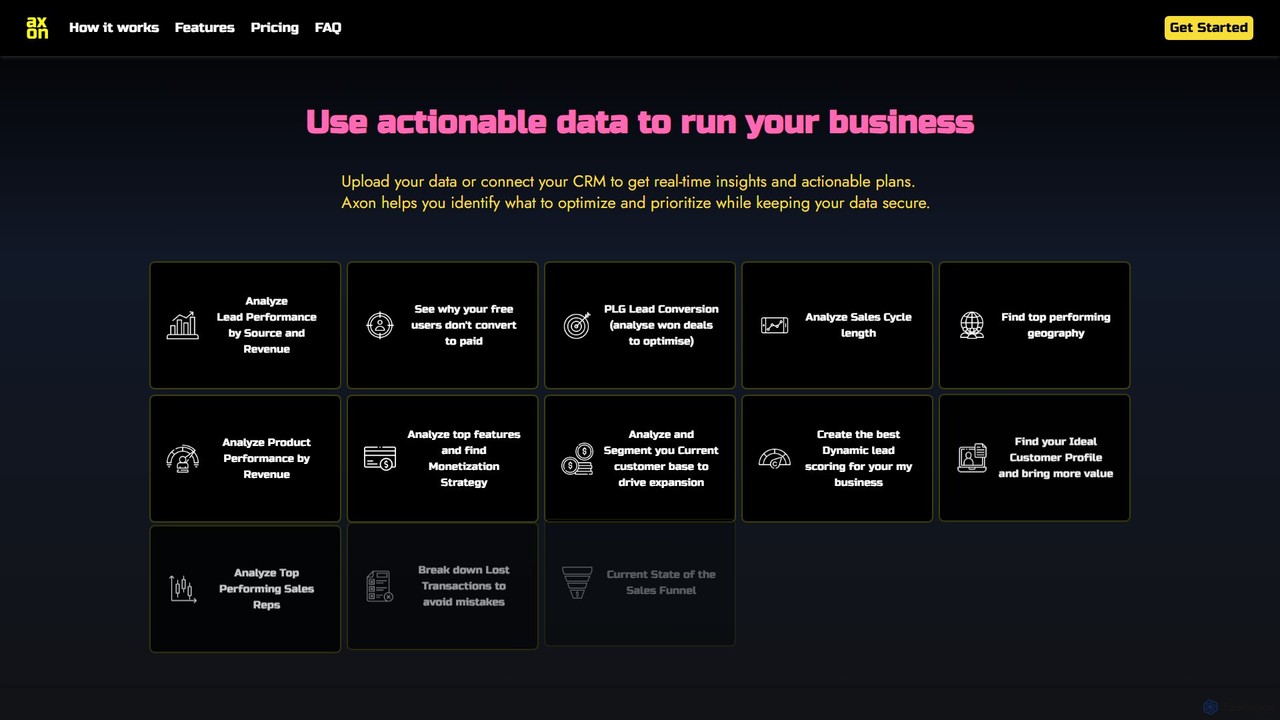
Axon is an AI-powered revenue intelligence platform designed for solopreneurs, small teams, and SMBs. It transforms your business …

2.3K

About Business Analytics

Business Analytics tools are AI-powered platforms designed to forecast future trends and prescribe actions based on data. They utilize machine learning, predictive modeling, and statistical analysis to move beyond historical reporting and uncover actionable insights. These tools empower organizations to make proactive, data-driven decisions, optimizing everything from marketing spend to supply chain logistics. As a specialized field within Data Analysis, Business Analytics focuses specifically on forward-looking, outcome-oriented intelligence rather than just descriptive data exploration.

Core Features

  • Predictive Modeling: Builds models to forecast future outcomes like sales, customer churn, or demand.
  • Prescriptive Analytics: Recommends specific actions to achieve desired business goals.
  • Scenario Simulation: Allows users to test the potential impact of different business decisions.
  • Automated Insight Generation: Automatically identifies significant trends, anomalies, and correlations in data.
  • Root Cause Analysis: Drills down into data to understand the underlying drivers of specific performance metrics.

Use Cases

Business Analytics tools are vital for roles like financial analysts, marketing managers, and operations directors. They are commonly used in retail for demand forecasting, in finance for credit risk scoring, and in marketing for predicting customer lifetime value. For example, an e-commerce company can use these tools to identify which customers are at high risk of churning and proactively target them with retention offers.

How to Choose

When selecting a Business Analytics tool, consider the complexity of its modeling capabilities and whether they match your team's skills. Evaluate its integration with your existing data sources (e.g., CRM, ERP). Assess the clarity of its visualizations and reporting features for communicating insights to stakeholders. Finally, compare pricing models, considering factors like data volume, user count, and feature tiers.

Business AnalyticsUse Cases

1

Predicting Customer Churn

A marketing manager at a subscription-based service needs to reduce customer churn. Using a Business Analytics tool, they connect data from their CRM and usage logs. The tool's AI builds a predictive model that identifies customers with a high probability of canceling their subscription based on factors like decreased login frequency, reduced feature usage, and recent support tickets. The manager can then create a targeted retention campaign, offering personalized discounts or support to these at-risk customers, ultimately reducing the churn rate by a projected 15%.

2

Optimizing Marketing Campaign Spend

A digital marketing team wants to maximize the return on investment (ROI) for their advertising budget. They use a Business Analytics platform to analyze historical campaign data, including ad spend, channel, target audience, and conversion rates. The tool's prescriptive analytics engine recommends an optimal budget allocation across different channels (e.g., social media, search ads, email) to achieve the highest number of conversions. It simulates various spending scenarios, allowing the team to make informed decisions and reallocate funds from underperforming campaigns to more profitable ones, improving overall ROI.

3

Forecasting Retail Product Demand

An operations manager for a retail chain needs to ensure optimal inventory levels across hundreds of stores. They use a Business Analytics tool to create a demand forecasting model. The model analyzes historical sales data, seasonality, promotional events, and even external factors like weather forecasts. The AI provides accurate, store-level demand predictions for each product. This allows the manager to automate reordering processes, reduce instances of stockouts on popular items, and minimize overstocking of slow-moving products, leading to improved sales and lower carrying costs.

4

Assessing Financial Credit Risk

A loan officer at a financial institution needs to evaluate the risk of lending to new applicants. Instead of relying solely on traditional credit scores, they use a Business Analytics tool to build a more sophisticated risk model. The model incorporates hundreds of variables, including transaction history, income stability, and behavioral data. The AI scores each applicant's risk level and provides a recommendation to approve, deny, or review the loan application. This data-driven approach leads to more accurate lending decisions, reducing the rate of loan defaults and improving the institution's profitability.

5

Identifying Sales Cross-Sell Opportunities

A sales director for an e-commerce platform aims to increase the average order value. They use a Business Analytics tool to perform a market basket analysis on historical transaction data. The AI identifies products that are frequently purchased together. Based on these insights, the tool provides prescriptive recommendations, such as creating product bundles or displaying 'Frequently Bought Together' suggestions on product pages. This strategy encourages customers to add more items to their cart, directly leading to an increase in both average order value and overall revenue.

6

Performing Root Cause Analysis for Production Defects

A quality control manager in a manufacturing plant observes a sudden increase in product defects. To find the cause, they feed sensor data from the production line, raw material specifications, and operator shift logs into a Business Analytics tool. The AI performs a root cause analysis, correlating various factors with the defect rate. It identifies that a specific batch of raw material combined with a slight temperature variation in one machine is the primary cause. This allows the manager to take immediate corrective action, preventing further defects and saving significant costs associated with waste and rework.

Business AnalyticsFrequently Asked Questions