ToolMage
Sign in

Best 1 Chat Data AI tools for Data Analysis

Popular Chat Data AI tools in Data Analysis include Export Reader, helping you work more efficiently.

Export Reader
Free

Export Reader

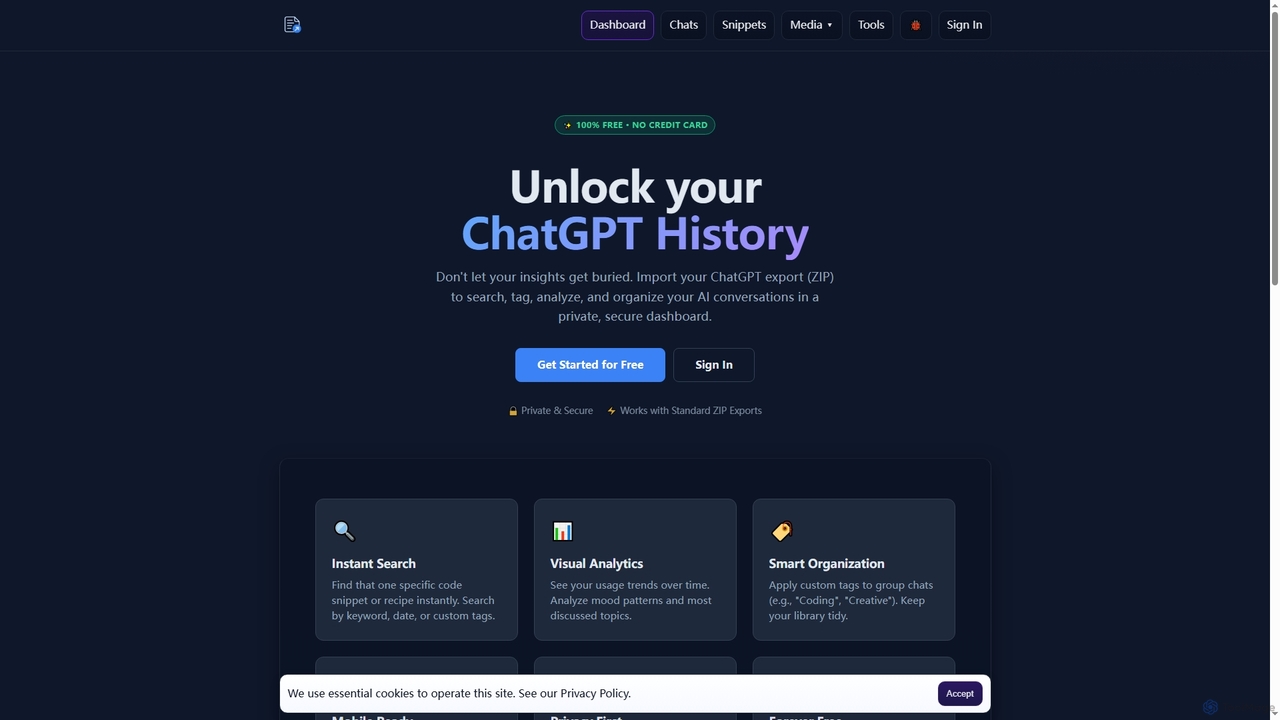
Export Reader is a free, private, and secure tool designed to help users manage their ChatGPT conversation history. It allows you to import your ChatGPT data export (ZIP file) to easily search, tag, analyze, and organize your AI interactions within a responsive dashboard.

Chat Data
Visits 6.5KFavorites 158Likes 153

About Chat Data

Chat Data tools are AI-powered platforms designed to collect, process, and analyze conversational data from various sources like customer support chats, social media messages, and internal communications. These tools leverage advanced Natural Language Processing (NLP) and machine learning algorithms to extract valuable insights, identify trends, and understand user sentiment and intent. As a specialized branch within data analysis, they empower businesses to transform unstructured text conversations into actionable intelligence, driving improvements in customer experience, product development, and operational efficiency.

Core Features

  • Sentiment Analysis: Automatically detects and classifies the emotional tone (positive, negative, neutral) of chat interactions.
  • Topic Extraction: Identifies recurring themes, subjects, and key discussion points within large volumes of chat data.
  • User Segmentation: Groups users based on their conversational patterns, needs, and behaviors revealed through chat interactions.
  • Trend Identification: Uncovers emerging patterns, common issues, or popular requests over time from chat conversations.
  • Anomaly Detection: Flags unusual or critical chat interactions that deviate from normal patterns, indicating potential problems or urgent requests.

Applicable Scenarios

These tools are crucial for customer service departments to optimize agent performance and automate responses, for marketing teams to understand customer preferences and campaign effectiveness, and for product managers to gather direct user feedback for feature enhancements. They also assist compliance officers in monitoring communications for policy adherence and risk mitigation.

How to Choose

When selecting Chat Data tools, consider their compatibility with your existing chat platforms and data sources, the accuracy and depth of their NLP capabilities, and the flexibility of their visualization and reporting features. Evaluate their scalability to handle your data volume, integration options with CRM or analytics systems, and the level of customization available for specific business needs.

Chat Data use cases

1

Enhance Customer Service Quality

Customer service managers can leverage Chat Data tools to automatically analyze thousands of support chat transcripts. By identifying recurring issues, common customer pain points, and agent performance patterns through sentiment analysis and topic modeling, they can pinpoint areas for agent training, improve FAQ resources, and reduce average resolution times by up to 20%.

2

Optimize Customer Service Operations

Customer service managers utilize Chat Data tools to analyze thousands of support conversations. By identifying common customer pain points, frequently asked questions, and agent performance patterns through sentiment and topic analysis, they can refine knowledge bases, improve agent training, and develop more effective automated responses, leading to reduced resolution times and higher customer satisfaction.

3

Identify Product Feedback and Feature Requests

Product managers can utilize Chat Data analysis to gather direct user feedback from customer support chats, social media DMs, and in-app messaging. By applying topic modeling and entity recognition, they can quickly identify common feature requests, bug reports, and user pain points, informing product roadmap decisions and prioritizing development efforts based on real user needs.

4

Enhance Product Development with User Feedback

Product teams leverage chat data from support tickets, in-app chats, and user forums to gather direct, unfiltered feedback. Tools extract feature requests, bug reports, and usability issues, providing actionable insights for prioritizing new features, improving existing functionalities, and ensuring product development aligns closely with user needs and expectations.

5

Optimize Sales and Marketing Campaigns

Marketing and sales teams can analyze chat data from website chatbots, live chat, and social media interactions to understand customer intent and preferences. By identifying common questions during the sales funnel or reactions to marketing messages, businesses can refine their messaging, personalize offers, and improve conversion rates by tailoring content to specific customer segments.

6

Identify Sales Leads and Improve Conversion

Sales and marketing teams analyze website chat interactions to qualify leads and understand customer intent. By detecting keywords related to purchasing intent, specific product interests, or budget discussions, these tools help prioritize high-value prospects, enabling sales representatives to engage with more informed and ready-to-buy customers, thereby boosting conversion rates.

7

Monitor Brand Sentiment and Marketing Campaign Effectiveness

Marketing professionals use Chat Data tools to track public sentiment and reactions to brand mentions, product launches, or marketing campaigns across social media and direct messaging platforms. Analyzing chat conversations helps gauge campaign impact, identify brand advocates or detractors, and quickly respond to public perception shifts, allowing for agile campaign adjustments.

8

Monitor Compliance and Risk in Communications

Compliance officers and legal teams can use Chat Data tools to monitor internal and external communications for adherence to regulatory standards and company policies. Automated detection of keywords, phrases, or sentiment indicating potential risks, fraud, or non-compliance helps in proactive risk management, ensuring data privacy and ethical conduct across all conversational channels.

9

Personalize User Experience and Recommendations

E-commerce platforms and content providers can analyze chat data from user interactions with chatbots or customer support to understand individual preferences and browsing history. This allows for highly personalized product recommendations, content suggestions, and tailored user experiences, leading to increased engagement and customer loyalty by anticipating user needs.

10

Improve User Experience (UX) and Journey Mapping

UX researchers and designers analyze chat logs to pinpoint areas of friction or confusion in the user journey. By understanding where users struggle, ask for help, or express frustration during their interaction with a website or application, teams can redesign interfaces, streamline workflows, and create more intuitive and satisfying user experiences.

11

Ensure Compliance and Mitigate Risk in Communications

Compliance officers and legal teams deploy Chat Data tools to monitor internal and external communications for adherence to regulatory standards, company policies, and ethical guidelines. These tools can automatically flag sensitive information, potential policy violations, or suspicious activities within chat logs, helping organizations proactively manage risks and maintain legal compliance.

12

Automate Reporting and Trend Analysis

Business analysts and data scientists can automate the generation of reports on conversational trends, sentiment shifts, and common inquiries using Chat Data tools. This automation frees up valuable time, allowing them to focus on deeper strategic analysis rather than manual data compilation, providing real-time insights into customer behavior and operational performance across various communication channels.

Chat Data FAQ

What are Chat Data tools?

Chat Data tools are AI-powered platforms that analyze conversational interactions from various sources like customer support chats, social media, and messaging apps. They leverage NLP and machine learning to extract insights such as sentiment, topics, and entities, helping businesses understand customer behavior, improve communication, and optimize operations. They are a specialized form of data analytics focused specifically on conversational data.

What are Chat Data tools?

Chat Data tools are specialized AI-powered platforms designed to collect, process, and analyze conversational text data from various sources like customer support chats, social media, and messaging apps. Their primary purpose is to extract meaningful insights, identify patterns, and understand the sentiment and intent behind user interactions, transforming unstructured text into actionable business intelligence.

How do Chat Data tools differ from general Data Analysis tools?

While general Data Analysis tools handle a wide array of structured and unstructured data, Chat Data tools specifically focus on conversational text. They employ advanced Natural Language Processing (NLP) and machine learning techniques tailored for understanding human language nuances, sentiment, and context, which are critical for deriving insights from dialogues, unlike tools primarily designed for numerical or tabular data.

How do Chat Data tools differ from general data analytics platforms?

While general data analytics platforms offer broad capabilities for various data types, Chat Data tools are specifically tailored for unstructured conversational data. They possess advanced NLP models to accurately interpret human language nuances, sentiment, and context, which generic tools may struggle with. This specialization allows for deeper, more relevant insights into customer interactions, agent performance, and communication trends that are unique to chat-based data.

What are the key benefits of using Chat Data tools?

Using Chat Data tools offers several key benefits, including improved customer satisfaction through better understanding of needs and faster issue resolution, enhanced product development by incorporating direct user feedback, and optimized marketing strategies based on real-time sentiment and preference insights. They also aid in operational efficiency by automating analysis and identifying areas for process improvement.

What are the key benefits of analyzing chat data?

Analyzing chat data offers several key benefits. It provides direct insights into customer needs and pain points, enabling businesses to improve products and services. It helps optimize customer service operations by identifying training gaps and automating responses. Furthermore, it allows for better personalization of marketing and sales efforts, leading to increased customer satisfaction, loyalty, and ultimately, higher conversion rates and revenue growth.

Who typically uses Chat Data tools?

Chat Data tools are primarily used by professionals in customer service, marketing, sales, and product development. Customer service managers use them for agent performance and issue resolution. Marketing and sales teams leverage them for lead qualification and campaign optimization. Product managers gain insights for feature development, while business analysts and data scientists use them for trend analysis and strategic decision-making across various industries.

What types of data can Chat Data tools analyze?

Chat Data tools can analyze a wide range of conversational text data. This includes customer support chat transcripts, chatbot interactions, social media direct messages and comments, forum discussions, internal team communications (e.g., Slack, Teams), and even transcribed voice calls. Essentially, any text-based dialogue can be processed to extract valuable information.

How can I choose the right Chat Data tool for my business?

To choose the right Chat Data tool, consider your primary data sources (e.g., live chat, social media), the specific insights you need (e.g., sentiment, topics, agent performance), and the tool's NLP accuracy for your language(s). Evaluate its integration capabilities with your existing CRM or analytics platforms, its scalability for your data volume, and the quality of its reporting and visualization features. Also, assess the level of customization and support offered.

What should I consider when choosing a Chat Data solution?

When selecting a Chat Data solution, prioritize its NLP accuracy and multilingual support to ensure precise analysis of diverse conversations. Evaluate its integration capabilities with your existing CRM, customer support, and communication platforms for seamless data flow. Consider the scalability to handle your current and future data volumes, the depth of its analytical features (e.g., custom dashboards, real-time alerts), and its compliance with data privacy regulations like GDPR or CCPA.