Science Best in category 1 results Academic Journals AI Tool

Popular AI tools in the Academic Journals field of Science include Synthical, etc., helping you quickly improve efficiency.

Synthical

Synthical

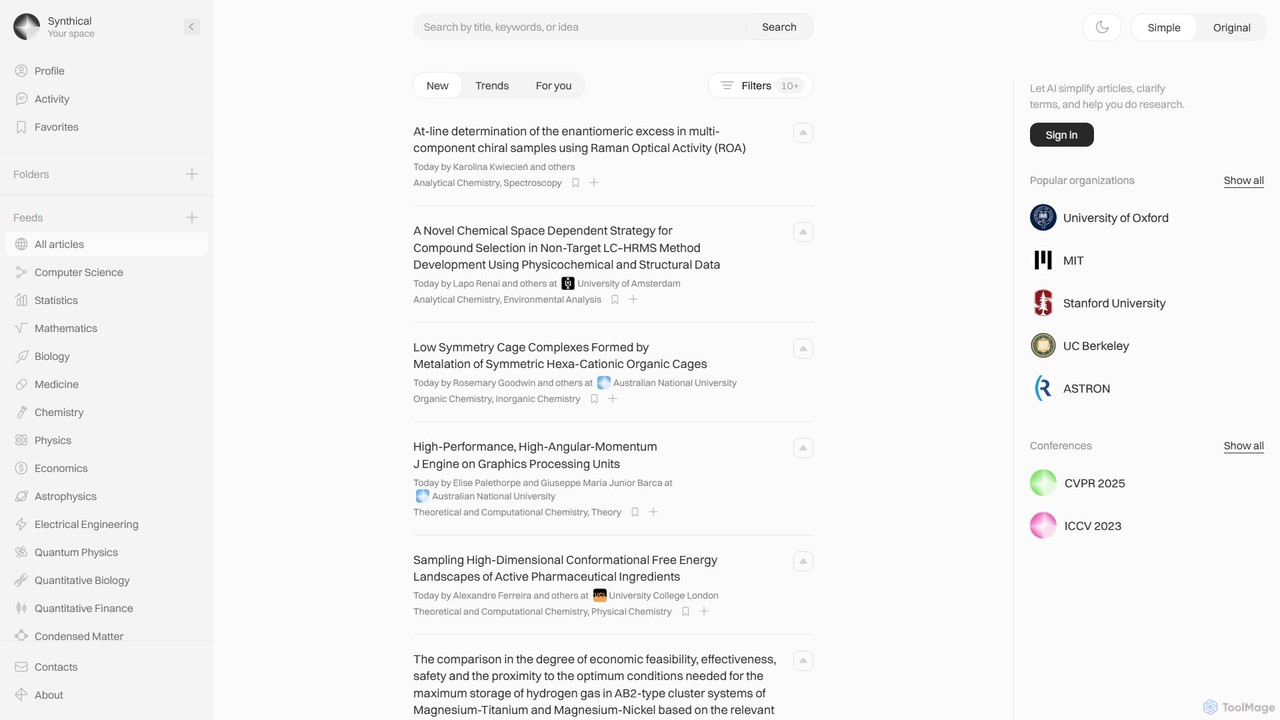
Synthical is an AI-powered research environment designed for academics, students, and scientists. It aggregates scientific papers from diverse …

7.9K

About Academic Journals

AI Academic Journal tools are specialized platforms that leverage artificial intelligence to streamline the discovery, analysis, and management of scholarly literature. These tools utilize Natural Language Processing (NLP) and machine learning models to go beyond simple keyword searches, offering semantic understanding of research papers. They enable users to quickly find relevant articles, generate concise summaries, and identify key trends within a field. This significantly accelerates literature reviews and helps researchers stay current with the latest advancements.

Core Features

  • Semantic Search: Finds articles based on conceptual meaning and context, not just keyword matches.
  • AI-Powered Summarization: Automatically generates abstracts or key takeaways from complex research papers.
  • Literature Mapping: Visually represents the connections between papers, authors, and concepts to identify research trends and gaps.
  • Data Extraction: Isolates and extracts specific information such as methodologies, datasets, and key findings from articles.
  • Automated Alerts: Notifies users of new publications relevant to their specific research interests.

Applicable Scenarios

These tools are invaluable for academics, PhD students, and corporate R&D teams. For instance, a graduate student can use them to rapidly build a literature review for their thesis, while a pharmaceutical researcher can track the latest clinical trial results. They are also used by policy analysts and patent attorneys to monitor scientific developments and prior art.

How to Choose

When selecting an AI Academic Journal tool, consider the breadth of its database (e.g., coverage of PubMed, Scopus, arXiv). Evaluate the accuracy of its AI features, particularly summarization and data extraction. Check for integrations with existing reference managers like Zotero or Mendeley. Finally, assess the user interface for its ability to handle complex queries and visualize results effectively.

Academic JournalsUse Cases

1

Accelerating Literature Reviews for PhD Students

A PhD student beginning their research needs to conduct a comprehensive literature review, a process that can take months. Using an AI Academic Journal tool, they can input their core research questions and concepts. The tool performs a semantic search to identify seminal papers and recent advancements, presenting them in a visual map to highlight research clusters and gaps. The student then uses the AI summarization feature to quickly grasp the key findings of dozens of papers, prioritizing which ones to read in full. This reduces the initial review time by over 70%, allowing them to formulate a novel research hypothesis much faster.

2

Tracking Competitor R&D for Corporate Strategists

An R&D manager at a tech company needs to monitor the innovation landscape and track competitors' research output. They set up automated alerts in an AI Academic Journal tool for specific keywords, competitor company names, and key researchers. When a new relevant paper is published, the manager receives a notification with an AI-generated summary. This allows them to quickly assess the significance of the new research without needing to read every paper. They can identify emerging technological threats or opportunities and provide timely, evidence-based insights to the strategy team.

3

Evidence-Based Practice for Medical Professionals

A clinician is treating a patient with a rare condition and needs to find the most current treatment protocols. A standard keyword search in medical databases yields thousands of results, many irrelevant. Using an AI tool, they perform a semantic search using a detailed description of the patient's case. The tool returns a highly curated list of the most relevant clinical trials and case studies. The AI summaries allow the clinician to quickly compare the methodologies and outcomes of different studies, helping them make a well-informed, evidence-based decision for the patient's care plan in a fraction of the time.

4

Grant Proposal Preparation for Researchers

A scientist is preparing a grant proposal for a new research project in a field adjacent to their expertise. To write a compelling background section, they need to quickly get up to speed on the key literature. They use an AI tool to identify the most cited and influential papers and researchers in this new field. The literature mapping feature helps them understand the historical development of the topic and pinpoint current debates. This enables them to position their proposed research effectively within the existing body of knowledge, significantly strengthening their proposal and increasing its chances of being funded.

5

Automating Data Extraction for Systematic Reviews

A research team is conducting a systematic review or meta-analysis, which requires extracting specific data points (like sample size, methodology, outcomes) from hundreds of papers. This manual process is tedious and prone to error. By using an AI tool with advanced data extraction capabilities, they can define the data points they need. The AI then scans the full text of all selected articles and populates a spreadsheet with the required information automatically. This not only saves hundreds of hours of manual labor but also improves the accuracy and consistency of the data collected for the analysis.

6

Discovering Interdisciplinary Research Connections

A materials scientist is exploring how their novel polymer could be applied in biomedical engineering. Traditional searches within their own field's journals yield limited results. They use an AI Academic Journal tool's literature mapping feature to explore connections between 'polymer science' and 'tissue engineering'. The tool generates a visual graph showing how these fields intersect, highlighting key researchers who work across both disciplines and influential papers that bridge the gap. This allows the scientist to uncover unexpected applications and identify potential collaborators outside their usual network, fostering interdisciplinary innovation.

Academic JournalsFrequently Asked Questions