ToolMage
Sign in

Best 1 Chemistry AI tools for Science

Popular Chemistry AI tools in Science include Chemistry AI, helping you work more efficiently.

Chemistry AI
Freemium

Chemistry AI

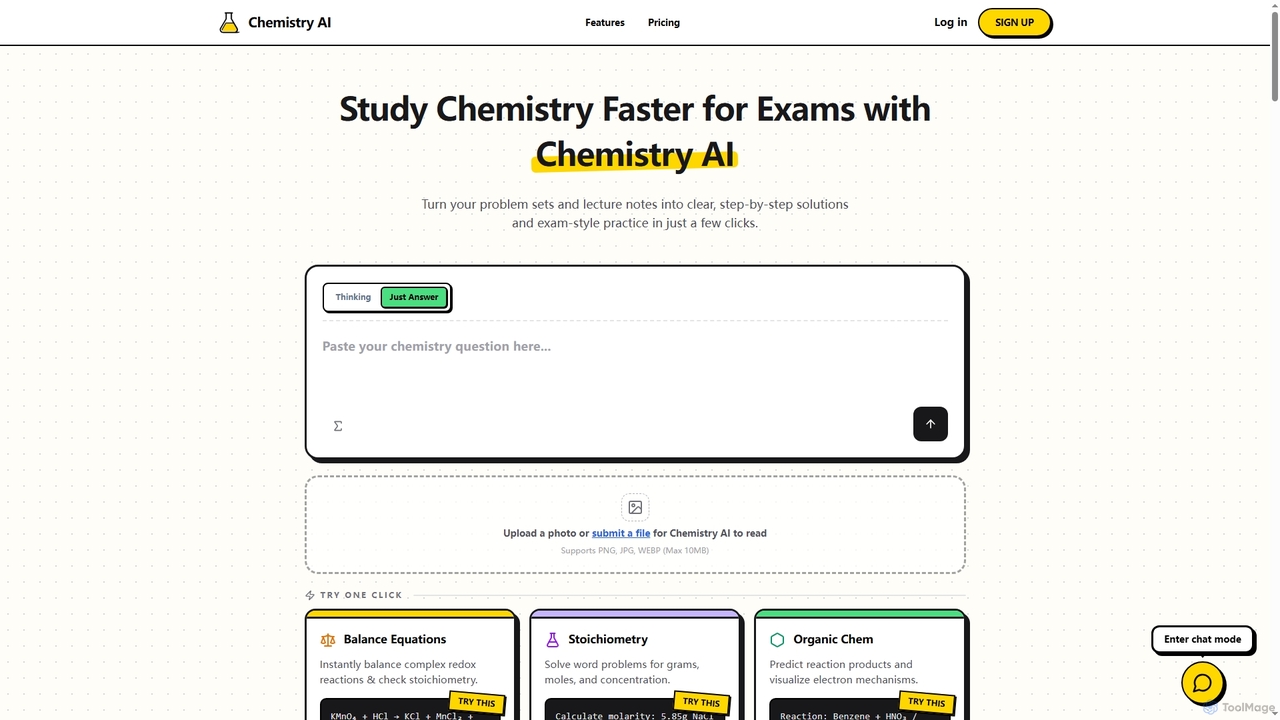
Chemistry AI is an online solver designed to accelerate chemistry learning and problem-solving for students, tutors, and self-learners. It provides clear, step-by-step solutions for complex chemistry problems, balances equations, solves stoichiometry word problems, and predicts organic reaction mechanisms, supporting both text and image inputs without requiring sign-up for basic use.

Study Aid
Visits 18.7KFavorites 108Likes 95

About Chemistry

Chemistry AI tools are specialized platforms leveraging artificial intelligence to revolutionize chemical research, development, and analysis. These tools utilize machine learning algorithms, computational chemistry, and data analysis to predict molecular properties, simulate reactions, and accelerate material discovery. They provide chemists, researchers, and pharmaceutical scientists with powerful capabilities to innovate faster and more efficiently, transforming traditional laboratory workflows into data-driven processes.

Core Features

  • Molecular Property Prediction: Accurately forecasts chemical and physical properties of molecules based on their structure.
  • Reaction Pathway Prediction: Identifies optimal synthetic routes and predicts reaction outcomes, minimizing experimental trial-and-error.
  • Materials Design & Discovery: Accelerates the identification and design of novel materials with desired characteristics.
  • Spectroscopy Data Analysis: Interprets complex spectroscopic data (NMR, MS, IR) for structural elucidation and compound identification.
  • Drug Discovery & Optimization: Aids in identifying potential drug candidates, optimizing their efficacy, and predicting toxicity.

Applicable Scenarios

These tools are indispensable in various chemical domains. Pharmaceutical companies use them for rapid drug candidate screening and lead optimization. Materials scientists leverage AI to design new alloys or polymers with specific functionalities. Academic researchers apply them to explore complex reaction mechanisms and predict novel compounds, significantly reducing experimental costs and time.

How to Choose

When selecting Chemistry AI tools, consider the specific chemical domain (e.g., drug discovery, materials science) and the types of data you work with. Evaluate the tool's predictive accuracy, the breadth of its chemical database, and its integration capabilities with existing computational chemistry software. User interface, computational resources required, and the level of domain expertise needed for operation are also crucial factors.

Chemistry use cases

1

Accelerating Drug Lead Identification

Pharmaceutical researchers use AI Chemistry tools to rapidly screen vast chemical libraries, identifying potential drug candidates that bind effectively to target proteins. By predicting binding affinities, ADMET properties (absorption, distribution, metabolism, excretion, toxicity), and synthetic feasibility, these tools drastically reduce the time and cost associated with traditional high-throughput screening, allowing scientists to focus on the most promising compounds for further experimental validation.

2

Accelerating Drug Lead Identification

Pharmaceutical researchers utilize AI chemistry tools to rapidly screen vast chemical libraries, predicting potential drug candidates' binding affinities, toxicity, and pharmacokinetic properties. By simulating molecular interactions and filtering compounds based on desired criteria, AI significantly reduces the time and cost associated with early-stage drug discovery, allowing scientists to focus on the most promising molecules for experimental validation.

3

Accelerate Drug Candidate Screening

Pharmaceutical researchers utilize Chemistry AI tools to rapidly screen vast libraries of compounds for potential drug candidates. By predicting binding affinities, ADMET properties (absorption, distribution, metabolism, excretion, toxicity), and efficacy, AI significantly narrows down the pool of promising molecules, saving years of costly laboratory experiments and accelerating the drug discovery pipeline.

4

Designing Novel Materials with Desired Properties

Material scientists employ AI to predict the properties of hypothetical new materials before synthesis. By inputting desired characteristics like strength, conductivity, or thermal stability, AI algorithms can suggest optimal chemical compositions and structural arrangements. This accelerates the discovery of advanced materials for applications in electronics, energy storage, and aerospace, bypassing extensive trial-and-error experimentation.

5

Design Novel Materials with Specific Properties

Materials scientists employ AI to design and discover new materials with tailored properties, such as enhanced conductivity, strength, or thermal stability. By inputting desired characteristics, the AI can suggest novel molecular structures or compositions, guiding experimental synthesis and reducing the iterative trial-and-error process in materials engineering.

6

Designing Novel Materials with Specific Properties

Materials scientists leverage AI Chemistry platforms to predict and design new materials with tailored properties, such as enhanced conductivity, strength, or catalytic activity. By inputting desired characteristics, the AI can explore vast chemical spaces, suggest novel compositions, and simulate their performance at an atomic level, guiding experimental synthesis and accelerating the discovery of next-generation materials for industries like electronics, energy, and aerospace.

7

Optimizing Chemical Reaction Pathways

Organic chemists and process engineers utilize AI tools to predict optimal synthetic routes and reaction conditions for complex chemical transformations. These platforms analyze historical reaction data and mechanistic principles to suggest reagents, solvents, catalysts, and temperatures that maximize yield and selectivity while minimizing byproducts. This capability is crucial for efficient and sustainable chemical manufacturing, reducing waste and improving process safety.

8

Optimizing Chemical Synthesis Pathways

Organic chemists leverage AI tools to predict the most efficient and cost-effective routes for synthesizing complex molecules. These tools analyze known reaction mechanisms and conditions, suggesting optimal reagents, solvents, and temperatures, while also identifying potential side reactions. This capability streamlines experimental planning, reduces waste, and improves reaction yields in both academic and industrial settings.

9

Predict Complex Chemical Reaction Outcomes

Organic chemists use Chemistry AI tools to predict the outcomes and optimal pathways for complex chemical reactions. This capability helps in planning synthetic routes, identifying potential byproducts, and optimizing reaction conditions, which is crucial for efficient and safe chemical synthesis in both academic research and industrial production.

10

Automate Spectroscopy Data Interpretation

Analytical chemists leverage AI to automate the interpretation of complex spectroscopic data from techniques like NMR, mass spectrometry, and IR. The AI can quickly identify unknown compounds, elucidate molecular structures, and quantify components in mixtures, significantly speeding up analysis and reducing human error in quality control and research.

11

Predicting Molecular Toxicity and Efficacy

Toxicologists and pharmacologists employ AI Chemistry tools to predict the potential toxicity and therapeutic efficacy of new chemical entities early in the development pipeline. By analyzing structural features and comparing them to known toxicophores or active compounds, AI models can flag potential safety concerns or confirm desired biological activity, preventing costly failures in later clinical stages and ensuring safer product development across pharmaceuticals, agrochemicals, and consumer goods.

12

Automated Interpretation of Spectroscopic Data

Analytical chemists use AI to automatically interpret complex spectroscopic data from techniques like NMR, mass spectrometry, and infrared spectroscopy. The AI can identify unknown compounds, elucidate molecular structures, and quantify components in mixtures with high accuracy and speed. This significantly reduces manual analysis time, especially for high-throughput screening and quality control in chemical manufacturing.

13

Automated Interpretation of Spectroscopic Data

Analytical chemists benefit from AI Chemistry tools that automate the interpretation of complex spectroscopic data, such as Nuclear Magnetic Resonance (NMR), Mass Spectrometry (MS), and Infrared (IR). The AI can rapidly identify functional groups, elucidate molecular structures, and even detect impurities by comparing experimental spectra against extensive databases and learned patterns, significantly speeding up structural characterization and quality control processes in research and industry.

14

Environmental Pollutant Behavior Modeling

Environmental chemists apply AI to model the fate and transport of pollutants in various ecosystems. By analyzing chemical properties, environmental conditions, and historical data, AI can predict how substances will degrade, accumulate, or spread in soil, water, and air. This aids in assessing environmental risks, designing effective remediation strategies, and informing policy decisions for chemical management.

15

Optimize Catalytic Processes

Chemical engineers and industrial chemists apply AI to optimize catalytic processes for improved yield, selectivity, and energy efficiency. AI models can predict the performance of different catalysts under varying conditions, leading to the design of more effective catalysts and more sustainable industrial chemical production.

16

Virtual Screening for Agrochemical Discovery

Agricultural scientists use AI Chemistry tools for virtual screening to discover novel agrochemicals, including pesticides, herbicides, and plant growth regulators. By predicting the interaction of compounds with biological targets in pests or plants, AI helps identify candidates with high efficacy and low environmental impact. This approach accelerates the development of sustainable agricultural solutions, reducing reliance on broad-spectrum chemicals and promoting targeted interventions.

17

Enhancing Chemical Education and Research

Students and educators use AI chemistry tools for interactive learning and research exploration. These tools can visualize complex molecular structures, simulate chemical reactions, and provide real-time feedback on theoretical concepts. Researchers can quickly generate hypotheses, explore "what-if" scenarios, and analyze preliminary data, making complex chemical principles more accessible and accelerating scientific inquiry.

18

Virtual Screening for Agrochemicals

Agrochemical researchers use Chemistry AI tools for virtual screening of compounds to identify potential pesticides, herbicides, or fertilizers. By predicting efficacy against target pests or plants and assessing environmental impact, AI helps in developing safer and more effective agricultural chemicals, reducing the need for extensive field trials.

Chemistry FAQ

What are AI Chemistry tools?

AI Chemistry tools are software applications that leverage artificial intelligence, machine learning, and computational chemistry techniques to solve complex problems in chemical science. They are designed to analyze vast chemical datasets, predict molecular properties, simulate reactions, and accelerate discovery processes. These tools are distinct from general scientific AI tools by their specific focus on chemical structures, reactions, and properties, offering specialized algorithms for cheminformatics and molecular modeling.

What are AI tools in Chemistry?

AI tools in Chemistry are software applications that use artificial intelligence and machine learning algorithms to solve problems in chemical research and development. They analyze vast datasets of chemical structures, reactions, and properties to predict outcomes, design experiments, and accelerate discovery. These tools are distinct from traditional computational chemistry by their ability to learn from data and identify non-obvious patterns.

What are Chemistry AI tools?

Chemistry AI tools are software applications that use artificial intelligence, particularly machine learning and deep learning, to solve complex problems in chemistry. They typically feature capabilities like molecular property prediction, reaction pathway analysis, and materials design, transforming traditional chemical research into a data-driven process.

How do AI Chemistry tools accelerate drug discovery?

AI Chemistry tools accelerate drug discovery by automating and optimizing several key stages. They can rapidly screen millions of compounds for potential therapeutic activity, predict their binding to target proteins, and assess ADMET (absorption, distribution, metabolism, excretion, toxicity) properties. This virtual screening capability significantly reduces the need for costly and time-consuming laboratory experiments, allowing researchers to quickly identify and prioritize the most promising drug candidates for further development.

How do Chemistry AI tools differ from traditional computational chemistry software?

While both involve computation, Chemistry AI tools primarily leverage data-driven machine learning models to learn patterns and make predictions from vast datasets, often without explicit programming of chemical rules. Traditional computational chemistry relies more on first-principles physics and quantum mechanics calculations. AI tools excel in pattern recognition and accelerating discovery, while traditional methods provide deeper mechanistic insights.

How do AI chemistry tools differ from traditional computational chemistry software?

Traditional computational chemistry software relies heavily on predefined physical laws and quantum mechanics to model chemical systems. In contrast, AI chemistry tools leverage data-driven approaches, learning from large datasets of experimental and simulated results. While both involve computation, AI tools excel at pattern recognition, prediction from incomplete data, and generating novel hypotheses, often complementing traditional methods rather than replacing them.

What specific tasks can AI chemistry tools perform?

AI chemistry tools can perform a wide range of tasks, including:

  • Predicting molecular properties: Estimating solubility, toxicity, and reactivity.
  • Designing novel molecules: Generating new chemical structures with desired characteristics.
  • Optimizing synthesis routes: Suggesting efficient pathways for chemical reactions.
  • Interpreting analytical data: Automating the analysis of spectroscopy and chromatography results.
  • Simulating complex systems: Modeling protein-ligand interactions or material behavior.

What are the main applications of AI in chemistry?

AI in chemistry has diverse applications, including accelerating drug discovery by predicting molecular interactions and ADMET properties, designing novel materials with specific functionalities, predicting complex reaction outcomes and synthetic routes, and automating the interpretation of spectroscopic data for structural elucidation and compound identification.

What is the difference between AI Chemistry and traditional computational chemistry?

Traditional computational chemistry relies on physics-based equations and quantum mechanics to model molecular behavior, often requiring significant computational power and expert knowledge for setup. AI Chemistry, while often incorporating computational chemistry principles, primarily uses data-driven machine learning models to learn patterns from large datasets. This allows for faster predictions and the ability to handle more complex, high-throughput tasks, often without explicit programming of chemical rules, making it more scalable for discovery and optimization.

Who benefits most from using AI tools in Chemistry?

Researchers and professionals across various chemical disciplines benefit significantly. This includes pharmaceutical scientists accelerating drug discovery, material engineers designing advanced materials, environmental chemists modeling pollutant behavior, and academic researchers exploring fundamental chemical principles. Anyone dealing with large chemical datasets, complex simulations, or the need for accelerated discovery processes finds these tools invaluable.

What types of problems can AI Chemistry tools solve?

AI Chemistry tools can solve a wide range of problems, including predicting the properties of new molecules, designing synthetic routes for complex compounds, identifying novel drug candidates, discovering advanced materials, and interpreting complex analytical data. They are also used for optimizing chemical processes, understanding reaction mechanisms, and predicting environmental impacts of chemicals, making them versatile across various chemical and related scientific disciplines.

How accurate are AI predictions in chemistry?

The accuracy of AI predictions in chemistry varies depending on the quality and quantity of the training data, the complexity of the problem, and the specific AI model used. While AI can achieve high accuracy for many tasks, especially with large, high-quality datasets, it's often used to guide experiments rather than entirely replace them, requiring experimental validation for critical applications.

What factors should I consider when choosing a Chemistry AI tool?

When selecting a Chemistry AI tool, consider its specific domain focus (e.g., drug discovery, materials science), the types of chemical data it supports, and its integration capabilities with your existing workflows. Evaluate the tool's predictive models, the size and quality of its underlying chemical database, ease of use, and the level of technical support provided.

Who benefits most from using AI Chemistry tools?

Researchers and professionals in pharmaceuticals, biotechnology, materials science, and academic chemistry benefit most from AI Chemistry tools. This includes medicinal chemists, computational chemists, materials engineers, toxicologists, and process developers. These tools empower them to accelerate discovery, reduce experimental costs, optimize processes, and gain deeper insights from complex chemical data, ultimately driving innovation and efficiency in their respective fields.

How to choose the right AI tool for chemical research?

To choose the right AI tool, consider your specific research needs:

  • Domain Specialization: Does it focus on organic, inorganic, computational biology, or materials science?
  • Data Compatibility: Can it integrate with your existing data formats and databases?
  • Model Accuracy & Interpretability: How reliable are its predictions, and can you understand the underlying reasoning?
  • User Interface & Support: Is it user-friendly, and is technical support available?
  • Scalability & Cost: Can it handle your data volume, and does it fit your budget?